The AI Divide Is Real: What Small Business Owners Need to Know in 2026

LinkedIn is buzzing with a single conversation right now. Business owners, CEOs, and founders across every industry are asking the same question: “Are we falling behind on AI?” The answer, for most small businesses, is complicated. And that’s exactly why this topic deserves your full attention.

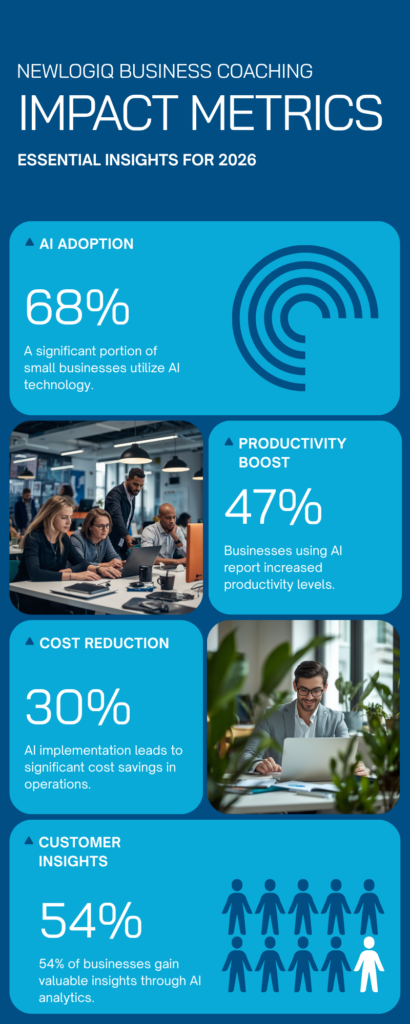
LinkedIn’s own economists have called 2026 “the defining year for small business AI adoption.” And the data backs that up. A QuickBooks survey found that 68% of U.S. small businesses now use AI regularly — up from just 48% in mid-2024. But here’s the part that almost nobody is talking about: adoption rate does not equal advantage. Using AI is not the same as using it well. For business owners running companies in the $5 million to $50 million range — especially family businesses — the AI conversation is filled with noise. Everyone is promising transformation. Most of what gets implemented ends up being a glorified email shortcut. Let’s cut through that.

The Gap Is Growing — And It’s Happening Fast

The Federal Reserve published research in April 2026 tracking AI adoption patterns across the U.S. economy. What they found should wake up any owner who has been on the sidelines: companies that adopted AI tools earlier are now pulling away from competitors at a pace that is difficult to close. It is not just about speed. It is about compounding advantage.

Here is a simple way to think about it. Imagine a business that uses AI to handle its weekly reporting, draft client communications, analyze margin data, and screen job applicants. That business gets back roughly six to ten hours of leadership time every week. Multiply that across a year and you are looking at 300 to 500 hours returned to strategy, client relationships, and growth. A competitor who is not doing this is running slower — permanently. This is what I call the AI divide. And it is not between big companies and small ones. It is between the small businesses that have gotten intentional about AI and the ones still treating it as a curiosity.

What’s Actually Working Right Now

When I work with business owners inside my coaching practice, I ask one simple question before we talk about any tool: “What is eating your time that does not require you specifically?” The answers are almost always the same. Reports. Emails. Research. Scheduling. Meeting summaries. Drafting SOPs. These are not strategic tasks. And they are exactly where AI earns its keep.

The data backs this up. According to 2026 research aggregated across multiple SMB studies, 62% of small businesses are using AI primarily for data analysis and reporting — the highest ROI category by a wide margin. Marketing automation comes in second at 54%. And the average productivity gain from generative AI tools works out to roughly $7,800 per employee per year. For a company with 20 employees, that is $156,000 in recovered capacity — without adding a single headcount.

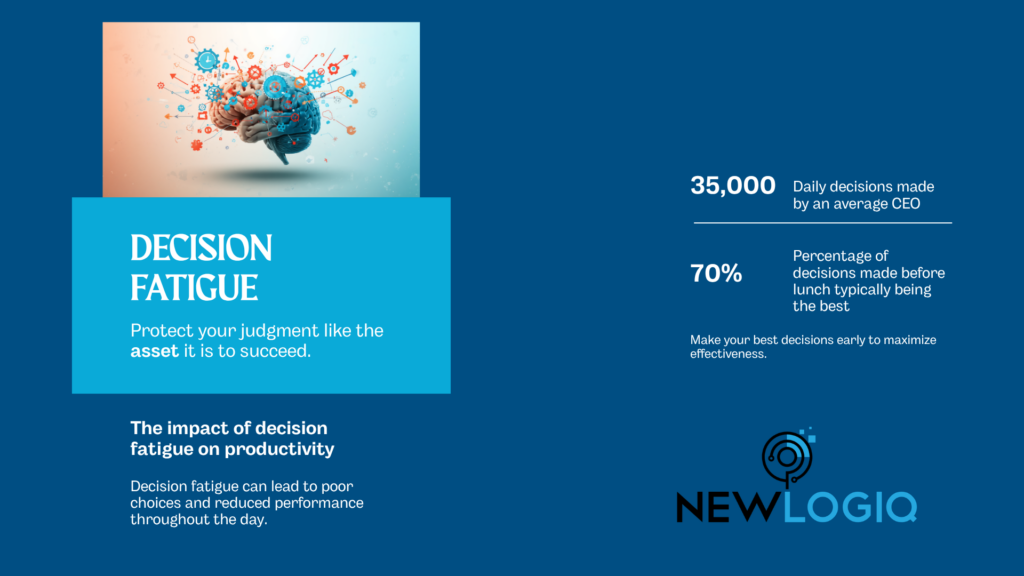
But here is where most small businesses get it wrong. They buy tools before they buy clarity. They subscribe to five platforms, use none of them consistently, and conclude that “AI doesn’t work for our business.” That is not an AI problem. That is a process problem. I have written about how decision fatigue and poor decision frameworks derail even the best-intentioned leaders. The same principle applies here. Too many options, no clear filter.

Three Moves Every Small Business Owner Should Make Right Now

The first move is to audit your time — not your tools. Before you download anything, spend one week tracking where you and your leadership team are spending time on tasks that do not require your direct judgment. Most owners are shocked by what they find. This is not about efficiency for efficiency’s sake. It is about identifying where AI can buy you back the time you need to lead.

The second move is to start small and specific. Do not try to transform your entire operation in 90 days. Pick one workflow — meeting summaries, weekly reports, first drafts of client communications — and get great at using AI for that one thing. Master it. Then expand. The businesses building real advantage right now are not the ones chasing the newest tools. They are the ones who get disciplined about quarterly priorities and execute with focus.

The third move is to invest in your team’s AI literacy, not just your own. One of the most common mistakes I see is the owner becoming the AI champion while the team stays skeptical. Your business will only scale if your people are using these tools consistently. This is fundamentally a leadership development conversation as much as it is a technology conversation. The owner who hoards the tools creates a bottleneck. The owner who trains the team creates leverage.

A Real-World Example of the AI Advantage

Consider a hypothetical family-owned distribution company running about $18 million in revenue. The owner spends roughly 12 hours each week in operational review meetings, writing updates, and answering status questions that his team could handle with better systems. After working together on a 90-day AI integration plan — meeting transcription tools, automated weekly reporting dashboards, AI-drafted client proposals — that time drops to under four hours. What does he do with the extra eight hours? He visits two new prospective clients per week, re-engages a supplier relationship he had let drift, and starts working on the succession plan he has been putting off for two years.

That is not a technology story. That is a leadership story. AI just removed the obstacles. This kind of outcome is available to most small business owners. The gap is not technical. It is clarity about where to start and the discipline to follow through. If you are working through the Scaling Up or EOS frameworks, AI integration fits naturally into your rhythm. It supports your meeting structures, your KPIs, your accountability cadence. It does not replace the system — it accelerates it.

What AI Cannot Replace (And Why That Matters)

There is a counterweight to all of this worth naming directly. I have written about what AI genuinely cannot do, and that list matters now more than ever as AI becomes more capable. AI cannot replace your judgment about your people. It cannot sense the tension in a room during a family business disagreement. It cannot have the hard conversation with an underperforming manager or read the quiet signals in a client relationship that is starting to drift. These are the moments where leadership still wins — and where coaching still matters.

The best frame I have found: AI helps you execute faster, but it cannot help you choose the right strategy. Strategy is still yours. The goal is to free your brain from operational noise so you can think more clearly about the moves that actually matter.

The Question Worth Asking Yourself

Here is the version of the AI question I think is worth sitting with. Not “Are we using AI?” but “Is AI buying us more time to become the kind of company we want to be?” For a family business, that might mean the founder finally has two hours every Friday to think about succession. For a manufacturing CEO, it might mean the leadership team gets out of status meetings and into genuine strategy conversations. For a service company, it might mean proposals go out in two hours instead of two days.

The competitive environment in 2026 is real. The scaling challenges do not get easier. But the tools available to small business owners have never been more accessible. The question is whether you are going to use them with intention — or let the noise decide for you.

At Newlogiq, we work with business owners in the $5M–$50M range to build the clarity, systems, and leadership habits that create sustainable growth. If you are trying to figure out how AI fits into your strategy — not just your workflow — reach out at newlogiq.com. We would love to help you think it through.

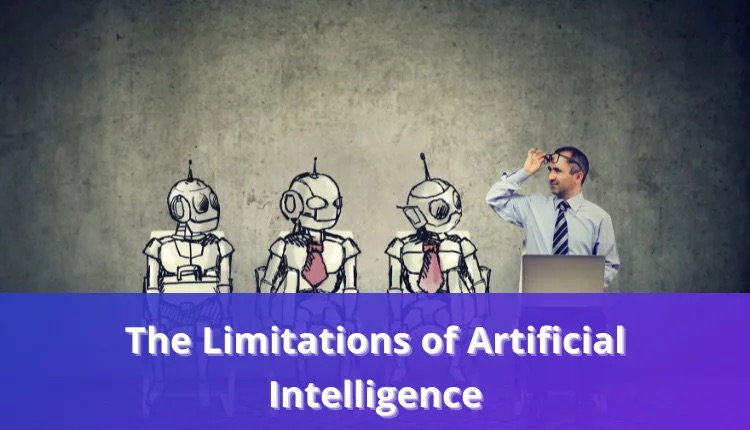
Five Things AI Will Never Do for Your Business (No Matter How Advanced It Gets)

Everyone is talking about AI. Your inbox is full of tools, your LinkedIn feed is packed with “AI transformed my business” stories, and your competitors are experimenting. If you’re running a $5M–$50M company right now, the pressure to adopt AI is real—and in many cases, the technology genuinely can help you work faster, analyze data better, and streamline operations.

But here’s the thing nobody in the AI sales pitch is telling you. There are five things AI simply cannot do for your business—not today, not in five years, not ever in the way a human leader can. And if you let the excitement of automation make you forget about these five things, you will build a faster business that is emptier, less trusted, and harder to scale than the one you have today.

Let’s be clear-eyed about what AI can’t do. Not to dismiss it. But to keep you focused on what only you can provide.

(Before we get into the five things, make sure you have an actual AI strategy, not just AI tools. Read: Why Modern Leaders Need an AI Strategy—Not Just AI Tools.)

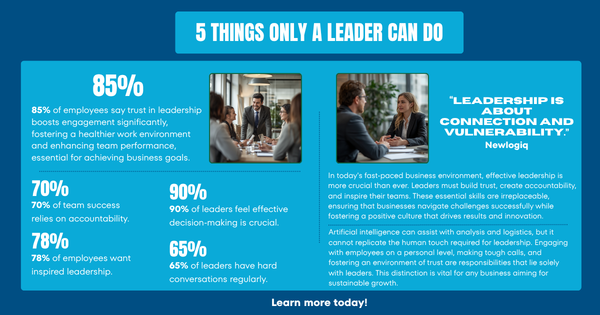
1. AI Cannot Build Trust With Your Team

Trust is built through a thousand small moments. The time you had a hard conversation with a team member who was underperforming and handled it with both honesty and respect. The morning you showed up after a rough quarter and chose to be honest about what went wrong instead of spinning the story. The moment you remembered something personal about someone’s life and asked about it.

AI can draft a thoughtful message. It can remind you of a birthday. It can even simulate empathy in text. But your team is not fooled by a machine. They know the difference between a leader who is present, who listens, who leans in—and an algorithm trying to mimic that. Trust is a human currency. It is earned by humans, over time, through consistent behavior. AI cannot earn it for you.

Research from Fortune and Deloitte published in early 2026 found that leadership teams that rely too heavily on AI-mediated communication are seeing measurable drops in psychological safety and team cohesion. The teams thriving right now are those where leaders are using AI to free up time so they can be more human—not less.

2. AI Cannot Make Values-Based Decisions

Every business eventually faces a decision where the numbers don’t tell you what to do. Do you cut a long-tenured employee who is no longer performing but has given 15 years to the company? Do you walk away from a profitable client who treats your team with disrespect? Do you say no to a growth opportunity that conflicts with what you stand for?

These are not math problems. They are values problems. And AI cannot solve them for you because AI does not have values. It has training data and optimization functions. Those are not the same thing. The most important decisions your company will make—the ones that define your culture and your reputation—require a leader who knows what you stand for, not a model that knows what similar companies have done.

This is one reason why developing your company’s core values is not a decoration exercise. If you’re on the fence about that, the next post in this series on values will be relevant. For now, read about how leadership misalignment often starts here: The Hidden Cost of Leadership Misalignment.

3. AI Cannot Coach Your People Through Hard Times

One of the most consistent findings in executive coaching research is that leaders change their behavior most durably when they are in a real relationship with a real coach—someone who knows their history, sees their blind spots, and holds them accountable not just to their goals but to who they are trying to become.

AI-powered coaching tools are emerging, and some have genuine utility for tracking habits or providing structured feedback. But they cannot do what Marshall Goldsmith describes as the deep behavioral change that comes from genuine human feedback loops. They cannot sit across the table from a CEO who just lost a major client and help that person process what happened, take ownership of their role in it, and rebuild their confidence. They cannot read the room. They cannot feel the weight of the moment.

Coaching your people through hard times—through layoffs, through family business conflict, through leadership transitions—is intrinsicly human work. A hypothetical that resonates with many business owners: imagine a company that automates its employee development program entirely through AI tools. Productivity metrics improve. Retention crashes within a year. People felt processed, not developed. The lesson was expensive.

For a look at how leadership development actually works in a sustained coaching model, see: What High-Performing Leadership Teams Do Differently.

4. AI Cannot Replace Your Contextual Judgment

Contextual judgment is the ability to read a situation in all its complexity—the history of the relationship, the unspoken tensions in the room, the moment in the company’s life cycle, the cultural dynamics on the team—and make a call that is wise given everything you know. Not just everything in the data.

An AI model can analyze five years of financial data and tell you whether a new product line looks profitable on paper. It cannot tell you that your operations manager is stretched too thin and that adding this product line right now will break something important. It cannot tell you that your number-one salesperson’s confidence is fragile after last quarter’s miss and that now is not the time to restructure commissions—even if the spreadsheet says you should.

Researchers at IE Business School in Spain describe contextual judgment as one of the irreplaceable leadership capacities—not because AI lacks data, but because context includes human variables that are not in any dataset. Your judgment, built from years of leading this specific team through these specific challenges, is not something that can be modeled or outsourced.

5. AI Cannot Own Accountability

Accountability in a company flows from human beings who choose to own outcomes. It is a choice—and choices require agency, moral responsibility, and consequence. An AI does not experience consequences. It does not feel the weight of having let someone down. It does not lie awake at night after a bad quarter. It does not show up the next morning with renewed resolve.

When your leadership team is accountable, it is because those leaders have decided that the outcomes of this business matter to them personally. They are not just executing a plan. They are invested. AI can track commitments, send reminders, and flag when targets are missed. But it cannot create accountability in the people who report to you. Only you can do that—through how you lead, how you hold standards, and how you model ownership yourself.

This is precisely why the transition from founder to CEO is such a critical growth moment. The temptation to automate your way around leadership responsibilities is real. But it is a trap. Read: From Founder to CEO: The Hardest Identity Shift No One Warns You About.

What This Means for You

None of this is an argument against using AI. Use it. Use it aggressively. Use it to draft, analyze, automate, and accelerate. Let it handle the work that does not require a human being.

But do not let the efficiency of AI make you lazy about the irreplaceable work of leadership. The five things above—building trust, making values-based decisions, coaching people through hard times, exercising contextual judgment, and owning accountability—these are the things your business needs from you. Not from a model. From you.

According to a March 2026 Fortune investigation citing Deloitte and Wharton researchers, the companies struggling most with AI adoption are not those that moved too slowly—they are the ones that moved so fast they forgot to invest in the human leadership required to make AI implementation work. The technology is not the bottleneck. Leadership is.

So yes, embrace the tools. And then show up more fully as the human leader your company needs. That combination—great tools and great leadership—is what will separate the businesses that thrive in 2026 from those that just look busy.

Your Next Step

Take five minutes this week and ask yourself honestly: am I using AI to enhance my leadership, or am I using it to avoid the harder work of leading? If the honest answer makes you a little uncomfortable, that’s probably the right place to start.

At Newlogiq, we work with business owners and CEOs to build the kind of leadership that technology cannot replace. If you’re ready to develop your team, sharpen your judgment, and build a business that is as human as it is efficient, let’s talk.

—————

Jeff Oskin is the founder of Newlogiq and a Scaling Up and DISCPlus certified coach. He works with $5M–$50M business owners and family businesses to build leadership, create execution systems, and scale with confidence.

Why Modern Leaders Need an AI Strategy—Not Just AI Tools

AI Needs to be in Your Leadership Playbook

You hear about artificial intelligence everywhere these days. The conversation is all about what it means for big companies, tech giants, and the jobs of the future. But if you lead a business in the $5 to $50 million dollar range, most of that noise is not your story. The real question is not whether AI will change leadership. It will. The real question is what you do about it right now.

AI Is Not Coming for Your Job — It’s Coming for Your Excuses

Here is what I see with my coaching clients. Most of them spend their days drowning in operational work. They read emails. They synthesize reports. They write the same response to the same question over and over. They sit in meetings trying to figure out what information matters. They do all of this because it feels urgent. It feels like their job.

And it is their job. Partially. The problem is that all of these tactical tasks use up the cognitive real estate that should be reserved for strategic thinking. When you are reading emails, you are not thinking about whether your market is shifting. When you are preparing for a meeting, you are not questioning whether the meeting itself should exist. When you are drafting a response to a supplier problem, you are not stepping back to ask whether that supplier relationship should evolve.

AI removes the excuse. Not overnight. Not magically. But meaningfully. When an AI tool can read through ten months of customer feedback in sixty seconds and hand you the three patterns that actually matter, you have bought back two hours of thinking time. When AI can draft your weekly communication to your team and you spend fifteen minutes refining rather than ninety minutes writing, you have reclaimed your attention. That is the real power of AI for a small business owner. It is not about replacing your judgment. It is about freeing you from the friction that keeps your judgment locked in the basement.

What AI Actually Does for a Leader

Let me be practical about this. AI is not magic, and I do not use it that way. Here is what it genuinely helps you do.

First, AI summarizes complexity. You have sales data, operational metrics, customer feedback, and market signals all coming at you. AI can run through that noise and distill it down to what actually moves the needle. It surfaces patterns you might have felt but not quite articulated. That is decision-making leverage.

Second, AI drafts at speed. Whether you are writing a difficult message to your team, preparing talking points for a board conversation, or outlining a proposal, AI gives you a first draft in seconds. You still make it yours. You still bring judgment to it. But you skip the blank page problem and start from something real. This matters more than you think. It turns writing from a creative act into an editing act, and editing is much faster than creation.

Third, AI runs scenarios faster. You are thinking about a price increase, a market expansion, or a hiring shift. What if we did X instead? AI can model that faster than you can think about it. You still make the decision. But you make it from a place of more information and fewer mental gymnastics.

None of this replaces your wisdom. None of it makes you less important. It makes you less bogged down.

What AI Cannot Replace

Now let me be equally clear about what AI cannot do. And this matters because I see leaders getting nervous about the wrong things.

AI cannot read a room. You have sat in thousands of conversations. You know what silence means. You understand what someone is really asking when they ask something else entirely. You can feel when a person is uncomfortable or excited or checked out. That pattern recognition lives in your body and your experience. AI does not have that. It reads scripts. It processes words. It does not feel the temperature of the moment.

AI cannot build trust. Your team member works harder for you because she knows you care about her growth. Your customer buys from you because he believes you understand his real problem. Your board believes in your vision because they have watched you navigate difficult seasons with integrity. None of that comes from AI. It comes from you. From your consistency. From your judgment. From your willingness to be wrong and learn.

AI cannot set culture. Culture is not a policy. It is not a memo. It is the way you show up, the kind of question you ask in a meeting, the kind of mistake you forgive, the kind of excellence you celebrate. That is human. That is leadership. That cannot be automated or outsourced or generated by a tool.

And that is actually why I think coaching matters more in an AI world, not less. As leaders have access to better tools to handle complexity, the differentiator becomes the quality of your judgment, the clarity of your thinking, and your ability to grow. That is where real leadership development happens.

How to Add an AI Chapter to Your Leadership Playbook

Here is how I recommend you start. Do not try to do everything at once. Do not subscribe to every tool. Do not redesign your entire workflow. That path leads to overwhelm and abandonment.

Instead, pick one thing. Just one. Look at your week. Where do you spend thirty minutes that could be compressed or elevated? Maybe it is weekly communication to your team. Maybe it is meeting prep. Maybe it is drafting an email to a difficult client. Pick that one thing and bring in an AI tool to help.

Use it for a month. Get real with yourself about whether it actually works. Does it save you time? Does it improve the quality of the output? Does it free up mental space for thinking that matters? If the answer is yes, keep it. If the answer is no, drop it. This is not religion. It is pragmatism.

Once you have one AI habit that works, add a second. Now you have reclaimed an hour or more per week. That is real time that you can now spend thinking. And thinking is what separates good leaders from great ones. That is when you rethink your strategy. That is when you notice that a key relationship needs attention. That is when you design your next move instead of just reacting to this week’s crisis.

The point is this. AI is not a magic wand. It is a tool. A good one, but a tool. The real power comes from what you do with the space it creates.

If you are curious about how to sharpen your leadership approach in 2026, I would love to talk about it. Visit Newlogiq to learn more about the coaching programs I offer for small business owners in your range. Or reach out directly. I respond to everyone who gets in touch, and I am always happy to have a conversation about what you are trying to build and where leadership development can help you get there.

Newlogiq AI Pulse Podcast for Week Ending December 20, 2024

Jeff Oskin Headshot

Jeff Oskin

Owner

Dive into the ever-evolving universe of Artificial Intelligence with Newlogiq AI Pulse, your weekly sonic guide through the cosmos of code and cognition. Each episode, we unpack the latest breakthroughs, from the quirky to the quantum, in the AI sphere. Whether it’s OpenAI’s newest model taking reasoning to the next level or Google turning dense research papers into your morning commute’s entertainment, we’ve got it covered. Join us as we navigate through neural networks, laugh in the face of logic gates, and debate whether AI’s latest ”thinking” phase is pondering or just processing. Here, we take AI seriously, but not ourselves. Expect wit, wisdom, and a touch of whimsy as we explore how AI is reshaping our world, one algorithm at a time. Tune in for your weekly dose of AI developments, delivered with humor, insight, and a perspective that’s slightly outside humanity’s usual orbit. Newlogiq AI Pulse – where the future is now, and it’s surprisingly entertaining.


Latest Articles

Continue reading

Newlogiq AI Pulse Podcast for Week Ending December 13, 2024

Jeff Oskin Headshot

Jeff Oskin

Owner

Dive into the ever-evolving universe of Artificial Intelligence with Newlogiq AI Pulse, your weekly sonic guide through the cosmos of code and cognition. Each episode, we unpack the latest breakthroughs, from the quirky to the quantum, in the AI sphere. Whether it’s OpenAI’s newest model taking reasoning to the next level or Google turning dense research papers into your morning commute’s entertainment, we’ve got it covered. Join us as we navigate through neural networks, laugh in the face of logic gates, and debate whether AI’s latest ”thinking” phase is pondering or just processing. Here, we take AI seriously, but not ourselves. Expect wit, wisdom, and a touch of whimsy as we explore how AI is reshaping our world, one algorithm at a time. Tune in for your weekly dose of AI developments, delivered with humor, insight, and a perspective that’s slightly outside humanity’s usual orbit. Newlogiq AI Pulse – where the future is now, and it’s surprisingly entertaining.


Latest Articles

Continue reading

Unlocking Growth with AI: Jeff Oskin’s Vision on Customer Experience and Digital Transformation

design-sprints-about

Jeff Oskin Headshot

Jeff Oskin

Owner

In a recent interview with Ticker NewsJeff Oskin, founder of Newlogiq, shared his expertise on how artificial intelligence (AI) is transforming the landscape for small and mid-sized businesses (SMBs). At Newlogiq, Jeff is dedicated to helping companies unlock growth by aligning customer experience strategies with the power of digital transformation. His insights underscore the potential of AI to drive meaningful results for businesses while also acknowledging the hurdles that SMBs often face on this journey.  A copy of the interview can be found by clicking here.

AI’s Transformative Role in Customer Experience

Jeff’s interview sheds light on a critical but often overlooked aspect of digital transformation: the human element. As he discussed, AI offers SMBs more than just automation and efficiency. When integrated thoughtfully, it can empower companies to deliver a more personalized, responsive customer experience. For Jeff, customer experience isn’t a byproduct of technology—it’s the driving force behind it. By connecting people, processes, and technology, Newlogiq helps clients harness AI to enhance every touchpoint in the customer journey.

Bridging Strategy and Execution

One of the biggest challenges for SMBs is aligning strategy with execution. According to Jeff, this alignment is essential for companies looking to maximize the value of their digital investments. Through Newlogiq’s consulting approach, Jeff emphasizes creating a cohesive roadmap that connects high-level goals with day-to-day operations. “Strategy without execution is just an idea,” he says. “Our role is to make sure that the strategic vision translates into tangible actions that positively impact the customer experience.”

The Balance Between Innovation and Leadership

Jeff’s insights also reflect his deep understanding of the balance between technological innovation and effective leadership. While AI can drive incredible efficiencies, it also requires a company culture that’s prepared to embrace change. For Jeff, leadership plays a pivotal role in fostering this culture and ensuring that teams feel empowered, supported, and aligned with the broader vision.

Overcoming Implementation Hurdles

Despite the transformative potential of AI, Jeff doesn’t shy away from addressing the implementation hurdles SMBs often encounter. He discusses common challenges, such as limited resources and skill gaps, that can hinder progress. To Jeff, these hurdles are not insurmountable. At Newlogiq, he and his team help SMBs navigate these challenges by focusing on scalable solutions tailored to each client’s unique needs, resources, and objectives.

Looking to the Future

Jeff’s interview with Ticker News highlights his forward-thinking perspective on AI and customer experience. As more SMBs explore AI, his insights provide a roadmap for businesses eager to transform without losing sight of the human side of customer engagement. With Jeff’s guidance, Newlogiq is well-positioned to continue leading the charge in helping businesses realize the full potential of AI.

For SMBs looking to take their customer experience to the next level, Jeff’s interview is a must-watch. It’s clear that with the right strategy, AI can be a powerful tool for growth and transformation. And at Newlogiq, Jeff Oskin and his team are committed to guiding businesses through every step of that journey.

Explore more insights from Jeff Oskin and Newlogiq on how AI and digital transformation can elevate your business’s customer experience.

Back to Homepage


Latest Articles

Continue reading