The AI Divide Is Real: What Small Business Owners Need to Know in 2026

LinkedIn is buzzing with a single conversation right now. Business owners, CEOs, and founders across every industry are asking the same question: “Are we falling behind on AI?” The answer, for most small businesses, is complicated. And that’s exactly why this topic deserves your full attention.

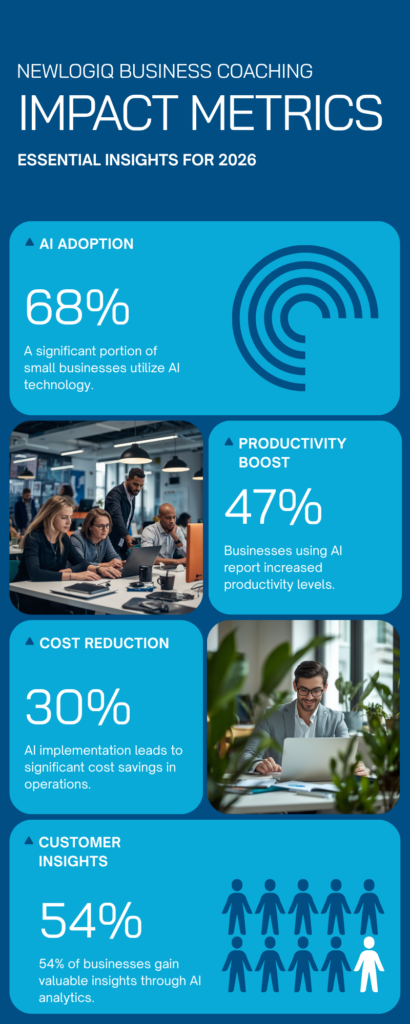
LinkedIn’s own economists have called 2026 “the defining year for small business AI adoption.” And the data backs that up. A QuickBooks survey found that 68% of U.S. small businesses now use AI regularly — up from just 48% in mid-2024. But here’s the part that almost nobody is talking about: adoption rate does not equal advantage. Using AI is not the same as using it well. For business owners running companies in the $5 million to $50 million range — especially family businesses — the AI conversation is filled with noise. Everyone is promising transformation. Most of what gets implemented ends up being a glorified email shortcut. Let’s cut through that.

The Gap Is Growing — And It’s Happening Fast

The Federal Reserve published research in April 2026 tracking AI adoption patterns across the U.S. economy. What they found should wake up any owner who has been on the sidelines: companies that adopted AI tools earlier are now pulling away from competitors at a pace that is difficult to close. It is not just about speed. It is about compounding advantage.

Here is a simple way to think about it. Imagine a business that uses AI to handle its weekly reporting, draft client communications, analyze margin data, and screen job applicants. That business gets back roughly six to ten hours of leadership time every week. Multiply that across a year and you are looking at 300 to 500 hours returned to strategy, client relationships, and growth. A competitor who is not doing this is running slower — permanently. This is what I call the AI divide. And it is not between big companies and small ones. It is between the small businesses that have gotten intentional about AI and the ones still treating it as a curiosity.

What’s Actually Working Right Now

When I work with business owners inside my coaching practice, I ask one simple question before we talk about any tool: “What is eating your time that does not require you specifically?” The answers are almost always the same. Reports. Emails. Research. Scheduling. Meeting summaries. Drafting SOPs. These are not strategic tasks. And they are exactly where AI earns its keep.

The data backs this up. According to 2026 research aggregated across multiple SMB studies, 62% of small businesses are using AI primarily for data analysis and reporting — the highest ROI category by a wide margin. Marketing automation comes in second at 54%. And the average productivity gain from generative AI tools works out to roughly $7,800 per employee per year. For a company with 20 employees, that is $156,000 in recovered capacity — without adding a single headcount.

But here is where most small businesses get it wrong. They buy tools before they buy clarity. They subscribe to five platforms, use none of them consistently, and conclude that “AI doesn’t work for our business.” That is not an AI problem. That is a process problem. I have written about how decision fatigue and poor decision frameworks derail even the best-intentioned leaders. The same principle applies here. Too many options, no clear filter.

Three Moves Every Small Business Owner Should Make Right Now

The first move is to audit your time — not your tools. Before you download anything, spend one week tracking where you and your leadership team are spending time on tasks that do not require your direct judgment. Most owners are shocked by what they find. This is not about efficiency for efficiency’s sake. It is about identifying where AI can buy you back the time you need to lead.

The second move is to start small and specific. Do not try to transform your entire operation in 90 days. Pick one workflow — meeting summaries, weekly reports, first drafts of client communications — and get great at using AI for that one thing. Master it. Then expand. The businesses building real advantage right now are not the ones chasing the newest tools. They are the ones who get disciplined about quarterly priorities and execute with focus.

The third move is to invest in your team’s AI literacy, not just your own. One of the most common mistakes I see is the owner becoming the AI champion while the team stays skeptical. Your business will only scale if your people are using these tools consistently. This is fundamentally a leadership development conversation as much as it is a technology conversation. The owner who hoards the tools creates a bottleneck. The owner who trains the team creates leverage.

A Real-World Example of the AI Advantage

Consider a hypothetical family-owned distribution company running about $18 million in revenue. The owner spends roughly 12 hours each week in operational review meetings, writing updates, and answering status questions that his team could handle with better systems. After working together on a 90-day AI integration plan — meeting transcription tools, automated weekly reporting dashboards, AI-drafted client proposals — that time drops to under four hours. What does he do with the extra eight hours? He visits two new prospective clients per week, re-engages a supplier relationship he had let drift, and starts working on the succession plan he has been putting off for two years.

That is not a technology story. That is a leadership story. AI just removed the obstacles. This kind of outcome is available to most small business owners. The gap is not technical. It is clarity about where to start and the discipline to follow through. If you are working through the Scaling Up or EOS frameworks, AI integration fits naturally into your rhythm. It supports your meeting structures, your KPIs, your accountability cadence. It does not replace the system — it accelerates it.

What AI Cannot Replace (And Why That Matters)

There is a counterweight to all of this worth naming directly. I have written about what AI genuinely cannot do, and that list matters now more than ever as AI becomes more capable. AI cannot replace your judgment about your people. It cannot sense the tension in a room during a family business disagreement. It cannot have the hard conversation with an underperforming manager or read the quiet signals in a client relationship that is starting to drift. These are the moments where leadership still wins — and where coaching still matters.

The best frame I have found: AI helps you execute faster, but it cannot help you choose the right strategy. Strategy is still yours. The goal is to free your brain from operational noise so you can think more clearly about the moves that actually matter.

The Question Worth Asking Yourself

Here is the version of the AI question I think is worth sitting with. Not “Are we using AI?” but “Is AI buying us more time to become the kind of company we want to be?” For a family business, that might mean the founder finally has two hours every Friday to think about succession. For a manufacturing CEO, it might mean the leadership team gets out of status meetings and into genuine strategy conversations. For a service company, it might mean proposals go out in two hours instead of two days.

The competitive environment in 2026 is real. The scaling challenges do not get easier. But the tools available to small business owners have never been more accessible. The question is whether you are going to use them with intention — or let the noise decide for you.

At Newlogiq, we work with business owners in the $5M–$50M range to build the clarity, systems, and leadership habits that create sustainable growth. If you are trying to figure out how AI fits into your strategy — not just your workflow — reach out at newlogiq.com. We would love to help you think it through.

MOST GROWING COMPANIES PRICE WRONG; HERE’S WHY

Most founders in the $5-50M revenue range leave money on the table. Not because they’re bad at their jobs, but because they’ve never actually rebuilt their pricing strategy as their business scaled.

Most scaling companies are leaving money on the table

You priced your offering when you had 10 customers. Maybe 50. You charged what felt reasonable at the time. Then you started winning bigger deals. Your product got better. Your market position strengthened. Your ops matured. And your pricing… stayed the same.

This is the pricing power gap.

It’s the gap between what you’re charging and what your market will bear. For most scaling businesses, it’s worth 15-40% of annual revenue that you’re leaving unclaimed. That’s not a typo. A company doing $25M in revenue is typically sitting on $3.75-10M in captured price opportunity.

Why This Happens

Three reasons, all fixable.

First: founder psychology. You built this thing from nothing. It feels expensive to you. You remember charging $2,000/month because that was a fortune when you started. Now you’re at $5,000/month and you feel like you’re already “expensive.” The market doesn’t care about your origin story. They care about the value you deliver relative to alternatives.

Second: operational invisibility. You’re not systematically tracking what you’re worth. You don’t have clean data on customer outcomes, ROI multiples, or competitive positioning. You’re pricing on intuition and what your salespeople can close, not on what your clients actually get back from you.

Third: segmentation failure. You’re charging everyone the same price for fundamentally different value. A $2M company using your software gets different ROI than a $50M company. A bootstrapped founder’s problem is different from a PE-backed growth stage company. But if you’re charging a flat rate (or worse, a percentage of revenue that doesn’t scale with your own costs), you’re systematically underpricing to sophisticated buyers.

The Reengineering Process

Pricing reengineering isn’t guesswork. It’s systematic. Most founders who work through a structured scaling-up framework discover that pricing sits at the intersection of strategy, psychology, and operations.

Start by mapping your customer outcomes. Not features—outcomes. What do your customers make, save, or avoid because they work with you? For B2B software, this is usually some combination of: revenue captured, cost reduction, time saved, or risk eliminated.

Quantify the outcomes. A customer using your platform that increases sales velocity by 3 weeks across a 100-person team isn’t a feature benefit—it’s $5-15M in unlocked revenue. A customer that reduces operational friction by 15% is saving the cost of 5-10 full-time roles. These numbers are your pricing power. If you need a structured approach to defining and measuring this, read “Value Proposition Design” by Osterwalder — it’s the bible for mapping customer outcomes to pricing tiers.

Segment by the size of the opportunity. A company with $500K ACV has a fundamentally different pricing model than one with $5M ACV. You need separate economic models for each. This isn’t just about price points—it’s about what you can afford to deliver at each tier.

Run a willingness-to-pay analysis. Simple version: ask 15-20 of your best customers: “If you had to replace us, what would you spend on an alternative?” Their answer is your ceiling. If they say $50K/year and you’re charging $15K, you have immediate optimization.

Build tiered pricing that reflects value, not just volume. Most scaling companies benefit from moving away from flat-rate or percentage-of-revenue models and toward value-based tiers. Example structure:

Starter: $X/month for companies doing <$5M revenue
Scale: $Y/month for companies $5-25M (usually 2-2.5x starter)
Enterprise: Custom for $25M+

The ratio matters. A 2-2.5x jump between tiers is healthy. Anything lower means you’re leaving money on the table. Anything higher creates friction for natural progression.

Implementation Strategy

You can’t just flip a switch. Existing customers are anchored to current pricing. New customer acquisition moves faster.

Phase 1 (months 1-2): Introduce new pricing tier on new sales only. Keep existing customers where they are (or grandfather them). This lets you test demand and refine the model with zero friction.

Phase 2 (months 3-6): Migrate customers up tiers as they naturally scale. When a customer crosses a revenue threshold (say, from $5M to $10M), move them to the next tier. Frame it as “we’re adjusting your plan because you’ve grown”—which is true.

Phase 3 (month 6+): Annual contract refresh conversations. When renewals hit, present the updated tier mapping. Most will accept—they’re already getting the value, and pricing adjustments feel normal at renewal time.

Expect customer churn of 3-7% during this process. That’s actually conservative. Most of that churn will be your smallest customers, which is fine—they have the lowest lifetime value anyway.

The Math

Let’s run a realistic example:

Current state: 80 customers at $10K/year average = $800K ARR.

After reengineering (new tiers, 12-month implementation):

  • 60 existing customers migrate to appropriate tiers (avg $14K/year, 20%+ churn)
  • 30 new customers added in year 1 (avg $16K/year, benefits from new pricing)
  • New ARR: ~$1.3-1.5M (62-87% growth) vs. $1.1M if you kept pricing as is and had NO churn

The upside isn’t just from raising prices. It’s from removing customer acquisition friction (prospects aren’t shocked by tier differences) and from natural upsell momentum (customers move up as they grow).

Common Mistakes to Avoid

Don’t confuse “raising prices” with “pricing optimization.” Raising prices by 20% across the board is dumb. Reengineering is about right-sizing the entire model.

Don’t price on cost. Your cost structure is irrelevant to what customers will pay. I don’t care that you had to hire three engineers to build this. I care what it’s worth to me.

Don’t set it and forget it. Pricing should be reviewed annually. Every 18 months, you should ask: “Are we still capturing the full value we deliver?”

Don’t tell your sales team last. They need to understand the logic before they talk to prospects. If you can’t explain why a customer at $20M revenue pays 2.5x more than one at $5M, your salespeople can’t either.

What This Unlocks

Pricing reengineering isn’t just about revenue. It’s a forcing function for clarity. You have to understand your customer segments. You have to quantify your outcomes. You have to decide who you’re building for.

If you’d like help working through this framework, Newlogiq’s business coaching specializes in helping scaling businesses close their pricing power gap.

The best part? Most of our clients see the upside within 6 months, not years.

Remote Team Management at Scale: Lead Without Micromanaging

Remote work solved a problem. It created three more.

Trust + Systems = Leadership that Works

When your team was in an office, visibility was passive. You walked by desks. You overheard conversations. You got a feel for who was crushing it, who was struggling, and who was just moving things around their desk.

Now? Your team is scattered across three states. You can’t walk by anything. And the temptation is strong: jump into Slack all day, request update calls, install monitoring software, or create daily standup rituals that feel more like surveillance than leadership.

Then you realize people are miserable. The ones who were going to leave are leaving faster. And you’ve built a culture of compliance instead of ownership.

This is the hybrid leadership trap: you can’t see work anymore, so you default to tracking it. And tracking kills the very thing remote work was supposed to provide: autonomy.

The answer isn’t more visibility. It’s better systems.

The Visibility Problem Is Actually a Trust Problem

Here’s what I hear from CEOs managing distributed teams:

I don’t know if people are working.

How do I ensure they’re focused?”  

Accountability seems to disappear without an office.

These aren’t really problems with remote work. They’re symptoms of a deeper issue: you never built systems robust enough to run without you being present.

In an office, a weak system gets papered over by hallway conversations and ambient accountability. You catch problems because you’re around. Remote work strips away that cushion. Suddenly, the system’s weakness is catastrophic.

So leaders do what feels safe: they add oversight. More check-ins. More updates. More documentation of work. And what they actually build is a culture of fear.

Your best people—the ones who don’t need oversight—leave because they hate the constant reporting. Your weaker performers get worse because they’re spending energy managing the perception of work instead of doing work. And you become the bottleneck again, because now you have to review all these status updates.

The answer isn’t more control. It’s clear expectations, transparent outcomes, and trust.

What Remote Teams Actually Need

There are four things that replace the visibility you lost when people left the office:

1. Crystalline clarity on roles and outcomes.

Not tasks. Outcomes.

In an office, you can delegate something vague (“Look at that partnership opportunity”) and catch it if they misunderstand. Remote? Vague kills you.

Every person on your team needs to be able to finish this sentence: “I know I’m winning at my job when…

And that sentence should not include “my boss approves my work.” It should include metrics.

The VP of Sales isn’t “checking in with prospects.” They’re hitting 50 qualified meetings a month and a 35% deal close rate. The Head of Marketing isn’t “managing social.” They’re generating 200 qualified leads monthly with <$50 CAC.

These aren’t made-up numbers. You define them, together, at the start. Then you trust them to hit them.

2. Asynchronous-first communication with structured check-ins.

Most remote companies over-index on meetings. It feels productive because you can see faces. But it’s actually killing deep work.

Here’s the better model:

Async by default: Team members update progress in shared docs, Slack channels, or project management tools on their own schedule. No daily standups. No “what did you do yesterday” rituals.

Sync when necessary: Weekly 1-on-1s (30 mins, focused on blockers and coaching, not reporting). Monthly all-hands (vision, wins, what’s coming). Quarterly deep dives on strategy.

This does two things:

  • It protects deep work time (especially for engineers, designers, strategists)
  • It forces clarity (people write down their progress, which means they have to think about it)

The asynchronous record also becomes your visibility. You can see what’s being shipped, not just that someone was “at their desk.” Companies like GitLab have pioneered this approach, documenting their entire communication culture asynchronously.

3. Outcome-based reviews, not activity-based reviews.

This is huge and most companies get it wrong.

When you can’t see people working, the temptation is to measure activity: hours logged, emails sent, messages responded to. It’s a trap.

Judge by outcomes. Did they hit their numbers? Did they ship? Did customers/stakeholders get what they needed? If yes, how they spent their time is not your business.

There will be people who work 35 hours and ship 10x. There will be people who work 50 hours and ship 2x. In an office, the person who looks busy wins the culture war. Remote? The person who delivers wins.

This is actually more fair. And it’s definitely more scalable.

4. Psychological safety so people actually tell you when something’s wrong.

Here’s the risk no one talks about: remote teams with bad communication cultures go silent when there’s a problem.

Someone’s struggling? They don’t want to “bother” you over Slack. There’s a risk you’re not seeing? They assume you know and don’t say anything. A project is derailing? They wait for the next check-in, by which time it’s too late.

In an office, you catch these because you overhear, bump into someone, see body language. Remote? You need intentional cultural permission to speak up.

This is where Patrick Lencioni’s work on psychological safety becomes critical. His research shows that teams with high psychological safety outperform those without it by a significant margin.
:

  • Regular 1-on-1s focused on “What’s blocking you?” and “What would help?” not “Did you finish?”
  • Blameless problem-solving (“That missed deadline was bad. Let’s figure out what broke so it doesn’t happen again”)
  • Public acknowledgment when someone surfaces a risk early (“Thank you for flagging this. This is exactly what we need to know”)
  • Modeling vulnerability (“I made this mistake last week. Here’s what I learned”)

You build trust by showing that the culture is genuinely safe for people to be honest about problems.  Kim Scott’s Radical Candor framework reinforces this: care personally, challenge directly. Remote teams need both

Building the System That Replaces Your Presence

Here’s what this actually looks like implemented:

Quarterly planning: Each person’s OKRs or key results are defined in a shared doc. Not written down by you. Co-created in conversation. Then it’s their north star.

Weekly async updates: Monday AM, each person posts a 2-3 bullet summary: What won this week. What’s coming next. What’s blocked. It’s not “I worked 40 hours.” It’s “We hit 45 qualified meetings, closed 2 deals, and we need to finalize the vendor contract.”

Weekly 1-on-1s: 30 minutes, video. Agenda: blockers, coaching on 1-2 items, and one personal question (how are you, what’s on your mind outside work). Not a status dump. A conversation.

Monthly all-hands: 45 minutes. CEO shares: where we are, where we’re going, wins from the team. Space for Q&A. Feeling of “we’re in this together.”

Slack norms: Async-first. If something needs an immediate response, people DM you. Otherwise, you catch up in batches. Set expectations: “I check Slack mornings and evenings, not continuously.”

Quarterly reviews: Based on outcomes vs. goals. What did they ship? What impact did it have? What could they improve? Where do they want to grow?

This system doesn’t require you to know what everyone did every day. It requires you to know: Are they hitting their outcomes? Are they unblocked? Are they growing? Are they honest with me about problems?

And oddly, that’s better information than presence.

The Company That Runs Without You in the Room

Here’s what happens 6 months into this approach:

  • People aren’t waiting for your input. They’re making decisions with clear frameworks.
  • Problems surface early because the culture is safe for honest conversations.
  • You actually know what’s happening in the company better than you did when people were “in the office”—because it’s all documented.
  • Your best people stay because they get autonomy without abandonment.
  • Meetings are shorter and fewer because you’re not defaulting to video calls for everything.

And maybe most importantly: you’re not the bottleneck anymore.

You’re not reading activity logs. You’re not in every meeting. You’re not the person who has to approve everything. You’re leading a company that runs because it has systems, not because you’re present.

That’s what scales.

Key Takeaway

Remote work doesn’t require more monitoring. It requires better systems. Define outcomes clearly, use asynchronous communication as your default, judge by results not activity, and build psychological safety so people actually tell you what’s happening. Do that, and hybrid work becomes your competitive advantage—not your management headache.To learn more about how to apply this to your unique situation, contact Newlogiq today.

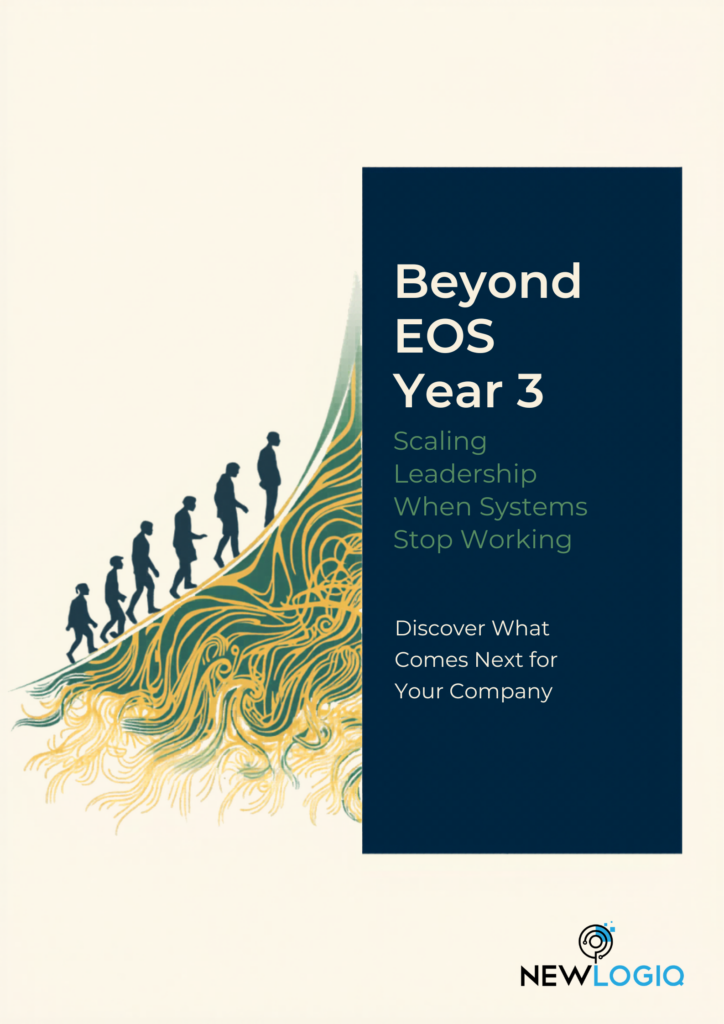
Beyond EOS Year 3: Scaling Leadership When Systems Stop Working

The Conversation Happens Around Year 4

Sarah runs her company with flawless EOS discipline. Level 10 meetings every week. Rocks defined every quarter. The People Analyzer filled out. The Vision/Traction Organizer sitting proudly on her desk.

It worked beautifully for three years.

But last month, she called me with a frustration I’ve heard dozens of times: “We’re still having the same conversations. The issues aren’t changing. And honestly? The system feels like it’s running us instead of us running it.”

She asked the question that signals a deeper problem: “Is there something after EOS?”

Yes. And you probably need it.

The EOS Sweet Spot (And Its Limits)

First, let me be clear: EOS is brilliant. It’s the most effective operating system I’ve seen for taking a chaotic $1-8M company and bringing it structure, alignment, and accountability.

The Level 10 meeting cadence works. The Rocks system creates clarity. The People Analyzer surfaces difficult conversations. The V/TO gives people direction.

For the first 2-3 years, EOS typically delivers:

  • Faster decision-making
  • Clear accountability
  • Reduced chaos
  • Aligned leadership team
  • Measurable business momentum

The problem isn’t that EOS fails. The problem is that success itself reveals the limits.

When you cross $5M, when your leadership team grows beyond 4-5 people, when you move from a single product/market to multiple business units, EOS starts to feel thin.

Not because it’s broken. Because your complexity has outgrown its framework.

The Three Ways the EOS System Plateaus

1. Strategy Stops Being Strategic

The V/TO was designed as a one-page snapshot: your purpose, values, vision, goals. Beautiful simplicity.

But when you need to think about market positioning, competitive differentiation, pricing strategy, revenue model evolution, or geographical expansion, one page isn’t enough. The V/TO starts to feel like it’s in the way rather than clarifying direction.

You find yourself doing strategy work *outside* the system because the system doesn’t have room for it.

2. Leadership Development Becomes Invisible

“Right people, right seats” is excellent shorthand. It pushes you to think about fit. But it doesn’t tell you:

  1. How you’re building future leaders for the next two years
  2. What pipeline you’re creating for your next layer of leadership
  3. How you’re systematically closing gaps between current capability and future needs
  4. How you’re creating true bench strength so you’re not dependent on any single person

You end up with a team that’s organized well but not developing strategically. When someone leaves, you panic because you didn’t build a bench.

3. Financial Strategy Remains Surface-Level

EOS gives you a scorecard. Metrics. Execution discipline. But it doesn’t give you, pricing architecture and margin strategy, cash flow forecasting by business unit or customer segment, capital efficiency metrics, profitability levers and sensitivity analysis or the relationship between revenue growth and profitability.

You can be hitting your numbers and still running low on cash. You can be growing at 30% and destroying profitability. EOS doesn’t catch it because EOS doesn’t go that deep into financial strategy.

If you want to dig deeper into these issues, read a recent post that takes a deep dive on EOS plateau specific framework options.

The Real Problem: Systems vs. Leadership

Here’s what I’ve come to understand: systems take you from chaos to clarity. Leadership takes you from clarity to scale.

EOS is a magnificent system. But it’s a system. Which means it works best when it’s well-designed and well-executed, but it works within limits.

The companies that scale beyond $5-10M don’t do it because their systems improved. They do it because their leadership improved.

That’s the shift that typically happens around Year 3-4 of EOS. You realize: the system is locked in. We’re executing it well. But we’re not leading strategically.

A few examples of what I mean:

Sarah’s Case: EOS got her to $7M. Clean leadership team. Good execution. But at $7M, she realized she needed to make strategic bets:

  • Invest in a new market (risky, might cannibalize existing revenue)
  • Shift pricing model (improves profitability but requires customer re-negotiation)
  • Build a new division (requires new leadership structure)

Her EOS system couldn’t help her think through these choices because they exist outside the one-page vision. She needed a framework for strategic thinking, not just execution discipline.

Marcus’s Case: Marcus had $9M revenue and a 4-person leadership team. All in the right seats. All executing rocks well.

But none of them were ready to step into larger roles when the company needed to expand from 30 to 50 people. He’d optimized for current execution rather than future leadership. By the time he realized the gap, it was painful and expensive.

John’s Case:  John had profit margins that looked good on paper (25%) but cash flow was tight. EOS metrics showed strong progress. But he wasn’t tracking margin by customer segment, wasn’t managing pricing discipline, and had no visibility into cash conversion cycle.

When a big customer went away, the company nearly imploded—not because the loss was that big, but because he’d never developed financial literacy beyond scorecard metrics.

All three of them needed something more than a better-executed system. They needed a different kind of thinking.

What “Leadership Beyond Systems” Looks Like

The next evolution for companies that have maximized EOS typically involves:

1. Strategic Clarity Beyond the Vision Statement

Strategic thinking means:

  • Clear understanding of what makes you different (and defensible)
  • Intentional choices about where not to compete
  • 3-5 year roadmap that’s customer/market driven, not just revenue driven
  • Meaningful diversification strategy (new products? new markets? new customer segments?)
  • Coherent capital allocation across strategic bets

This is the work that the Scaling Up framework handles well. EOS doesn’t have the tools for it.

2. Leadership Bench Building

Not just “right people right seats” but:

  • Intentional talent pipeline for the next 2-3 layers of leadership
  • Development plans for high-potential team members
  • Systematic skill-building in your leadership team
  • Succession planning that’s real, not theoretical
  • Cultural clarity about what “leadership in our company” means

This means moving from a 90-day goal orientation to a multi-year people strategy.

3. Financial Sophistication

Beyond the dashboard and KPIs:

  • Margin analysis by customer, product line, or business unit
  • Cash flow dynamics and capital requirements
  • Profitability drivers and how to optimize them
  • Unit economics for new initiatives
  • Financial modeling for strategic scenarios

When you have this, you stop having vague conversations about “profitability” and start having precise conversations about “which customer segments and products are actually profitable, and which are subsidizing growth?”

4. Execution Across Complexity

EOS meetings work great for a core leadership team of 4-5 people. When you have 8-10 people, or multiple divisions, or matrix accountability, the Level 10 format starts to strain.

You need:

  • Different cadence and format for different organizational layers
  • Cross-functional alignment mechanisms (not just departmental)
  • Cascading goals that actually cascade (and don’t contradict)
  • Innovation budgets and processes for experimental work
  • Risk management frameworks for decisions outside the quarterly cycle

What Happens to Founders Who Push Through

I’ve worked with dozens of founders who’ve successfully navigated the EOS-to-next-phase transition. Here’s what changed:

They Stopped Optimizing for Execution and Started Optimizing for Scale

Early years: How do we execute our plan better?

Next phase: Are we building an organization that can grow beyond our current leadership capacity?

They Built Advisory/Strategic Partners

Usually around Year 4-5, the best scaling companies brought in fractional CFO expertise, strategic advisors, or board-level coaching. Not because something was wrong, but because the complexity required deeper expertise than internal team could provide.

They Separated Strategy from Execution

This is critical. They protected space for strategic thinking—often quarterly or bi-annual strategic off-sites—and separated it from the weekly execution rhythm.

They Invested in Their Own Leadership Development

The founders who broke through realized: the system is only as good as the leader running it. They invested in executive coaching, peer groups, or mastermind groups to develop themselves at the level the next phase required.

The Most Important Question

Here’s the question I ask founders who’ve hit the EOS ceiling:

“What would it look like if your company could grow profitably 10x without you needing to work harder?  100x?”

Most of them can’t answer it because they’ve never thought strategically about it. EOS got them to $5-10M with excellence in execution. But $50M or $500M requires excellence in strategy AND execution.

You need both. EOS gives you execution. But you need something more for strategy.

Your Honest Assessment

If any of these feel true, you might be at the EOS ceiling:

  • You’re executing flawlessly but growth has slowed
  • You have the right people in the right seats, but no clear pipeline for the next level
  • Your metrics are solid but you’re not sure about profitability by customer or product
  • You’ve hit a growth plateau that feels like it’s about your current team’s capacity, not market opportunity
  • You’re running the system, not leading the company
  • Your best people are asking “what’s next for me?” and you don’t have an answer

If three or more of those resonate, it’s time to evolve beyond the system.

What Comes Next

You don’t abandon EOS. Most of the best scaling companies I know keep Level 10 meetings and the Rocks system. Those tools still work.

But you layer on strategic thinking frameworks. You add financial depth. You build leadership development systems. You create strategic planning cadences.

For some companies, that looks like Scaling Up. For others, it’s a custom blend of frameworks. But all of them move from “executing a system” to “leading an organization.”

The Transition

The transition from Year 3 of EOS to Year 4+ of Scaling Up typically takes 6-12 months. Here’s what I usually recommend:

Quarter 1-2: Assess where you are. Is the EOS ceiling real? Are there genuine gaps in strategy, finance, or leadership that the system can’t address?

Quarter 2-3: Introduce new frameworks or tools for the areas where you’ve hit limits. Don’t replace EOS, layer on.

Quarter 3-4: Let it settle. Get comfortable with the new rhythm. See what works. What doesn’t.

Year 2: Refine. Double down on what’s working. Modify what isn’t.

Your Move

If you’re past Year 3 of EOS and something feels off, trust that instinct. It’s not a sign the system failed. It’s a sign you’ve succeeded at the first phase and you’re ready for the next one.

The companies that successfully scale recognize that transition points are normal. What got you to $5M won’t get you to $20M. That’s not failure—that’s growth.

If you’re ready to explore what “beyond EOS” looks like for your company, let’s talk about where you actually are and what’s next.  Schedule a Free Discovery Call. If you want to learn more about the core of Scaling Up and assess your current organization, read this great overview article on the Rockefeller Habits.

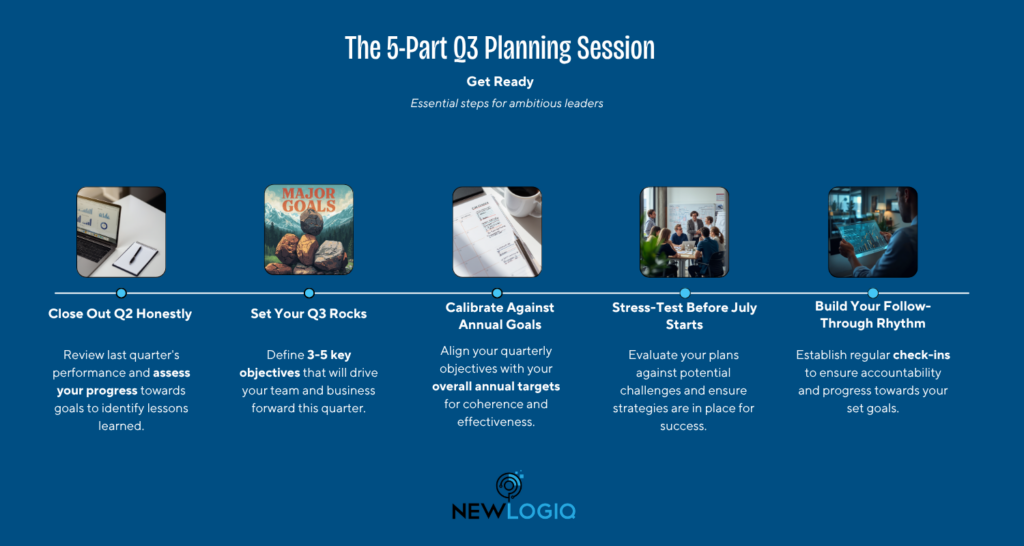
Why Most Quarterly Planning Sessions Are a Waste of Time (And What to Do Instead)

It’s the start of Q2. Your team is gathering around the conference table—or on a Zoom call—and everyone has that familiar look. Part hopeful, part exhausted. Last quarter’s Rocks didn’t all get done. The issues list is still full. And somewhere between the PowerPoint slides and the catered lunch, you wonder: Is this session actually going to change anything?

For most $5M–$50M business owners, the honest answer is no. Not because quarterly planning is a bad idea. But because the way most teams run these sessions is broken before the meeting even starts. The problem isn’t commitment. It’s execution. And the difference between a quarterly session that drives real traction and one that just burns a day comes down to a few critical choices.

The good news: those choices are learnable. Let’s dig in.

The 90-Day Rhythm Is Real—But Only If You Take It Seriously

Verne Harnish’s Scaling Up framework and Gino Wickman’s EOS (Entrepreneurial Operating System) both center on the power of 90-day execution cycles—and for good reason. Human beings’ attention spans and energy naturally align to roughly three-month windows. Annual goals are too distant to feel urgent. Monthly reviews don’t give enough runway to build momentum. But 90 days? That’s close enough to feel the pressure and far enough to accomplish something meaningful.

Research from the EOS community confirms that teams operating inside a clear 90-day world consistently outperform those stuck in annual planning mode. Rocks get completed. Accountability sharpens. And teams stay aligned because everyone is executing against the same short-term priorities—not some twelve-month wishlist nobody remembers by March.

(Not sure which framework is right for your business? Read: EOS vs. Scaling Up vs. Business Made Simple: Which One Fits Your Business?)

What Most Teams Get Wrong

Here’s the pattern I see again and again with the business owners I coach. The quarterly session is scheduled. People show up. Someone opens a Google Doc or fires up the slideshow. You review last quarter’s priorities. A few things got done. A few didn’t. Nobody fully explains why. Then you spend forty-five minutes listing new priorities—and call those your “Rocks.”

But they’re not Rocks. They’re wishes. A real Rock, in EOS language, is a specific, measurable outcome that one person owns and that can clearly be marked complete or not complete at the end of the quarter. A wish sounds like “improve marketing.” A Rock sounds like “Launch the updated website by May 31, owned by Sarah.” Those are completely different commitments.

The second mistake is more subtle. Most teams treat the quarterly meeting as a standalone event. They walk in cold, talk fast, and walk out with a list of priorities nobody truly believes in. The meeting becomes a ritual, not a turning point.

The real problem? More meetings without more clarity won’t fix execution. For a deeper look, read: Why ‘More Meetings’ Isn’t the Answer to Execution Problems.

The Pre-Work That Changes Everything

The most effective quarterly sessions I’ve facilitated don’t start at 9:00 a.m. on the day of the meeting. They start two to three weeks before, with structured prep work that every leader completes individually. Here’s what that looks like.

Each leader reviews their personal Rocks from last quarter and honestly scores each one complete or not complete—no “80% done.” They review their weekly measurables (their scorecard numbers). They identify the top issues they want to solve in the coming quarter. And they come in ready to talk about what’s working, what isn’t, and what genuinely needs to change.

When every leader walks into the room having done this work, the conversation is completely different. You spend less time catching up and more time solving. You spend less time debating what’s important and more time committing to it. That’s when quarterly planning becomes a competitive advantage.

What a Great Quarterly Session Actually Looks Like

A great quarterly planning session has four movements. First, you close the last quarter. That means reviewing every Rock (complete or not) with brutal honesty, reviewing your scorecards, and identifying patterns in what’s working and what keeps breaking. No sugarcoating.

Second, you open the new quarter. You revisit your one-year plan and ask: are we still on track? Has anything changed that we need to account for? This is where strategy meets reality.

Third, you set Rocks. Not twenty priorities. Not ten. Between three and seven Rocks per quarter at the company level—and the same for each leader. Less is more here. Trying to move fifteen things forward simultaneously is how nothing actually moves. The discipline of choosing your top three to seven is where most teams fail, and it’s where the best teams win.

Fourth, you clear the Issues List. This is the heart of Gino Wickman’s IDS process: Identify, Discuss, Solve. For each major issue facing the business, the team names it clearly, discusses the root cause honestly, and lands on a clear resolution. Issues that leave the room unresolved are issues that will cost you next quarter.

If accountability is slipping between quarters, there’s usually a clarity problem underneath it. Read: Why Accountability Systems Fail Without Clarity.

How to Know If Your Quarterly Was Worth It

Here’s the test I give every leadership team I work with. After the session, every leader should be able to answer three questions without hesitation. First: What are my Rocks for this quarter and what does ‘done’ look like for each one? Second: What are the three most important things the company is focused on achieving in the next 90 days? Third: What was the most important issue we solved today, and how did we resolve it?

If anyone on your team can’t answer those questions walking out of the room, the session didn’t work. Not because people weren’t in the room. But because the session lacked the structure and discipline needed to create genuine alignment.

Here’s a hypothetical I share with clients. Imagine two companies at the same revenue level. Company A has great people but runs quarterly planning as a loose two-hour all-hands meeting. Company B runs a disciplined full-day session with prep work, real Rocks, and a cleared Issues List. Within a year, Company B consistently outpaces Company A—not because they worked harder, but because they were aligned on what mattered.

High-performing leadership teams have distinct habits beyond just planning sessions. See what else sets them apart: What High-Performing Leadership Teams Do Differently.

The Framework That Makes This Stick

Whether you use EOS, Scaling Up, or Business Made Simple, the underlying principle is the same: great execution requires great rhythm. Quarterly planning is not a box to check. It is the engine that turns your annual goals into 90-day realities.

According to the EOS Quarterly Meeting Guide from EOSWorldwide, the most effective sessions share a common trait: they are treated as sacred time—not a calendar obligation, but a leadership discipline. The structure is respected. The prep work is done. And the team leaves with clarity, commitment, and a short, focused list of what must happen next.

That’s the kind of quarterly planning that doesn’t just fill your calendar. It fills your pipeline, builds your team, and drives your business forward one 90-day sprint at a time.

Your Next Step

If your last quarterly planning session felt like a waste of time, the answer isn’t to skip the next one. The answer is to run it differently. Start with the pre-work. Set real Rocks. Clear your Issues List. And walk out of the room with every leader aligned on what’s next.

If you’d like help facilitating your next quarterly planning session or building a meeting rhythm that actually drives growth, let’s talk. That’s exactly the kind of work we do at Newlogiq.

And if quarterly planning feels hard because you’re still the bottleneck in your business, start here first: How to Stop Being the Bottleneck in Your Own Business.

—————

Jeff Oskin is the founder of Newlogiq and a Scaling Up and DISCPlus certified coach. He works with $5M–$50M business owners and family businesses to build leadership, create execution systems, and scale with confidence.

Your Hiring Problem Isn’t Really a Hiring Problem

You’ve hired the wrong person. Again.

It happens to almost every small business owner at some point. You find someone who seems great in the interview. You bring them on. And then, a few months later, something is clearly off.

So you start over. Another job post. Another round of interviews. Another hire that doesn’t quite work out.

Here’s the hard truth: if this keeps happening, the problem probably isn’t the people you’re hiring. The problem is the system — or lack of one — you’re using to hire them.

Why Small Business Owners Keep Hiring Wrong

SHRM, the Society for Human Resource Management, estimates that a bad hire can cost up to 50-60% of that employee’s annual salary — when you factor in recruiting, training, lost productivity, and starting over. For a small business, that’s not just painful. It can be a real threat to your survival.

But why does it keep happening?

The most common reason: most small business owners hire for skills and fire for culture. They look at a resume and think about what someone can do. They don’t think hard enough about whether this person fits how the business works — and needs to work — going forward.

The Three Root Causes

  1. No clear role definition. If you can’t describe what success looks like in the role after 90 days, you can’t hire for it. Most owners hire on gut feel because the role was never clearly defined in the first place.
  2. No alignment to your core values. If your company doesn’t have written core values — or if you don’t use them in your hiring process — you’re leaving culture to chance. Patrick Lencioni makes this point clearly in The Advantage: a team that’s not aligned on values will always struggle, no matter how talented the individuals are.
  3. You’re hiring to fill pain, not to build strength. When someone critical leaves, the pressure to fill the seat fast is real. That pressure causes you to lower your standards. You hire the best of a bad batch instead of waiting for the right person.

What a Better Hiring Process Looks Like

You don’t need an HR department to hire well. You need a process. Here is a simple one to start with:

Write a one-page role scorecard before you post the job. Define the top three outcomes the person must achieve in their first 90 days. Make those outcomes — not the job duties — the center of every interview.

Add one values-based question to every interview. Ask the candidate to describe a time they had to make a hard call when no one was watching. Their answer will tell you more about their character than their entire resume.

Slow down when you feel the most pressure to go fast. If you catch yourself saying “good enough” during a hiring process, stop. That is your signal to pause, not push forward.

The Bigger Picture: Leadership Comes First

Hiring problems are often symptoms of a deeper leadership challenge. When a team doesn’t have clarity — about goals, about roles, about what is and isn’t acceptable — the wrong people feel comfortable staying and the right people feel uncomfortable leaving. We explore this more in What Your Team Needs From You as a Leader.

And if you’ve been losing good people before you’ve had a real chance to help them succeed, it’s worth reading If Your Team Isn’t Pushing Back, You Have a Problem. Psychological safety and hiring are more connected than most owners realize.

One Last Thing

You can’t build a great business with the wrong team. But you also can’t build a great team without a clear picture of what great looks like.

That clarity — about roles, about culture, about what you actually need — is work that starts with you, not with your next hire.

Take the time to build the process. It will save you more money — and more headaches — than any single hire ever could.

────────────────────────────────────

Jeff Oskin is a Scaling Up certified coach who helps small and family-owned businesses hire better, lead better, and grow with purpose. Learn more at newlogiq.com.

The Owner Burnout Trap: Why Working Harder Is Making Things Worse

Introduction

You started your business because you wanted freedom. More control. A better life.

But somewhere along the way, the business started running you instead.

Sound familiar? You’re not alone. You’ve fallen into what I call the Owner Burnout Trap — and it’s more common than you think.

What Is the Owner Burnout Trap?

The Owner Burnout Trap happens when a business owner keeps piling work onto their own plate instead of building a team that can carry it. You become the answer to every question. The approver of every decision. The solver of every problem.

Gallup research on employee burnout causes and cures finds that burned-out employees are 63% more likely to take sick days and 2.6 times more likely to be actively looking for a new job. For owners, there’s no calling in sick. There’s no quitting. So the burnout quietly builds.

The trap looks like this: you work more hours, your team depends on you more, you have less time to think, and you make worse decisions. Around and around it goes.

Three Signs You’re Already in the Trap

  1. You are the bottleneck. If work stops when you go on vacation — or you can’t take a vacation because work would stop — you are the bottleneck. We wrote more about this pattern in Are You Being Your Own Bottleneck? It’s worth a read.
  2. Your best people are going quiet. When a team feels like their input doesn’t matter, they stop giving it. Read Why Your Best Employees Are Staying Silent to see if this is already happening on your team.
  3. You can’t picture yourself stepping back. If you can’t imagine being gone from the business for a week without something breaking, the business doesn’t have a foundation yet. It just has you.

Why Working Harder Won’t Fix It

This is the hardest thing for most owners to hear: more effort from you is not the answer. In fact, it makes things worse.

Every time you step in and solve a problem your team should be solving, you teach them one thing — wait for the owner. Marshall Goldsmith, one of the world’s top executive coaches, calls this “adding too much value.” You jump in. You fix the thing. And in doing so, you signal that your team’s judgment isn’t enough on its own.

The result? A team that stops trying. And an owner who never stops.

The Way Out: Build the Business Around Systems, Not Yourself

Getting out of the trap starts with one question: what would have to be true for this to run without me?

That question forces you to think like a CEO instead of an operator. Here’s where to start:

Write down the decisions only you make — and why you make them that way. That becomes a playbook your team can follow.

Name your top three bottlenecks. Pick the one that, if fixed, gives you back the most time. Start there.

Hold a weekly team meeting and let your team run it. Your job is to listen, not to lead.

A Note on Coaching

Getting out of the Owner Burnout Trap isn’t just about tactics. It’s about changing how you see your role — shifting from operator to owner. That’s the core of what I work on with every client. If you’re curious about whether coaching could help you make that shift, learn more about the ROI of executive coaching here.

The Bottom Line

You built something real. Something worth protecting.

But if you are always the hardest-working person in the building, your business has a ceiling — and it is you.

The goal isn’t to work harder. The goal is to build something that works harder than you do. That’s what real growth looks like.

────────────────────────────────────

Jeff Oskin is a Scaling Up certified coach who helps small and family-owned businesses build the systems and leadership habits needed to grow without burning out. Learn more at newlogiq.com.

What Marshall Goldsmith Teaches CEOs About Sustainable Change

Most CEOs don’t struggle because they’re incapable.

They struggle because they’re successful.

The habits that built the business, decisiveness, control, speed, high standards, are often the same habits that quietly limit the next stage of growth.

Marshall Goldsmith has spent decades coaching executives at the highest levels, and one of his most powerful insights is simple:

“What got you here won’t get you there.”

That phrase hits differently when you’re leading a $5M–$50M company.

Because at that stage, growth isn’t just operational.
It’s personal.

The Hidden Trap of Success

In early stages, the CEO drives everything.

You:

  • Make most of the decisions
  • Carry the strategy in your head
  • Jump in to fix problems
  • Set the pace

That intensity creates traction.

But as the business scales, those same behaviors create friction:

  • Leaders hesitate because you override decisions
  • Meetings slow down because everyone waits for your input
  • Accountability weakens because you rescue instead of coach
  • Strategy stays centralized instead of distributed

Goldsmith calls these “success delusions.”
Not because leaders are arrogant, but because they don’t realize the habits that once helped are now holding them back.

Sustainable Change Is Behavioral, Not Strategic

Most CEOs think growth problems are structural.

New org chart.
New meeting cadence.
New framework.

Those matter.

But Goldsmith’s work reminds us that sustainable change is behavioral.

It shows up in small patterns:

  • Do you listen fully or interrupt?
  • Do you ask for input or jump to the answer?
  • Do you follow up on commitments or assume people will handle it?
  • Do you ask for feedback and actually act on it?

In his coaching methodology, one practice stands out: feedforward.
Instead of analyzing past failures, leaders ask for suggestions on how to improve moving forward.

It shifts energy from defensiveness to progress.

You can explore more of his work here:
👉 https://marshallgoldsmith.com

His thinking has influenced how executive coaching for CEOs is practiced worldwide, especially for leaders transitioning from founder to enterprise builder.

Why This Hits Harder After $5M

Once your company passes $5M, complexity multiplies:

  • More leaders
  • More departments
  • More cross-functional tension
  • More need for CEO leadership team alignment

You can’t rely on force of will anymore.

You need leverage.

And leverage comes from:

  • Clear decision rights
  • Strong accountability systems for leadership teams
  • Organizational clarity for growing companies
  • A business operating system that distributes ownership

But none of those systems work if the CEO hasn’t evolved alongside the company.

That’s the uncomfortable truth.

The CEO Shift Goldsmith Talks About

At its core, Goldsmith’s message to CEOs is this:

You don’t scale by doing more.
You scale by becoming different.

That means:

  • Moving from being the smartest voice in the room to the best question-asker
  • Moving from solving problems to developing leaders
  • Moving from control to clarity
  • Moving from reactive speed to intentional rhythm

It’s not dramatic.
It’s subtle.

And it’s hard, because it requires self-awareness, not just strategy.

Where This Connects to Execution

This is where Goldsmith’s work becomes very practical.

When leadership habits don’t evolve, execution starts to feel heavier. Not because the team isn’t capable, but because alignment begins to erode.

If the CEO:

  • Jumps in too quickly
  • Overrides decisions
  • Fails to clarify ownership
  • Avoids direct feedback

The leadership team adjusts around that behavior.

Decisions slow down.
Accountability softens.
Meetings multiply.

Execution drag is often a leadership signal.

That’s why alignment matters so much at this stage of growth.

If you want to pressure-test how aligned your leadership team really is, this is a good place to start:

👉 The Leadership Team Alignment Test: How Does Yours Score?

Because sustainable change at the top doesn’t just improve culture.
It sharpens execution across the entire company.

Final Thought

Marshall Goldsmith doesn’t teach CEOs how to work harder.

He teaches them how to change, in ways that stick.

Sustainable change is not about intensity.
It’s about awareness, feedback, and deliberate behavioral shifts.

If you’re building a company that needs to scale beyond you, that work becomes essential.

And if this resonates, it’s worth paying attention.

A short conversation often brings clarity.
👉 www.newlogiq.com

The Leadership Team Alignment Test: How Does Yours Score?

Most CEOs can feel it before they can explain it.

The leadership team is smart.
Everyone’s busy.
The business is growing.

And yet… execution feels heavier than it should.

Decisions take longer.
Priorities get reinterpreted.
You find yourself repeating the same conversations.

That’s usually not a talent problem.

It’s an alignment problem.

And alignment is one of those things that’s easy to assume  and hard to measure.

So here’s a simple way to test it.

The Leadership Team Alignment Test

Score each statement from 1 to 5:

1 = Not true
3 = Sometimes true
5 = Consistently true

Be honest. This is for you.

1. We are clear on our top 3 priorities and they don’t change weekly.

If you asked each member of your leadership team what matters most right now, would you get the same answer?

2. Everyone knows who owns the final decision in each major area of the business.

No floating decisions. No quiet veto power. No back-channel overrides.

3. Meetings result in clear decisions and assigned ownership, not just discussion.

When you leave a leadership meeting, is it obvious who is doing what by when?

4. We resolve conflict directly and quickly.

Hard conversations happen in the room, not in the hallway afterward.

5. Our leaders think like owners of the business, not just heads of their function.

Sales doesn’t blame operations. Operations doesn’t blame finance. The team wins and loses together.

6. We revisit strategy regularly and connect it to weekly execution.

There’s a clear rhythm between long-term direction and day-to-day decisions.

7. I, as CEO, do not have to re-align the team after every major conversation.

You’re leading, not constantly translating.

How Did You Score?

30–35:  Your alignment is strong. Execution should feel relatively smooth, even during stress.

20–29:  You’re functional, but friction is costing you speed and energy. This is where most $5M to $50M companies sit.

Below 20: Your team may be working hard, but not truly together. That misalignment will eventually slow growth or strain culture.

Why Alignment Slips As You Grow

In early stages, alignment happens naturally.
Everyone’s close to the founder. Decisions are fast. Context is shared.

But once complexity increases, more leaders, more departments, more moving parts alignment requires structure.

Without:

  • Clear decision rights
  • Defined roles
  • Consistent operating rhythm
  • Real ownership

Execution starts to drag.

That’s when CEOs feel like they’re carrying too much context and spending too much time reconnecting dots.

What High-Performing Teams Do Differently

Strong leadership teams don’t leave alignment to chance.

They:

  • Clarify roles and decision ownership
  • Use structured cadences for strategic and weekly conversations
  • Address friction early
  • Document and reinforce key decisions
  • Align incentives around shared outcomes

Alignment is not a personality trait.
It’s a discipline.

And one of the clearest signs of misalignment is when teams try to solve execution problems by adding more meetings instead of fixing decision clarity and cadence.

We break that down here:
👉 Why “More Meetings” Isn’t the Answer to Execution Problems
https://newlogiq.com/why_more_meetings_isnt_the_answer_to_execution_problems/

Final Thought

If your score was lower than you expected, don’t panic.

Most growing companies hit this stage.
It’s not a sign of failure, it’s a signal that your leadership system needs to evolve.

The real question isn’t whether you have smart people. It’s whether they’re aligned around how the business actually runs.

If this resonates, it’s worth paying attention.

A short conversation often brings surprising clarity.
👉 Visit www.newlogiq.com

Why ‘More Meetings’ Isn’t the Answer to Execution Problems

If your company has ever added a meeting to solve a problem, you’re not alone.

Project falling behind? Let’s add a check-in.
Accountability slipping? Time for a weekly standup.
Execution dragging? Add a war room, sync, or cadence call.

The logic makes sense: more visibility = more control = better results.

But here’s the pattern we see again and again, especially in companies scaling past $5M:

Meetings multiply. Results don’t.

You’re still fighting for clarity.
Still chasing decisions.
Still leaving meetings with more to do… and less actual progress.

So what’s going on?

The Real Problem Isn’t the Meeting

The problem isn’t that you’re meeting too much.
It’s that your meetings aren’t solving the right things, in the right rhythm, with the right clarity.

More meetings won’t fix:

  • Vague ownership
  • Slow or unclear decisions
  • Poor follow-through
  • Misaligned priorities
  • Cross-functional confusion

In fact, without fixing those root issues, meetings just make everything feel heavier.

What High-Performing Companies Do Differently

In companies that scale well, execution isn’t driven by “more meetings.”
It’s driven by a clear operating cadence and strong decision hygiene.

Here’s what that looks like:

1. They meet to decide, not just discuss

High-performing teams don’t confuse talking about the work with actually moving it forward.

Meetings are designed to:

  • Solve issues
  • Make clear decisions
  • Determine accountability
  • Track progress week over week

They’re not just for updates.
They’re working sessions and they move the business forward.

2. They clarify who decides what and when

In growing teams, decisions stall when no one knows who is accountable for the decision.

Strong teams define:

  • What needs group input
  • Whos’ ultimately accountable for the decision
  • What decisions require escalation
  • How to revisit decisions (without reopening everything)

This speeds up execution and reduces circular debates.

3. They follow a shared rhythm

Execution isn’t random. It’s rhythmic.

  • Strategic planning happens quarterly
  • Weekly meetings focus on blockers and priorities
  • Scorecards get reviewed regularly
  • Decision logs or issue lists stay visible

This rhythm gives the business momentum and helps the CEO step back from being the “clarity chaser.”

4. They track decisions, not just tasks

One of the quiet killers of execution is decision amnesia.

You think something was decided… but it gets re-litigated next week. Or people don’t follow through. Or no one remembers what was agreed on.

High-performing teams log decisions, not just tasks and refer back to them to stay on track.

Why This Matters More As You Scale

At $1M, you can afford informal systems.
Everyone’s in the loop. Problems get handled quickly. You don’t need much structure.

But once you cross $5M, $20M, $50M, that falls apart.

  • Too many people in too many rooms
  • Too many priorities moving in parallel
  • Too much ambiguity without rhythm

That’s when CEOs feel like they’re in every meeting, but still chasing clarity.

It’s not a meeting problem. It’s a system problem.

Want to go deeper?

If you’re finding yourself in every meeting, making every call, and still chasing clarity, it might not be a meeting issue.

It might be a leadership leverage issue.

Before you bring in more tools or more structure, it’s worth asking the right questions about what kind of support will actually move the needle.

We break that down here:


👉 The 5 Questions Every CEO Should Ask Before Hiring an Executive Coach

Final Thought

Meetings can be useful. But they don’t create execution.

Clarity does. Cadence does. Decision hygiene does.

If your team is talented but your execution still feels slow, take a step back and ask:

“Are we solving for rhythm or just reacting with more meetings?”

If the answer’s unclear, let’s talk.
A short conversation often brings surprising clarity.

👉 Visit www.newlogiq.com