Tag: Leadership

The Next Leader Is Already in Your Building. Are You Developing Them?

The Clock Is Already Running

Here is a number that should get your attention: according to Deloitte, 28% of current family business leaders plan to hand over the reins within the next five years. Another 46% of the next generation say they hope to step into executive roles in that same window.

That’s a lot of people moving toward a door. The question is whether anyone is ready to walk through it.

If you run a business between $5M and $50M — especially if it’s a family business — this isn’t a theoretical problem. It’s a right now problem. The businesses that thrive across generations don’t wait until the founder is burned out or the succession is urgent. They build leaders continuously, long before they need them.

Developing next generation leaders in a family business is one of the most complex — and most rewarding — things you can do as a business owner. And most companies are doing it wrong, or not doing it at all.

Why Most Businesses Wait Too Long

Let me describe a pattern I see often. The founder — let’s call him David — has built a solid $15M company over 20 years. His daughter Sarah has been in the business for six years. She’s capable. She works hard. She cares about the company.

But David has never really thought about developing Sarah. He’s been too busy running the business. He assumes that because she’s been around, she’s absorbing what she needs to know. And Sarah has been operating in a kind of leadership limbo — doing important work, but never quite clear on whether she’s being groomed for leadership or just filling a role.

Then something happens. David has a health scare. A key client leaves. The business hits a rough patch. Suddenly the succession question is urgent — and neither David nor Sarah is prepared for the transition.

This isn’t a failure of love or intention. It’s a failure of structure. Most founders are so good at building businesses that they forget to build the people who will eventually run them.

The Real Cost of Not Developing Your Next Leader

According to a 2026 HEC Paris family business survey, 68% of next-generation family members say they’d prefer to “go do something else” rather than take over the family business — largely because they never felt truly prepared or invited into the leadership conversation.

That’s not a statistic about ambition. It’s a statistic about belonging. When people don’t feel developed, they don’t feel valued. And when they don’t feel valued, they leave — sometimes physically, sometimes emotionally, even while staying on the payroll.

On the other side, McKinsey research on family business succession shows that companies with a structured leader development approach significantly outperform those that rely on informal knowledge transfer. The difference isn’t talent — it’s intentionality.

For a deeper look at how leadership gaps affect execution, check out our post on When Your Org Chart Doesn’t Match Reality.

What Good Next-Gen Development Actually Looks Like

The frameworks I use — Scaling Up, EOS, Business Made Simple — all address this, though sometimes under different names. The core idea is the same: you cannot delegate leadership development to chance. It has to be an intentional system.

Good next-gen leadership development has four components that work together over time.

The first is clarity about the destination. Before you can develop someone, you have to be honest about what role they’re being developed for. Not just “running the business someday” — but specifically: What decisions will they make? Who will report to them? What results will they be accountable for? Without that clarity, development is just motion with no direction.

The second is real ownership of real things. The most important teacher for any future leader is experience. That means giving your next-gen leader ownership of a meaningful initiative, team, or strategic project — and then not rescuing them when it gets hard. They need to fail in contained ways, learn from it, and build the confidence that comes from working through difficulty.

The third is consistent feedback and reflection. This is where most founders fall short. They give plenty of feedback in the moment — “you should have handled that differently” — but very little structured reflection. Once a month, at minimum, your next-gen leader should sit down with someone and ask: What am I learning? Where am I growing? What am I still avoiding? That structured reflection is what turns experience into wisdom.

The fourth is exposure to outside thinking. Family businesses have a natural insularity that protects their culture — and also limits their growth. Next-gen leaders need to be exposed to how other organizations think, lead, and solve problems. That might mean peer groups, coaching, industry events, or time spent working somewhere else before joining the family business full-time.

A Note on the Uncomfortable Conversation

Here is the thing that nobody likes to say out loud: not every family member is the right person to lead the business. And one of the most loving things you can do — for your business, for your family, and for the individual — is to have that conversation early, clearly, and kindly.

Patrick Lencioni’s work is useful here. In his framework for healthy teams, one of the core habits is the ability to have difficult, honest conversations without letting them destroy the relationship. In a family business, that skill is even more critical — because the relationships are deeper and the stakes are higher.

If your next-gen candidate is great but needs another three years before they’re ready, say that — and build the plan. If they’re better suited for a different role than CEO, explore that together. If they don’t want the business at all, better to know now than after you’ve made promises neither of you can keep.

We’ve explored this kind of honest leadership conversation in our post on The Courage to Have the Conversation Your Business Needs.

How to Start This Week

You don’t need a complicated succession plan on day one. You need to start the conversation and build the habit. Here are three things you can do this week.

First, name your next potential leader — even if you’re not sure yet. Who in your organization has the most potential to step into greater responsibility? Put a name to it.

Second, schedule a development conversation with that person. Not a performance review. Not a project update. A genuine conversation about where they want to go, what they feel ready for, and where they want to grow.

Third, assign them something meaningful. Give them ownership of one initiative or decision area that stretches them slightly beyond where they are today. Then commit to debriefing with them monthly.

That’s it. Three steps. The rest — the frameworks, the accountability structures, the full leadership development plan — can be built from there.

If you want help building a structured next-gen leadership program for your business, we work with family business owners and CEOs to create exactly that. It’s one of the highest-leverage investments you’ll ever make. For more on building a culture that supports leadership development, read our post on Creating a Learning Culture in Your Small Business.

Is your next leader ready? Let’s find out — and build a plan together. Connect with Jeff at Newlogiq.

Sources & Further Reading

Deloitte: Family Business Succession Planning

HEC Paris: NextGen Family Stories 2026

McKinsey: Passing the Baton — CEO Succession at Family Businesses

Family Business Magazine: 2026 Succession and Governance Priorities

KMCO: 5 Ways to Develop the Rising Generation in Your Family Business (2026)

The Owner Burnout Trap: Why Working Harder Is Making Things Worse

Introduction

You started your business because you wanted freedom. More control. A better life.

But somewhere along the way, the business started running you instead.

Sound familiar? You’re not alone. You’ve fallen into what I call the Owner Burnout Trap — and it’s more common than you think.

What Is the Owner Burnout Trap?

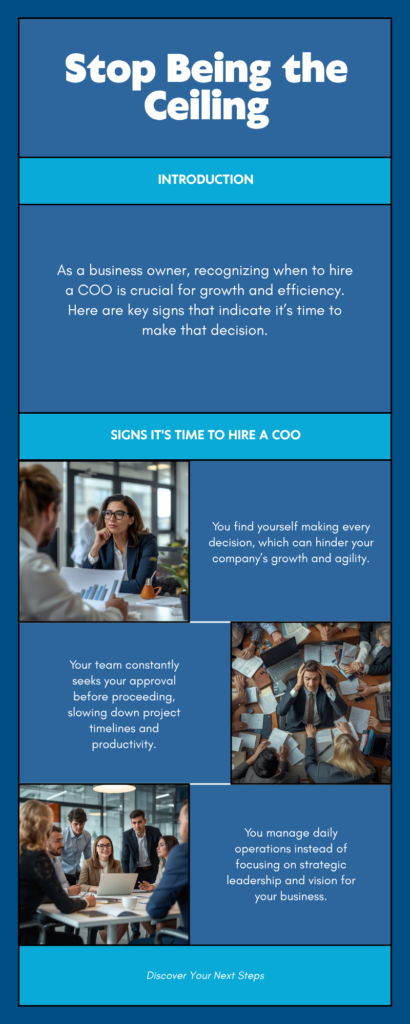
The Owner Burnout Trap happens when a business owner keeps piling work onto their own plate instead of building a team that can carry it. You become the answer to every question. The approver of every decision. The solver of every problem.

Gallup research on employee burnout causes and cures finds that burned-out employees are 63% more likely to take sick days and 2.6 times more likely to be actively looking for a new job. For owners, there’s no calling in sick. There’s no quitting. So the burnout quietly builds.

The trap looks like this: you work more hours, your team depends on you more, you have less time to think, and you make worse decisions. Around and around it goes.

Three Signs You’re Already in the Trap

  1. You are the bottleneck. If work stops when you go on vacation — or you can’t take a vacation because work would stop — you are the bottleneck. We wrote more about this pattern in Are You Being Your Own Bottleneck? It’s worth a read.
  2. Your best people are going quiet. When a team feels like their input doesn’t matter, they stop giving it. Read Why Your Best Employees Are Staying Silent to see if this is already happening on your team.
  3. You can’t picture yourself stepping back. If you can’t imagine being gone from the business for a week without something breaking, the business doesn’t have a foundation yet. It just has you.

Why Working Harder Won’t Fix It

This is the hardest thing for most owners to hear: more effort from you is not the answer. In fact, it makes things worse.

Every time you step in and solve a problem your team should be solving, you teach them one thing — wait for the owner. Marshall Goldsmith, one of the world’s top executive coaches, calls this “adding too much value.” You jump in. You fix the thing. And in doing so, you signal that your team’s judgment isn’t enough on its own.

The result? A team that stops trying. And an owner who never stops.

The Way Out: Build the Business Around Systems, Not Yourself

Getting out of the trap starts with one question: what would have to be true for this to run without me?

That question forces you to think like a CEO instead of an operator. Here’s where to start:

Write down the decisions only you make — and why you make them that way. That becomes a playbook your team can follow.

Name your top three bottlenecks. Pick the one that, if fixed, gives you back the most time. Start there.

Hold a weekly team meeting and let your team run it. Your job is to listen, not to lead.

A Note on Coaching

Getting out of the Owner Burnout Trap isn’t just about tactics. It’s about changing how you see your role — shifting from operator to owner. That’s the core of what I work on with every client. If you’re curious about whether coaching could help you make that shift, learn more about the ROI of executive coaching here.

The Bottom Line

You built something real. Something worth protecting.

But if you are always the hardest-working person in the building, your business has a ceiling — and it is you.

The goal isn’t to work harder. The goal is to build something that works harder than you do. That’s what real growth looks like.

────────────────────────────────────

Jeff Oskin is a Scaling Up certified coach who helps small and family-owned businesses build the systems and leadership habits needed to grow without burning out. Learn more at newlogiq.com.

If Your Team Isn’t Pushing Back, You Have a Bigger Problem Than You Think

Picture the last time you sat in a leadership team meeting where every idea you floated got nodded at. No pushback. No “I’m not sure about that.” No “What about this risk?” Just heads bobbing and an agenda moving forward. If that scene sounds familiar, here is the uncomfortable truth: that kind of meeting is not a sign of a healthy team. It is a warning sign.

Patrick Lencioni’s The Five Dysfunctions of a Team is one of the most widely read business books of the last 25 years, and for good reason. It names five predictable patterns that make teams ineffective. But of the five, the one I see most often in growing family businesses and mid-sized companies is the second: fear of conflict. Specifically, the team’s unwillingness to have real, productive, ideological disagreement in the room.

Team psychological safety — the belief that you can speak up without being punished for it — is not just a trendy HR concept. Research from Google’s Project Aristotle found it to be the single most important factor in determining whether a team performs at a high level. And yet most leadership teams I work with are operating without it, often without realizing it.

What Silence Is Actually Telling You

When your team stops pushing back, they have not stopped having concerns. They have just stopped sharing them with you. That is a very different thing, and it is important to understand the distinction.

There is a moment in many organizations where someone raised a concern, got shut down, and decided the risk was not worth it. Maybe it was subtle — an eye roll, a “we’ve already decided this,” a dismissive tone in front of others. Maybe it was more direct. Either way, the message got received: disagreement is not welcome here. And once that message is received, it spreads through the team faster than any memo you will ever send.

Our post on why your best employees are staying silent goes deeper on this pattern. The short version is this: the people who stop speaking up are usually not your weakest team members. They are often your strongest. They have learned to protect themselves by keeping their ideas inside, which means you are making major decisions with incomplete information and you may not even know it.

Lencioni’s Framework: It Starts With Trust

Here is what most leaders get backwards about Lencioni’s model. They try to “fix the conflict problem” by pushing their team to be more direct, to debate more, to challenge each other in meetings. Sometimes they even mandate it: “I want everyone to voice their concerns.” And then nothing changes.

The reason is that Dysfunction #2 (fear of conflict) cannot be solved without first addressing Dysfunction #1: absence of trust. Lencioni is very specific about what he means by trust. He is not talking about reliability trust — the belief that people will do what they say. He is talking about vulnerability-based trust: the willingness to admit mistakes, ask for help, and be honest about limitations without fear of judgment.

You cannot ask a team to speak up if they do not first believe they are safe to be wrong. And you cannot create that safety by declaring it. You have to model it. When was the last time you said, in front of your team, “I got that wrong” or “I don’t know the answer to that” or “Help me understand what I’m missing”? If the answer is a long pause, that is useful data.

Our post on what your team actually needs from you covers this in depth. The short answer is that what most teams need most from their leader is not more direction. It is more honesty.

Three Ways to Build a Team That Speaks Up

If you want to move your team from polite agreement to honest dialogue, here are three things that work. These are not quick fixes. Each one requires consistent effort over weeks and months. But they are practical, they are grounded in real behavior change, and they do not require a team offsite to get started.

The first is what I call the “What am I missing?” habit. Before closing any significant decision in a meeting, you pause and ask the group: “What am I missing?” Not “Does anyone have concerns?” — that question is too easy to answer with silence. “What am I missing?” implies that something has been overlooked, which makes it safer to surface it. It also signals that you genuinely want the incomplete view, not confirmation that you are right.

The second is the designated devil’s advocate. Pick someone before the meeting — rotate the role — and give them the explicit job of finding the holes in whatever is being proposed. This does two things. It normalizes disagreement by making it structural rather than personal. And it takes the social risk off any individual who might otherwise stay quiet to preserve relationships.

The third is what Marshall Goldsmith calls feedforward: asking people for input on what you should do differently in the future, rather than asking for feedback on what you did in the past. “What’s one thing I could do differently to make our meetings more useful?” is a much more productive question than “Did I run that meeting well?” It opens a door rather than requiring judgment.

The Leader’s Real Job in a Healthy Conflict

Here is something Lencioni emphasizes that I think gets lost in most discussions of his framework: healthy conflict in teams is not about arguing more. It is about arguing about ideas, not people. And the leader’s job during that kind of conflict is not to mediate neutrally. It is to mine for disagreement actively.

This means calling on the quiet person in the room. It means asking the person who agreed most quickly what concerns they might have. It means being the first one to say, “I’m not sure we’ve thought through all the implications of this.” The leader does not just permit candor. The leader demonstrates it.

If you have ever wondered whether your leadership team is truly aligned or just avoiding conflict, our Leadership Team Alignment Test is a useful diagnostic. It takes about ten minutes and often surfaces patterns that would otherwise take months to see.

What Changes When People Start Speaking Up

When a leadership team develops the habit of honest, productive conflict, the results tend to compound quickly. Decisions get better because they are made with more complete information. Execution improves because people are committed to outcomes they actually believe in, rather than plans they silently disagree with. And the leader — you — spends less time managing around problems that could have been surfaced early.

One client I worked with had a leadership team that was, by all external appearances, high-functioning. They had good metrics, low turnover, and a clear strategic plan. But when we started digging in, it became clear that the team had stopped having real debates about anything. They were efficient. They were also slowly losing their best thinking to silence. Within about four months of doing the work described above, they had surfaced three significant operational issues that no one had been willing to raise before. All three were fixable. None of them would have been if they had gone another year unspoken.

Meetings that look smooth on the outside can be the most expensive ones you are running. If you want to go deeper on how to make your meetings more productive overall, our post on why more meetings isn’t the answer to execution problems is a good complement to this one.

One More Thing

Lencioni’s five dysfunctions are not a checklist you complete. They are a description of the natural gravity that pulls teams toward dysfunction over time. Left unattended, teams default toward safety. They stop challenging. They stop being honest. They start optimizing for harmony over results.

Your job as the leader is to fight that gravity every week. Not through speeches or policies, but through behavior. Ask the hard question. Admit the mistake. Call out the idea that no one is challenging. Model the standard you want the team to hold.

The most dangerous meeting is the one where everyone agrees. And the most powerful thing you can do as a leader is make sure you never have to wonder whether the agreement in the room is real.

Is your team speaking up — or just going along?

Let’s find out together. Schedule a complimentary strategy call at newlogiq.com.

The Three Conversations Every Family Business Owner Avoids (And Why They Can’t Afford To)

Tom had been running his family’s manufacturing business for 28 years. His son, Marcus, had worked there for the last six. Everyone on the outside assumed the plan was clear. Tom would hand it off, Marcus would take over, and the business would keep humming along. But when Tom had a minor health scare at 61, the truth came out: they had never actually talked about it. Not really. Tom had assumed Marcus wanted it. Marcus had assumed Tom would never let go. And the business, worth nearly $14 million at that point, was sitting on a plan that existed only in two people’s heads — differently.

That story is not unusual. According to the Family Business Alliance, fewer than one-third of family businesses successfully transition to the second generation, and only about 12 percent make it to the third. The reasons are rarely about business performance. They are almost always about conversations that never happened.

If you are a family business owner thinking about succession planning, this post is not about the legal structure of a buy-sell agreement or how to value your company. Those things matter, but they are not where most family businesses break down. They break down because three specific conversations never take place. Let’s talk about each one.

Why Most Succession Plans Fail Before They Start

Here is something I have observed working with family business owners across a wide range of industries: most of them have a succession “plan” that is really just a wish. It exists in the owner’s head, maybe sketched on a napkin, maybe outlined loosely in a conversation with an attorney. But it has never been tested by the one thing that makes plans real: honest conversation with the people it affects.

The Scaling Up framework talks about getting clear on your long-range goals — who you want to become as a company and what that requires. The problem with succession is that it is deeply personal. It involves identity, money, family dynamics, and fear. No framework can give you the courage to have hard conversations. But knowing which conversations to have is a good place to start.

Below are the three conversations I see family business owners avoid most often. Avoiding even one of them puts your legacy at risk.

Conversation #1: “Do You Actually Want This?”

This is the most uncomfortable conversation for most owners, so it gets skipped entirely. The owner assumes the child or next-gen family member wants to run the business. The next-gen member does not want to disappoint the person who built it. So everyone just moves forward without ever saying the quiet part out loud.

The question “Do you actually want this?” has three parts. First, does the next-generation leader genuinely want to run this business, or do they feel obligated? Second, are they capable of running it — not just technically, but in terms of temperament and leadership style? And third, do they want to run it the way it currently operates, or do they have a vision that might look quite different from yours?

I worked with one owner who had spent three years grooming his daughter to take over. She was smart, hardworking, and well-respected by the team. What she had never told her father was that she wanted to scale back the retail side and grow wholesale — a strategy he would have rejected outright. They got that conversation on the table about six months before the planned transition. It was hard. It also saved the business, because they worked through it together instead of discovering the disagreement after the handoff.

If you have been avoiding this conversation, I would encourage you to read our post on how to stop being the bottleneck in your own business. One of the root causes of bottleneck behavior in family businesses is an owner who has never been fully honest about whether they are developing a successor or controlling one.

Conversation #2: “What Does This Business Need That I Can’t See?”

Most founders have blind spots about their businesses. That is not an insult — it is just physics. You cannot see clearly what you are standing inside of. The second conversation that almost never happens is the one where the outgoing owner asks a trusted outside voice to tell them the truth about what the business needs during a transition.

This is where working with an outside coach or advisor pays for itself many times over. Not because an outside perspective is always right, but because it surfaces things the internal team has stopped saying. Your people may know that the company’s operations depend too heavily on your relationships. They may see that the systems are not documented well enough for someone new to run effectively. They may notice that the leadership team is loyal to you personally, not to the role of CEO — which means your successor walks into a credibility problem on day one.

The EOS Accountability Chart is a useful tool here. It forces a family business to look honestly at who is sitting in what seat, whether they are truly the right person for that seat, and what gaps would be exposed if the current owner stepped away. Doing this exercise with someone who does not have an emotional stake in the answer is far more valuable than doing it alone.

Our Leadership Team Alignment Test is a good starting point. It helps you see whether your team is aligned around the same direction — or just aligned around you.

Conversation #3: “Who Am I Without This Business?”

This is the one most owners resist most. It sounds soft. It feels irrelevant to a business conversation. And yet it is the number-one reason I see owners drag out the succession process, re-insert themselves after agreeing to step back, and sabotage successors in ways they do not even recognize.

Marshall Goldsmith writes extensively about the problem of identity tied to achievement. For family business owners, the business is not just a job. It is often the central organizing force of their life — their sense of purpose, their social circle, their daily structure, and in many cases, their identity in the community. Letting go of the business means answering a question most owners have never had to face: who are you when you are not the owner?

This is not a weakness. It is a normal human response to a major identity transition. But left unaddressed, it turns into behavior that wrecks succession plans. The owner who “transitions” but keeps calling the shots. The founder who undercuts the successor’s authority in front of the team. The parent who cannot stop parenting their child in front of employees.

The conversation to have — honestly, and ideally with someone outside the family — is about what comes next for you. What will you do with your time? What will give you purpose? What relationships outside the business are you investing in? This is not about retirement planning. It is about building an identity robust enough to survive the transition, so your successor can lead without your shadow making every decision for them.

How to Start

You do not have to do all three conversations at once. In fact, trying to is usually a mistake. Each one deserves its own time and space. Here is a simple sequence that works well.

Start with Conversation #3. Get clear on your own identity and what you want the next chapter to look like. This is private work, ideally with a coach. Until you have done it, you will not be able to have Conversations #1 and #2 with full honesty.

Then move to Conversation #1. Have a direct, honest, non-pressured conversation with the people you are considering as successors. Not “This is the plan” but “What do you want?” and “What do you see for this business?” Listen without defending. Take notes. Give it time to settle.

Finally, bring in Conversation #2. Engage someone outside the business — a coach, a board member, a trusted advisor — to help you see the gaps. Use tools like the EOS Accountability Chart or Scaling Up’s OPSP (One-Page Strategic Plan) to get an honest picture of what the business needs from its next leader.

If you are wondering whether coaching is worth it for this kind of work, I encourage you to read A Practical Guide for Business Owners Who Need Proof Coaching Works. Succession is exactly the kind of transition where having the right thinking partner makes a measurable difference.

The Cost of Waiting

I want to leave you with this: succession planning is not something you do when you are ready to leave. It is something you do while you still have time to fix what you find. Most of the family businesses that lose their way during a transition did not fail because the successor was unqualified. They failed because the conversations that should have happened over three or five years got compressed into six months of crisis.

Tom and Marcus, the father-son pair I mentioned at the start, eventually got their conversations on the table. It took a health scare to force it, but they got there. The business is still running today, with Marcus at the helm and Tom as a genuine advisor — not a shadow CEO. That outcome was possible because they finally started talking.

Your business is worth that conversation. So is your family.

Ready to work through your succession planning conversations?

Schedule a complimentary strategy conversation at newlogiq.com to see if a coaching engagement is the right next step.

Why Your Best Employees Are Staying Silent (And What It’s Costing You)

Why Your Best Employees Are Silent

Think about your last leadership team meeting. Every item got reviewed. People nodded. Nobody pushed back. The meeting ended on time, and everyone walked out. Then, about ten minutes later, two of your best people found each other in the hallway and had the real conversation—the one that should have happened in the room.

That gap—between what gets said in the meeting and what gets said outside of it—is one of the most expensive problems in a growing business. Patrick Lencioni called it artificial harmony. And in his landmark work The Five Dysfunctions of a Team, he argued that the absence of conflict is not a sign of a healthy team. It is a sign of a broken one.

For business owners running $5M to $50M companies, this shows up in subtle but costly ways. Decisions get made in rooms but reversed in hallways. Good ideas die because no one felt safe enough to challenge the status quo. Your most capable people disengage quietly, long before they ever hand you a resignation letter.

What Lencioni Actually Said (And Why It Still Matters in 2026)

Lencioni’s five dysfunctions build on each other like a pyramid. At the base is absence of trust—the unwillingness to be vulnerable with each other. On top of that sits fear of conflict. And fear of conflict creates exactly what you see in most leadership meetings: polished agreement that masks real disagreement.

Here is the key insight that most leaders miss. Lencioni was not saying that teams should fight. He was saying that teams should be willing to engage in what he called “passionate, unfiltered debate around issues of importance.” That is a very different thing from arguments and blame. It is the kind of productive tension that actually leads to better decisions.

The problem is that most leaders, especially founders and longtime CEOs, have accidentally trained their teams not to push back. Maybe they got defensive when challenged once. Maybe they moved quickly past ideas that contradicted their own. Maybe the culture of the company simply rewards agreement and punishes dissent. Whatever the cause, the result is the same: silence.

The Real Cost of Playing Nice

Let’s be specific about what artificial harmony actually costs a $15M or $25M company. First, you get poor decisions. When nobody challenges the strategy in the room, you lose the chance to catch blind spots before they become expensive mistakes. The leader’s perspective, however experienced, is still just one perspective.

Second, you get disengagement. Research from Gallup consistently shows that employees who feel their voice does not matter are significantly more likely to be disengaged. In a company with 50 to 150 employees, low engagement is not an HR problem. It is a revenue and retention problem. Your best people have options. They will find a culture where their voice counts.

Third, and perhaps most damaging: you lose institutional intelligence. The people closest to your customers, your operations, and your front lines have information you do not have. When they stop sharing it—because experience has taught them that sharing leads to awkward silence or dismissal—you are making decisions with incomplete data. This connects directly to how we think about leadership effectiveness at Newlogiq: the leader who creates safety for honest input consistently outperforms the one who demands agreement.

How to Tell If Your Team Has Stopped Talking

Most leaders with artificial harmony problems do not know they have them. That is part of what makes it so insidious. Here are the signs I look for when working with a new client.

Meetings end too quickly. If every agenda item gets resolved in under ten minutes and there are never any hard conversations, that is not efficiency. That is avoidance. Real decisions in complex businesses take real debate.

Agreement comes too fast. If your team consistently aligns on the first option presented, you should be suspicious. Good teams generate real alternatives and push on assumptions before committing. When consensus happens in under five minutes, someone is staying quiet.

Conversations happen after the meeting. As I mentioned at the top, the hallway conversation is the red flag. If you are the last person to know that your team has reservations about a decision you made, you have an artificial harmony problem.

Feedback stays surface level. Annual reviews that produce only positive feedback—or that produce carefully cushioned criticism delivered in vague language—are a symptom of this same culture. Real growth requires honest feedback. As we explore in our work on developing your leadership team, psychological safety is not the absence of standards. It is the presence of trust.

What Lencioni Recommends (And What Actually Works)

Lencioni recommends that leaders become “miners of conflict.” That means actively pulling buried disagreements to the surface. It means asking questions like: “Who disagrees with this?” or “What are the strongest arguments against this approach?” It means rewarding the person who raises the hard question, not tolerating them.

I have used a simple practice with clients that I call the “Contrarian Round.” Before any significant decision gets finalized, one team member is assigned the role of making the strongest possible case against it. Not because we expect the decision to change, but because the exercise surfaces assumptions, risks, and objections that would otherwise stay buried. After a few rounds, you will find that your quieter team members start to participate more naturally. They see that challenge is not just allowed—it is expected.

Marshall Goldsmith’s coaching work adds another layer here. He has written extensively about how leaders inadvertently discourage input by adding their own opinion too early, by “winnersizing” (agreeing and improving upon) every idea, or by reacting defensively to pushback. The leader sets the tone. If you want your team to speak up, you have to model what it looks like to welcome disagreement.

Building a Culture Where People Actually Speak Up

Culture change in a $10M to $30M company is not a programs initiative. It is a behavioral change that starts at the top and happens repeatedly, in small moments, over time. Here’s the practical framework I recommend. You can also see how this ties into your overall growth strategy and team alignment.

Make it safe to be wrong.

The next time someone raises an idea that does not work, your response is the teaching moment. If you dismiss it quickly, you train everyone else in the room to stay quiet. If you engage it seriously—even while ultimately declining it—you signal that ideas are welcome.

Ask for disagreement explicitly.

Do not just open the floor. Ask specifically: “Who sees this differently?” or “What am I missing here?” The explicit invitation lowers the social risk of being the person who pushes back.

Follow up on what gets raised.

When someone raises a concern or a challenge, come back to it. Even if the decision did not change, acknowledge what was raised: “Jen raised a concern in our last meeting about the timeline. Here’s how we addressed it.” This signals that speaking up leads to real engagement, not just acknowledgment and dismissal.

Build it into your meeting cadence.

Using the EOS (Entrepreneurial Operating System) model, Issues Lists exist for exactly this purpose—to surface and resolve the real problems that are slowing the business down. When conflict has a sanctioned, structured place in your operating rhythm, it becomes normal. Normal conflict is healthy. Suppressed conflict is poison.

The Leader’s Real Job

Here is the hardest truth Lencioni offers: if your team is not engaging in honest conflict, that is a leadership problem. Not a team problem. Not a personality problem. A leadership problem.

The culture of your company is a direct reflection of what you tolerate, what you model, and what you reward. If you have been tolerating polite agreement while decisions fester and resentments build, the fix is not a team training. The fix is you deciding to do something different.

The good news is that this is entirely fixable. Teams that learn to disagree well become dramatically better at deciding, executing, and holding each other accountable. That is not a coincidence. It is exactly the model Lencioni mapped out twenty-five years ago—and it still holds.

If you want to explore what this looks like in practice for your leadership team, browse the Newlogiq blog or reach out directly. The conversation your team is not having might be the most important one you can start.

Sources & Further Reading

Lencioni, Patrick M. The Five Dysfunctions of a Team (20th Anniversary Edition). Jossey-Bass.

Consult Clarity: 13 Warning Signs of Artificial Harmony in Your Team

The Succession Conversation You Keep Avoiding Could Cost Your Family Business Everything

Here is a number worth sitting with: only 30% of family-owned businesses survive into the second generation. Only 12% make it to the third. And the biggest reason—the one most people never talk about—is not the economy, a bad product, or even bad leadership. It is the conversation no one is willing to have.

The “succession conversation” sounds like a legal event. Something you schedule with an attorney and an accountant. Something you do when you are ready to retire. Something you plan to get to eventually. But in my work with business owners running $5M to $50M companies—many of them family businesses—I have seen the painful truth: the longer you wait to have this conversation, the harder it becomes. And the harder it becomes, the more you avoid it. And so the years pass.

This is the succession paradox. And it is destroying family businesses from the inside.

The Numbers Are Hard to Ignore

A February 2026 survey found that while 85% of business owners agree that succession planning is critical to long-term success, only 57% have even started a plan—and 23% are actively doing anything about it. Nearly half of all owners believe their next-generation leaders are only “somewhat prepared” to take the wheel, with 40% admitting those successors are simply unprepared.

What is behind this gap? The same survey revealed something telling: 62% of owners behind on succession planning said it is not a critical business priority “at the moment.” That phrase—at the moment—has been the most expensive pair of words in the family business world for decades.

The other problem is time. Leaders tend to dramatically underestimate how long succession takes. Many assume two years. Experts say it is closer to five to ten. That means the owner who is three years from wanting to retire and has not yet had the first real conversation is already behind. Not a little behind—significantly behind.

Why We Avoid the Conversation

I want to be direct here, because this is where most coaching conversations get uncomfortable. You are not avoiding succession planning because you are lazy or irresponsible. You are avoiding it because the conversation is loaded with things that feel dangerous: identity, mortality, family dynamics, and money.

For the founder who built a company from scratch, succession is not just a business event. It is the moment you begin to separate your identity from the company. That is terrifying. The business has been the source of your purpose, your income, your status, and your daily structure for decades. Talking about succession feels, on some deep level, like planning your own irrelevance.

For family businesses specifically, there is another layer: the risk of breaking relationships. If you have three children and one of them is clearly the right leader while the others are not, having that conversation means choosing. That feels like playing favorites. Many owners would rather avoid the conversation entirely than risk the fallout.

And yet avoiding the conversation does not prevent the fallout. It guarantees a bigger one later. As I explore in our work on developing the next generation of leaders, the cost of silence is always higher than the cost of an honest conversation.

What the Conversation Actually Needs to Cover

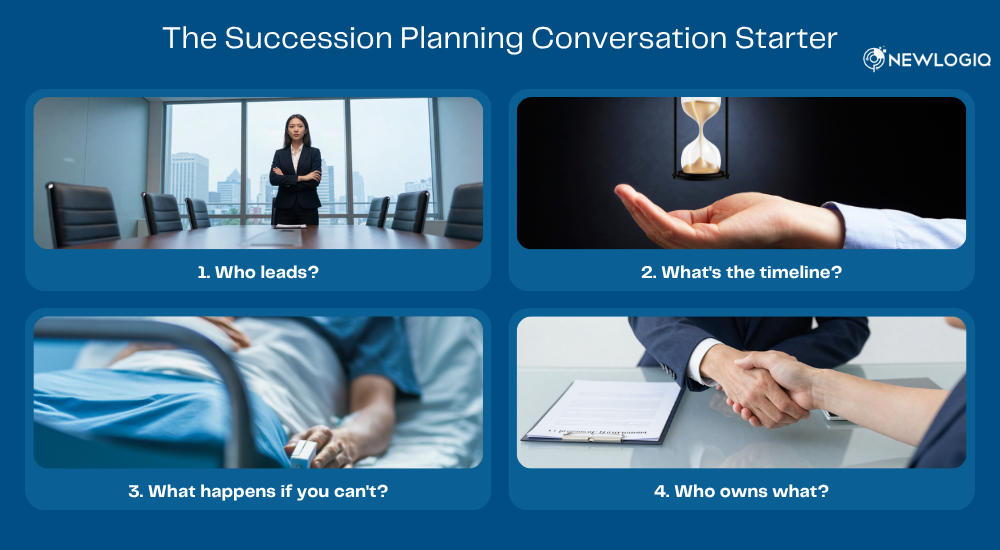
Most people think of succession as one conversation: “Who gets the business?” But that is not a conversation. That is an announcement. Real succession planning is a series of conversations that happen over months and years. Here is the framework I use with clients.

Avoiding this discussion could jeopardize your family's future in business.

1. The Values Conversation

Before you talk about who leads the company, talk about what the company stands for. What does it mean to be a leader here? What do you protect at all costs? What can never be compromised? This conversation grounds everything that follows. It also opens the door for the next generation to contribute to the identity of the business, rather than just inherit it.

2. The Readiness Conversation

This is not about declaring someone ready or not ready. It is about being honest about what readiness looks like and what gaps exist. Tools like the Momentum Lab leadership development framework can help identify where future leaders need to grow. The honest readiness conversation is an act of respect, not judgment. It says: we want you to succeed, and here is what it will take.

3. The Timeline Conversation

Give people a rough roadmap. It does not have to be exact. But saying “I plan to transition leadership responsibility within the next five to seven years” gives everyone a frame to work from. It reduces anxiety for both the current owner and the next generation. It also forces you to start acting accordingly.

4. The Financial Conversation

This is often the most avoided. But the next generation cannot make good decisions without understanding the financial picture. You do not have to share everything at once. But “age-appropriate” financial transparency—shared incrementally as trust and readiness grow—is how you build the capacity for real ownership.

A Framework from the Field: How to Start

I worked with a second-generation owner of a $22M manufacturing business. He had three children, two of whom worked in the company. He knew one of them was the stronger operational leader. He had been avoiding the conversation for four years because he did not want the other to feel overlooked.

We started not with the succession question itself, but with the values and legacy question: “What do you want this business to be in twenty years? What role does each child play in that?” That reframe changed everything. It moved the conversation from “who wins” to “how do we all contribute?”

The child who was not selected as the operational successor ended up taking on a board role and a real estate investment arm. Both felt heard. The succession process was not painless—but it was honest. That is the best you can ask for. For a deeper look at how this connects to your overall growth strategy, consider how succession fits into your long-range plan.

The EOS framework, from Gino Wickman’s Traction, refers to this kind of ownership-level clarity as “getting the right people in the right seats.” Succession is the ultimate version of that. You cannot get the right person in the right seat if you never have the honest conversation about who that person is and whether they are ready.

Make Succession a Rhythm, Not a Crisis

The best succession plans are not documents. They are habits. They are built into quarterly planning conversations, annual leadership reviews, and board discussions. When succession is on the agenda every year, it becomes normal. When it is normal, the conversations get easier. When the conversations get easier, the transitions get smoother.

Half of boards that have them include succession on the agenda at least once a year. If you do not have a board, build the habit another way. A trusted advisor, a peer group like the ones in Newlogiq’s Momentum Lab, or a structured coaching process can give you the external accountability to keep the conversation alive.

Here is the bottom line: your business does not fail because of a bad succession plan. It fails because the conversation never happened. The plan is just paper. The conversation is where the real work gets done.

The Question Worth Asking Today

If something happened to you tomorrow, would your company know what to do? Not the legal documents—would the

If the answer is uncertain, the problem is not your succession plan. The problem is that you have not had the conversation yet. Start there. Not with the attorney. Not with the accountant. With the people who matter.

The best time to have this conversation was ten years ago. The second-best time is today. If you’re ready to start thinking through your succession roadmap, explore more leadership insights on the Newlogiq blog or reach out to schedule a conversation.

Sources & Further Reading

ABA Banking Journal (2026): Survey — Family Businesses Facing a ‘Succession Paradox’

Teamshares: Succession Planning Statistics in 2025

A Practical Guide for Business Owners Who Need Proof Coaching Works

The ROI of Executive Coaching

The ROI of Executive Coaching
The return on executive coaching shows up in behavior first; and business results second.

You hired an executive coach six months ago. You’ve attended monthly sessions. You’ve worked through frameworks. You’ve adjusted some of your leadership habits. But as you sit in your office this morning, you’re asking yourself the question that most business owners ask at this point in their coaching journey: Is this actually working?

Here’s what I’ll tell you. It’s more common than most coaches admit that you feel stuck right now. The changes aren’t dramatic yet. Your revenue hasn’t spiked. Your team hasn’t transformed overnight. And you’re wondering whether you should keep going or cut your losses. The problem is that you’re looking for ROI in the wrong place. And that’s exactly what we need to fix.

Why ROI Is Hard to Measure in Coaching (And Why That’s Not an Excuse)

Let’s be honest. Leadership development is not the same as buying a new piece of equipment. When you install a new software system, you can measure cost savings within weeks. When you hire a new salesperson, you can track their revenue within a quarter. But when you work with a coach to develop as a leader, the improvements follow a different timeline.

The real changes from coaching are lagging indicators. They show up slowly. They compound quietly. And they often feel invisible until suddenly they aren’t. A decision that used to keep you up at night now takes you two hours to make. A conversation with your team that used to feel combative now feels collaborative. You’re delegating work that was keeping you stuck at sixty-hour weeks. None of these changes triggered an instant financial event, but all of them are moving your business forward.

The real trap is that many business owners confuse what’s hard to measure with what’s unmeasurable. There is a massive difference. The soft outcomes of coaching — self-awareness, behavioral change, clearer thinking — absolutely can be measured. You just have to know what to look for.

So here’s my commitment to you. If you work with a coach who doesn’t help you see and measure progress, that coach is failing you. The ROI has to be visible. It might not be obvious, but it has to be there.

The Three Levels Where Coaching Actually Pays Off

Real coaching doesn’t work in a vacuum. It creates a chain reaction. The chain always starts the same way. But most business owners never see the full chain because they’re looking at the wrong level.

Level One is where coaching happens first. This is leader behavior change. How do you communicate? How fast do you make decisions? How do you handle pressure? Do you listen with curiosity or listen to respond? Are you creating psychological safety on your team or fear? These behaviors are the soil where everything else grows. If your leadership behavior doesn’t change, nothing else changes. This is where the first ninety days of coaching happen. You’re building awareness. You’re noticing patterns. You’re experimenting with new ways of showing up.

Level Two is team performance. This is where the behavior changes start to cascade into measurable team outcomes. When you communicate with more clarity and less intensity, your team stops second-guessing your direction and starts executing faster. When you create psychological safety, people bring their ideas instead of hiding them. When you delegate with confidence, people step up. You see this in retention, in engagement scores, in the number of decisions that don’t need your sign-off. This is where months four through nine of coaching show up most clearly. Your team is performing differently because you are leading differently.

Level Three is business results. This is where most business owners start looking for ROI. But if you only look here, you miss the story. By the time your revenue, margin, or growth rate changes, two other levels of change have already happened. You see faster execution. You see better employee retention. You see fewer mistakes because your team is more aligned. All of those things eventually show up on the bottom line. But they show up late. Most coaching engagements hit meaningful business-level ROI somewhere between month nine and month twelve.

The mistake most business owners make is skipping Levels One and Two. They’re fixated on Level Three. They want to see the business results right now. But that’s like checking on a garden every day and being disappointed that the tomatoes aren’t ready to pick. The growth is happening underneath the soil first. You have to let that happen before you see the fruit.

A Simple Scorecard for Tracking Coaching Impact

Here’s what I do with every coaching client. Around month two or three, when the impatience usually starts creeping in, we build a simple scorecard. This scorecard cuts through all the noise. It answers the question you’re really asking: Am I actually different? Is my leadership changing?

The scorecard is straightforward. You ask yourself six questions and rate yourself honestly on a scale of one to ten. Question one: Are you making decisions faster than you used to? Not faster without thinking, but faster with confidence? Question two: How many decisions are escalating to you that didn’t before? Are fewer people bringing you problems that they should be solving themselves? Question three: Is your team more aligned on the direction and priorities of the business? Do they repeat back to you the same three to five things that matter most? Question four: How much of your time are you spending on strategic work versus firefighting? Are you protecting your thinking time, or is your calendar still chaos?

Question five: Do you feel less reactive? Can you pause before you respond to things? And question six: Is your team asking you better questions? Are they taking more initiative? These six questions are the real ROI of coaching. They’re measurable. They’re honest. And they tell you what’s actually changing.

Rate yourself on each question at the start of your coaching. Then check in every ninety days. Watch those numbers move. That’s your ROI. That’s the proof that something is working.

What to Expect in the First 90 Days vs. the First Year

If you’re going to measure coaching ROI honestly, you have to have realistic expectations about timing. The first ninety days feel very different from months nine through twelve. And if you don’t know what to expect, you’ll quit right when the real work is about to pay off.

In the first ninety days, expect discomfort. Your coach is going to hold up a mirror. You’re going to see patterns in your leadership that you didn’t see before. Some of these patterns are helping you. Many of them are limiting you. You’re going to start experimenting with new behaviors. You might feel awkward. You’re going to question whether this is worth the investment. This is normal. This is the work. You’ll notice some small shifts in how people respond to you. You’ll catch yourself pausing instead of reacting. Your awareness is going up faster than your execution. This is supposed to happen.

By month six, the awkwardness starts fading. The new behaviors are becoming more natural. You’re getting feedback from your team that something has shifted. They don’t have words for it yet, but they feel it. You’re making decisions faster. Your team is bringing you fewer problems that they could solve themselves. You’re spending more time thinking about where the business is going and less time putting out fires.

By month twelve, the changes are obvious. Your team is aligned. Execution is crisper. People are staying longer. You’re thinking like a CEO instead of a firefighter. And yes, by now, your business metrics are probably showing movement too. Revenue might be up. Margins might be improving. But more importantly, the trajectory of your business has changed because the trajectory of your leadership has changed.

Here’s the truth about ROI in coaching. I stand behind my work in a way that most coaches don’t. I offer every client I chose to help a short-pay guarantee. If you’re not fully satisfied with your results, you can pay me any amount you believe represents the value you received. If you don’t see the value, you don’t have to pay. I’m that confident the work delivers real impact.

But I can only stand behind that guarantee if you know what to measure. The ROI of coaching isn’t always obvious. But it is always real if you’re working with a coach who knows how to build it. If you want to explore what a year of focused coaching could look like for you and your business, I’d love to talk. Visit Newlogiq to learn more about how we work together.

Why Modern Leaders Need an AI Strategy—Not Just AI Tools

AI Needs to be in Your Leadership Playbook

You hear about artificial intelligence everywhere these days. The conversation is all about what it means for big companies, tech giants, and the jobs of the future. But if you lead a business in the $5 to $50 million dollar range, most of that noise is not your story. The real question is not whether AI will change leadership. It will. The real question is what you do about it right now.

AI Is Not Coming for Your Job — It’s Coming for Your Excuses

Here is what I see with my coaching clients. Most of them spend their days drowning in operational work. They read emails. They synthesize reports. They write the same response to the same question over and over. They sit in meetings trying to figure out what information matters. They do all of this because it feels urgent. It feels like their job.

And it is their job. Partially. The problem is that all of these tactical tasks use up the cognitive real estate that should be reserved for strategic thinking. When you are reading emails, you are not thinking about whether your market is shifting. When you are preparing for a meeting, you are not questioning whether the meeting itself should exist. When you are drafting a response to a supplier problem, you are not stepping back to ask whether that supplier relationship should evolve.

AI removes the excuse. Not overnight. Not magically. But meaningfully. When an AI tool can read through ten months of customer feedback in sixty seconds and hand you the three patterns that actually matter, you have bought back two hours of thinking time. When AI can draft your weekly communication to your team and you spend fifteen minutes refining rather than ninety minutes writing, you have reclaimed your attention. That is the real power of AI for a small business owner. It is not about replacing your judgment. It is about freeing you from the friction that keeps your judgment locked in the basement.

What AI Actually Does for a Leader

Let me be practical about this. AI is not magic, and I do not use it that way. Here is what it genuinely helps you do.

First, AI summarizes complexity. You have sales data, operational metrics, customer feedback, and market signals all coming at you. AI can run through that noise and distill it down to what actually moves the needle. It surfaces patterns you might have felt but not quite articulated. That is decision-making leverage.

Second, AI drafts at speed. Whether you are writing a difficult message to your team, preparing talking points for a board conversation, or outlining a proposal, AI gives you a first draft in seconds. You still make it yours. You still bring judgment to it. But you skip the blank page problem and start from something real. This matters more than you think. It turns writing from a creative act into an editing act, and editing is much faster than creation.

Third, AI runs scenarios faster. You are thinking about a price increase, a market expansion, or a hiring shift. What if we did X instead? AI can model that faster than you can think about it. You still make the decision. But you make it from a place of more information and fewer mental gymnastics.

None of this replaces your wisdom. None of it makes you less important. It makes you less bogged down.

What AI Cannot Replace

Now let me be equally clear about what AI cannot do. And this matters because I see leaders getting nervous about the wrong things.

AI cannot read a room. You have sat in thousands of conversations. You know what silence means. You understand what someone is really asking when they ask something else entirely. You can feel when a person is uncomfortable or excited or checked out. That pattern recognition lives in your body and your experience. AI does not have that. It reads scripts. It processes words. It does not feel the temperature of the moment.

AI cannot build trust. Your team member works harder for you because she knows you care about her growth. Your customer buys from you because he believes you understand his real problem. Your board believes in your vision because they have watched you navigate difficult seasons with integrity. None of that comes from AI. It comes from you. From your consistency. From your judgment. From your willingness to be wrong and learn.

AI cannot set culture. Culture is not a policy. It is not a memo. It is the way you show up, the kind of question you ask in a meeting, the kind of mistake you forgive, the kind of excellence you celebrate. That is human. That is leadership. That cannot be automated or outsourced or generated by a tool.

And that is actually why I think coaching matters more in an AI world, not less. As leaders have access to better tools to handle complexity, the differentiator becomes the quality of your judgment, the clarity of your thinking, and your ability to grow. That is where real leadership development happens.

How to Add an AI Chapter to Your Leadership Playbook

Here is how I recommend you start. Do not try to do everything at once. Do not subscribe to every tool. Do not redesign your entire workflow. That path leads to overwhelm and abandonment.

Instead, pick one thing. Just one. Look at your week. Where do you spend thirty minutes that could be compressed or elevated? Maybe it is weekly communication to your team. Maybe it is meeting prep. Maybe it is drafting an email to a difficult client. Pick that one thing and bring in an AI tool to help.

Use it for a month. Get real with yourself about whether it actually works. Does it save you time? Does it improve the quality of the output? Does it free up mental space for thinking that matters? If the answer is yes, keep it. If the answer is no, drop it. This is not religion. It is pragmatism.

Once you have one AI habit that works, add a second. Now you have reclaimed an hour or more per week. That is real time that you can now spend thinking. And thinking is what separates good leaders from great ones. That is when you rethink your strategy. That is when you notice that a key relationship needs attention. That is when you design your next move instead of just reacting to this week’s crisis.

The point is this. AI is not a magic wand. It is a tool. A good one, but a tool. The real power comes from what you do with the space it creates.

If you are curious about how to sharpen your leadership approach in 2026, I would love to talk about it. Visit Newlogiq to learn more about the coaching programs I offer for small business owners in your range. Or reach out directly. I respond to everyone who gets in touch, and I am always happy to have a conversation about what you are trying to build and where leadership development can help you get there.

What Marshall Goldsmith Teaches CEOs About Sustainable Change

Most CEOs don’t struggle because they’re incapable.

They struggle because they’re successful.

The habits that built the business, decisiveness, control, speed, high standards, are often the same habits that quietly limit the next stage of growth.

Marshall Goldsmith has spent decades coaching executives at the highest levels, and one of his most powerful insights is simple:

“What got you here won’t get you there.”

That phrase hits differently when you’re leading a $5M–$50M company.

Because at that stage, growth isn’t just operational.
It’s personal.

The Hidden Trap of Success

In early stages, the CEO drives everything.

You:

  • Make most of the decisions
  • Carry the strategy in your head
  • Jump in to fix problems
  • Set the pace

That intensity creates traction.

But as the business scales, those same behaviors create friction:

  • Leaders hesitate because you override decisions
  • Meetings slow down because everyone waits for your input
  • Accountability weakens because you rescue instead of coach
  • Strategy stays centralized instead of distributed

Goldsmith calls these “success delusions.”
Not because leaders are arrogant, but because they don’t realize the habits that once helped are now holding them back.

Sustainable Change Is Behavioral, Not Strategic

Most CEOs think growth problems are structural.

New org chart.
New meeting cadence.
New framework.

Those matter.

But Goldsmith’s work reminds us that sustainable change is behavioral.

It shows up in small patterns:

  • Do you listen fully or interrupt?
  • Do you ask for input or jump to the answer?
  • Do you follow up on commitments or assume people will handle it?
  • Do you ask for feedback and actually act on it?

In his coaching methodology, one practice stands out: feedforward.
Instead of analyzing past failures, leaders ask for suggestions on how to improve moving forward.

It shifts energy from defensiveness to progress.

You can explore more of his work here:
👉 https://marshallgoldsmith.com

His thinking has influenced how executive coaching for CEOs is practiced worldwide, especially for leaders transitioning from founder to enterprise builder.

Why This Hits Harder After $5M

Once your company passes $5M, complexity multiplies:

  • More leaders
  • More departments
  • More cross-functional tension
  • More need for CEO leadership team alignment

You can’t rely on force of will anymore.

You need leverage.

And leverage comes from:

  • Clear decision rights
  • Strong accountability systems for leadership teams
  • Organizational clarity for growing companies
  • A business operating system that distributes ownership

But none of those systems work if the CEO hasn’t evolved alongside the company.

That’s the uncomfortable truth.

The CEO Shift Goldsmith Talks About

At its core, Goldsmith’s message to CEOs is this:

You don’t scale by doing more.
You scale by becoming different.

That means:

  • Moving from being the smartest voice in the room to the best question-asker
  • Moving from solving problems to developing leaders
  • Moving from control to clarity
  • Moving from reactive speed to intentional rhythm

It’s not dramatic.
It’s subtle.

And it’s hard, because it requires self-awareness, not just strategy.

Where This Connects to Execution

This is where Goldsmith’s work becomes very practical.

When leadership habits don’t evolve, execution starts to feel heavier. Not because the team isn’t capable, but because alignment begins to erode.

If the CEO:

  • Jumps in too quickly
  • Overrides decisions
  • Fails to clarify ownership
  • Avoids direct feedback

The leadership team adjusts around that behavior.

Decisions slow down.
Accountability softens.
Meetings multiply.

Execution drag is often a leadership signal.

That’s why alignment matters so much at this stage of growth.

If you want to pressure-test how aligned your leadership team really is, this is a good place to start:

👉 The Leadership Team Alignment Test: How Does Yours Score?

Because sustainable change at the top doesn’t just improve culture.
It sharpens execution across the entire company.

Final Thought

Marshall Goldsmith doesn’t teach CEOs how to work harder.

He teaches them how to change, in ways that stick.

Sustainable change is not about intensity.
It’s about awareness, feedback, and deliberate behavioral shifts.

If you’re building a company that needs to scale beyond you, that work becomes essential.

And if this resonates, it’s worth paying attention.

A short conversation often brings clarity.
👉 www.newlogiq.com

The Leadership Team Alignment Test: How Does Yours Score?

Most CEOs can feel it before they can explain it.

The leadership team is smart.
Everyone’s busy.
The business is growing.

And yet… execution feels heavier than it should.

Decisions take longer.
Priorities get reinterpreted.
You find yourself repeating the same conversations.

That’s usually not a talent problem.

It’s an alignment problem.

And alignment is one of those things that’s easy to assume  and hard to measure.

So here’s a simple way to test it.

The Leadership Team Alignment Test

Score each statement from 1 to 5:

1 = Not true
3 = Sometimes true
5 = Consistently true

Be honest. This is for you.

1. We are clear on our top 3 priorities and they don’t change weekly.

If you asked each member of your leadership team what matters most right now, would you get the same answer?

2. Everyone knows who owns the final decision in each major area of the business.

No floating decisions. No quiet veto power. No back-channel overrides.

3. Meetings result in clear decisions and assigned ownership, not just discussion.

When you leave a leadership meeting, is it obvious who is doing what by when?

4. We resolve conflict directly and quickly.

Hard conversations happen in the room, not in the hallway afterward.

5. Our leaders think like owners of the business, not just heads of their function.

Sales doesn’t blame operations. Operations doesn’t blame finance. The team wins and loses together.

6. We revisit strategy regularly and connect it to weekly execution.

There’s a clear rhythm between long-term direction and day-to-day decisions.

7. I, as CEO, do not have to re-align the team after every major conversation.

You’re leading, not constantly translating.

How Did You Score?

30–35:  Your alignment is strong. Execution should feel relatively smooth, even during stress.

20–29:  You’re functional, but friction is costing you speed and energy. This is where most $5M to $50M companies sit.

Below 20: Your team may be working hard, but not truly together. That misalignment will eventually slow growth or strain culture.

Why Alignment Slips As You Grow

In early stages, alignment happens naturally.
Everyone’s close to the founder. Decisions are fast. Context is shared.

But once complexity increases, more leaders, more departments, more moving parts alignment requires structure.

Without:

  • Clear decision rights
  • Defined roles
  • Consistent operating rhythm
  • Real ownership

Execution starts to drag.

That’s when CEOs feel like they’re carrying too much context and spending too much time reconnecting dots.

What High-Performing Teams Do Differently

Strong leadership teams don’t leave alignment to chance.

They:

  • Clarify roles and decision ownership
  • Use structured cadences for strategic and weekly conversations
  • Address friction early
  • Document and reinforce key decisions
  • Align incentives around shared outcomes

Alignment is not a personality trait.
It’s a discipline.

And one of the clearest signs of misalignment is when teams try to solve execution problems by adding more meetings instead of fixing decision clarity and cadence.

We break that down here:
👉 Why “More Meetings” Isn’t the Answer to Execution Problems
https://newlogiq.com/why_more_meetings_isnt_the_answer_to_execution_problems/

Final Thought

If your score was lower than you expected, don’t panic.

Most growing companies hit this stage.
It’s not a sign of failure, it’s a signal that your leadership system needs to evolve.

The real question isn’t whether you have smart people. It’s whether they’re aligned around how the business actually runs.

If this resonates, it’s worth paying attention.

A short conversation often brings surprising clarity.
👉 Visit www.newlogiq.com