Month: April 2026

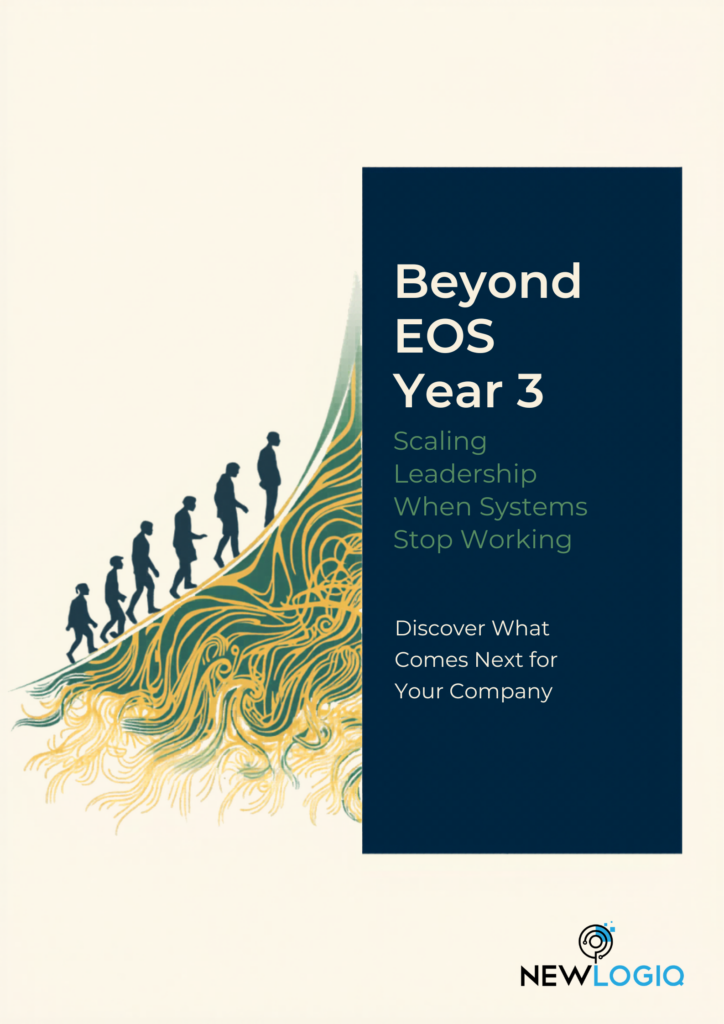
Beyond EOS Year 3: Scaling Leadership When Systems Stop Working

The Conversation Happens Around Year 4

Sarah runs her company with flawless EOS discipline. Level 10 meetings every week. Rocks defined every quarter. The People Analyzer filled out. The Vision/Traction Organizer sitting proudly on her desk.

It worked beautifully for three years.

But last month, she called me with a frustration I’ve heard dozens of times: “We’re still having the same conversations. The issues aren’t changing. And honestly? The system feels like it’s running us instead of us running it.”

She asked the question that signals a deeper problem: “Is there something after EOS?”

Yes. And you probably need it.

The EOS Sweet Spot (And Its Limits)

First, let me be clear: EOS is brilliant. It’s the most effective operating system I’ve seen for taking a chaotic $1-8M company and bringing it structure, alignment, and accountability.

The Level 10 meeting cadence works. The Rocks system creates clarity. The People Analyzer surfaces difficult conversations. The V/TO gives people direction.

For the first 2-3 years, EOS typically delivers:

  • Faster decision-making
  • Clear accountability
  • Reduced chaos
  • Aligned leadership team
  • Measurable business momentum

The problem isn’t that EOS fails. The problem is that success itself reveals the limits.

When you cross $5M, when your leadership team grows beyond 4-5 people, when you move from a single product/market to multiple business units, EOS starts to feel thin.

Not because it’s broken. Because your complexity has outgrown its framework.

The Three Ways the EOS System Plateaus

1. Strategy Stops Being Strategic

The V/TO was designed as a one-page snapshot: your purpose, values, vision, goals. Beautiful simplicity.

But when you need to think about market positioning, competitive differentiation, pricing strategy, revenue model evolution, or geographical expansion, one page isn’t enough. The V/TO starts to feel like it’s in the way rather than clarifying direction.

You find yourself doing strategy work *outside* the system because the system doesn’t have room for it.

2. Leadership Development Becomes Invisible

“Right people, right seats” is excellent shorthand. It pushes you to think about fit. But it doesn’t tell you:

  1. How you’re building future leaders for the next two years
  2. What pipeline you’re creating for your next layer of leadership
  3. How you’re systematically closing gaps between current capability and future needs
  4. How you’re creating true bench strength so you’re not dependent on any single person

You end up with a team that’s organized well but not developing strategically. When someone leaves, you panic because you didn’t build a bench.

3. Financial Strategy Remains Surface-Level

EOS gives you a scorecard. Metrics. Execution discipline. But it doesn’t give you, pricing architecture and margin strategy, cash flow forecasting by business unit or customer segment, capital efficiency metrics, profitability levers and sensitivity analysis or the relationship between revenue growth and profitability.

You can be hitting your numbers and still running low on cash. You can be growing at 30% and destroying profitability. EOS doesn’t catch it because EOS doesn’t go that deep into financial strategy.

If you want to dig deeper into these issues, read a recent post that takes a deep dive on EOS plateau specific framework options.

The Real Problem: Systems vs. Leadership

Here’s what I’ve come to understand: systems take you from chaos to clarity. Leadership takes you from clarity to scale.

EOS is a magnificent system. But it’s a system. Which means it works best when it’s well-designed and well-executed, but it works within limits.

The companies that scale beyond $5-10M don’t do it because their systems improved. They do it because their leadership improved.

That’s the shift that typically happens around Year 3-4 of EOS. You realize: the system is locked in. We’re executing it well. But we’re not leading strategically.

A few examples of what I mean:

Sarah’s Case: EOS got her to $7M. Clean leadership team. Good execution. But at $7M, she realized she needed to make strategic bets:

  • Invest in a new market (risky, might cannibalize existing revenue)
  • Shift pricing model (improves profitability but requires customer re-negotiation)
  • Build a new division (requires new leadership structure)

Her EOS system couldn’t help her think through these choices because they exist outside the one-page vision. She needed a framework for strategic thinking, not just execution discipline.

Marcus’s Case: Marcus had $9M revenue and a 4-person leadership team. All in the right seats. All executing rocks well.

But none of them were ready to step into larger roles when the company needed to expand from 30 to 50 people. He’d optimized for current execution rather than future leadership. By the time he realized the gap, it was painful and expensive.

John’s Case:  John had profit margins that looked good on paper (25%) but cash flow was tight. EOS metrics showed strong progress. But he wasn’t tracking margin by customer segment, wasn’t managing pricing discipline, and had no visibility into cash conversion cycle.

When a big customer went away, the company nearly imploded—not because the loss was that big, but because he’d never developed financial literacy beyond scorecard metrics.

All three of them needed something more than a better-executed system. They needed a different kind of thinking.

What “Leadership Beyond Systems” Looks Like

The next evolution for companies that have maximized EOS typically involves:

1. Strategic Clarity Beyond the Vision Statement

Strategic thinking means:

  • Clear understanding of what makes you different (and defensible)
  • Intentional choices about where not to compete
  • 3-5 year roadmap that’s customer/market driven, not just revenue driven
  • Meaningful diversification strategy (new products? new markets? new customer segments?)
  • Coherent capital allocation across strategic bets

This is the work that the Scaling Up framework handles well. EOS doesn’t have the tools for it.

2. Leadership Bench Building

Not just “right people right seats” but:

  • Intentional talent pipeline for the next 2-3 layers of leadership
  • Development plans for high-potential team members
  • Systematic skill-building in your leadership team
  • Succession planning that’s real, not theoretical
  • Cultural clarity about what “leadership in our company” means

This means moving from a 90-day goal orientation to a multi-year people strategy.

3. Financial Sophistication

Beyond the dashboard and KPIs:

  • Margin analysis by customer, product line, or business unit
  • Cash flow dynamics and capital requirements
  • Profitability drivers and how to optimize them
  • Unit economics for new initiatives
  • Financial modeling for strategic scenarios

When you have this, you stop having vague conversations about “profitability” and start having precise conversations about “which customer segments and products are actually profitable, and which are subsidizing growth?”

4. Execution Across Complexity

EOS meetings work great for a core leadership team of 4-5 people. When you have 8-10 people, or multiple divisions, or matrix accountability, the Level 10 format starts to strain.

You need:

  • Different cadence and format for different organizational layers
  • Cross-functional alignment mechanisms (not just departmental)
  • Cascading goals that actually cascade (and don’t contradict)
  • Innovation budgets and processes for experimental work
  • Risk management frameworks for decisions outside the quarterly cycle

What Happens to Founders Who Push Through

I’ve worked with dozens of founders who’ve successfully navigated the EOS-to-next-phase transition. Here’s what changed:

They Stopped Optimizing for Execution and Started Optimizing for Scale

Early years: How do we execute our plan better?

Next phase: Are we building an organization that can grow beyond our current leadership capacity?

They Built Advisory/Strategic Partners

Usually around Year 4-5, the best scaling companies brought in fractional CFO expertise, strategic advisors, or board-level coaching. Not because something was wrong, but because the complexity required deeper expertise than internal team could provide.

They Separated Strategy from Execution

This is critical. They protected space for strategic thinking—often quarterly or bi-annual strategic off-sites—and separated it from the weekly execution rhythm.

They Invested in Their Own Leadership Development

The founders who broke through realized: the system is only as good as the leader running it. They invested in executive coaching, peer groups, or mastermind groups to develop themselves at the level the next phase required.

The Most Important Question

Here’s the question I ask founders who’ve hit the EOS ceiling:

“What would it look like if your company could grow profitably 10x without you needing to work harder?  100x?”

Most of them can’t answer it because they’ve never thought strategically about it. EOS got them to $5-10M with excellence in execution. But $50M or $500M requires excellence in strategy AND execution.

You need both. EOS gives you execution. But you need something more for strategy.

Your Honest Assessment

If any of these feel true, you might be at the EOS ceiling:

  • You’re executing flawlessly but growth has slowed
  • You have the right people in the right seats, but no clear pipeline for the next level
  • Your metrics are solid but you’re not sure about profitability by customer or product
  • You’ve hit a growth plateau that feels like it’s about your current team’s capacity, not market opportunity
  • You’re running the system, not leading the company
  • Your best people are asking “what’s next for me?” and you don’t have an answer

If three or more of those resonate, it’s time to evolve beyond the system.

What Comes Next

You don’t abandon EOS. Most of the best scaling companies I know keep Level 10 meetings and the Rocks system. Those tools still work.

But you layer on strategic thinking frameworks. You add financial depth. You build leadership development systems. You create strategic planning cadences.

For some companies, that looks like Scaling Up. For others, it’s a custom blend of frameworks. But all of them move from “executing a system” to “leading an organization.”

The Transition

The transition from Year 3 of EOS to Year 4+ of Scaling Up typically takes 6-12 months. Here’s what I usually recommend:

Quarter 1-2: Assess where you are. Is the EOS ceiling real? Are there genuine gaps in strategy, finance, or leadership that the system can’t address?

Quarter 2-3: Introduce new frameworks or tools for the areas where you’ve hit limits. Don’t replace EOS, layer on.

Quarter 3-4: Let it settle. Get comfortable with the new rhythm. See what works. What doesn’t.

Year 2: Refine. Double down on what’s working. Modify what isn’t.

Your Move

If you’re past Year 3 of EOS and something feels off, trust that instinct. It’s not a sign the system failed. It’s a sign you’ve succeeded at the first phase and you’re ready for the next one.

The companies that successfully scale recognize that transition points are normal. What got you to $5M won’t get you to $20M. That’s not failure—that’s growth.

If you’re ready to explore what “beyond EOS” looks like for your company, let’s talk about where you actually are and what’s next.  Schedule a Free Discovery Call. If you want to learn more about the core of Scaling Up and assess your current organization, read this great overview article on the Rockefeller Habits.

The Next Leader Is Already in Your Building. Are You Developing Them?

The Clock Is Already Running

Here is a number that should get your attention: according to Deloitte, 28% of current family business leaders plan to hand over the reins within the next five years. Another 46% of the next generation say they hope to step into executive roles in that same window.

That’s a lot of people moving toward a door. The question is whether anyone is ready to walk through it.

If you run a business between $5M and $50M — especially if it’s a family business — this isn’t a theoretical problem. It’s a right now problem. The businesses that thrive across generations don’t wait until the founder is burned out or the succession is urgent. They build leaders continuously, long before they need them.

Developing next generation leaders in a family business is one of the most complex — and most rewarding — things you can do as a business owner. And most companies are doing it wrong, or not doing it at all.

Why Most Businesses Wait Too Long

Let me describe a pattern I see often. The founder — let’s call him David — has built a solid $15M company over 20 years. His daughter Sarah has been in the business for six years. She’s capable. She works hard. She cares about the company.

But David has never really thought about developing Sarah. He’s been too busy running the business. He assumes that because she’s been around, she’s absorbing what she needs to know. And Sarah has been operating in a kind of leadership limbo — doing important work, but never quite clear on whether she’s being groomed for leadership or just filling a role.

Then something happens. David has a health scare. A key client leaves. The business hits a rough patch. Suddenly the succession question is urgent — and neither David nor Sarah is prepared for the transition.

This isn’t a failure of love or intention. It’s a failure of structure. Most founders are so good at building businesses that they forget to build the people who will eventually run them.

The Real Cost of Not Developing Your Next Leader

According to a 2026 HEC Paris family business survey, 68% of next-generation family members say they’d prefer to “go do something else” rather than take over the family business — largely because they never felt truly prepared or invited into the leadership conversation.

That’s not a statistic about ambition. It’s a statistic about belonging. When people don’t feel developed, they don’t feel valued. And when they don’t feel valued, they leave — sometimes physically, sometimes emotionally, even while staying on the payroll.

On the other side, McKinsey research on family business succession shows that companies with a structured leader development approach significantly outperform those that rely on informal knowledge transfer. The difference isn’t talent — it’s intentionality.

For a deeper look at how leadership gaps affect execution, check out our post on When Your Org Chart Doesn’t Match Reality.

What Good Next-Gen Development Actually Looks Like

The frameworks I use — Scaling Up, EOS, Business Made Simple — all address this, though sometimes under different names. The core idea is the same: you cannot delegate leadership development to chance. It has to be an intentional system.

Good next-gen leadership development has four components that work together over time.

The first is clarity about the destination. Before you can develop someone, you have to be honest about what role they’re being developed for. Not just “running the business someday” — but specifically: What decisions will they make? Who will report to them? What results will they be accountable for? Without that clarity, development is just motion with no direction.

The second is real ownership of real things. The most important teacher for any future leader is experience. That means giving your next-gen leader ownership of a meaningful initiative, team, or strategic project — and then not rescuing them when it gets hard. They need to fail in contained ways, learn from it, and build the confidence that comes from working through difficulty.

The third is consistent feedback and reflection. This is where most founders fall short. They give plenty of feedback in the moment — “you should have handled that differently” — but very little structured reflection. Once a month, at minimum, your next-gen leader should sit down with someone and ask: What am I learning? Where am I growing? What am I still avoiding? That structured reflection is what turns experience into wisdom.

The fourth is exposure to outside thinking. Family businesses have a natural insularity that protects their culture — and also limits their growth. Next-gen leaders need to be exposed to how other organizations think, lead, and solve problems. That might mean peer groups, coaching, industry events, or time spent working somewhere else before joining the family business full-time.

A Note on the Uncomfortable Conversation

Here is the thing that nobody likes to say out loud: not every family member is the right person to lead the business. And one of the most loving things you can do — for your business, for your family, and for the individual — is to have that conversation early, clearly, and kindly.

Patrick Lencioni’s work is useful here. In his framework for healthy teams, one of the core habits is the ability to have difficult, honest conversations without letting them destroy the relationship. In a family business, that skill is even more critical — because the relationships are deeper and the stakes are higher.

If your next-gen candidate is great but needs another three years before they’re ready, say that — and build the plan. If they’re better suited for a different role than CEO, explore that together. If they don’t want the business at all, better to know now than after you’ve made promises neither of you can keep.

We’ve explored this kind of honest leadership conversation in our post on The Courage to Have the Conversation Your Business Needs.

How to Start This Week

You don’t need a complicated succession plan on day one. You need to start the conversation and build the habit. Here are three things you can do this week.

First, name your next potential leader — even if you’re not sure yet. Who in your organization has the most potential to step into greater responsibility? Put a name to it.

Second, schedule a development conversation with that person. Not a performance review. Not a project update. A genuine conversation about where they want to go, what they feel ready for, and where they want to grow.

Third, assign them something meaningful. Give them ownership of one initiative or decision area that stretches them slightly beyond where they are today. Then commit to debriefing with them monthly.

That’s it. Three steps. The rest — the frameworks, the accountability structures, the full leadership development plan — can be built from there.

If you want help building a structured next-gen leadership program for your business, we work with family business owners and CEOs to create exactly that. It’s one of the highest-leverage investments you’ll ever make. For more on building a culture that supports leadership development, read our post on Creating a Learning Culture in Your Small Business.

Is your next leader ready? Let’s find out — and build a plan together. Connect with Jeff at Newlogiq.

Sources & Further Reading

Deloitte: Family Business Succession Planning

HEC Paris: NextGen Family Stories 2026

McKinsey: Passing the Baton — CEO Succession at Family Businesses

Family Business Magazine: 2026 Succession and Governance Priorities

KMCO: 5 Ways to Develop the Rising Generation in Your Family Business (2026)

Five Things AI Will Never Do for Your Business (No Matter How Advanced It Gets)

Everyone is talking about AI. Your inbox is full of tools, your LinkedIn feed is packed with “AI transformed my business” stories, and your competitors are experimenting. If you’re running a $5M–$50M company right now, the pressure to adopt AI is real—and in many cases, the technology genuinely can help you work faster, analyze data better, and streamline operations.

But here’s the thing nobody in the AI sales pitch is telling you. There are five things AI simply cannot do for your business—not today, not in five years, not ever in the way a human leader can. And if you let the excitement of automation make you forget about these five things, you will build a faster business that is emptier, less trusted, and harder to scale than the one you have today.

Let’s be clear-eyed about what AI can’t do. Not to dismiss it. But to keep you focused on what only you can provide.

(Before we get into the five things, make sure you have an actual AI strategy, not just AI tools. Read: Why Modern Leaders Need an AI Strategy—Not Just AI Tools.)

1. AI Cannot Build Trust With Your Team

Trust is built through a thousand small moments. The time you had a hard conversation with a team member who was underperforming and handled it with both honesty and respect. The morning you showed up after a rough quarter and chose to be honest about what went wrong instead of spinning the story. The moment you remembered something personal about someone’s life and asked about it.

AI can draft a thoughtful message. It can remind you of a birthday. It can even simulate empathy in text. But your team is not fooled by a machine. They know the difference between a leader who is present, who listens, who leans in—and an algorithm trying to mimic that. Trust is a human currency. It is earned by humans, over time, through consistent behavior. AI cannot earn it for you.

Research from Fortune and Deloitte published in early 2026 found that leadership teams that rely too heavily on AI-mediated communication are seeing measurable drops in psychological safety and team cohesion. The teams thriving right now are those where leaders are using AI to free up time so they can be more human—not less.

2. AI Cannot Make Values-Based Decisions

Every business eventually faces a decision where the numbers don’t tell you what to do. Do you cut a long-tenured employee who is no longer performing but has given 15 years to the company? Do you walk away from a profitable client who treats your team with disrespect? Do you say no to a growth opportunity that conflicts with what you stand for?

These are not math problems. They are values problems. And AI cannot solve them for you because AI does not have values. It has training data and optimization functions. Those are not the same thing. The most important decisions your company will make—the ones that define your culture and your reputation—require a leader who knows what you stand for, not a model that knows what similar companies have done.

This is one reason why developing your company’s core values is not a decoration exercise. If you’re on the fence about that, the next post in this series on values will be relevant. For now, read about how leadership misalignment often starts here: The Hidden Cost of Leadership Misalignment.

3. AI Cannot Coach Your People Through Hard Times

One of the most consistent findings in executive coaching research is that leaders change their behavior most durably when they are in a real relationship with a real coach—someone who knows their history, sees their blind spots, and holds them accountable not just to their goals but to who they are trying to become.

AI-powered coaching tools are emerging, and some have genuine utility for tracking habits or providing structured feedback. But they cannot do what Marshall Goldsmith describes as the deep behavioral change that comes from genuine human feedback loops. They cannot sit across the table from a CEO who just lost a major client and help that person process what happened, take ownership of their role in it, and rebuild their confidence. They cannot read the room. They cannot feel the weight of the moment.

Coaching your people through hard times—through layoffs, through family business conflict, through leadership transitions—is intrinsicly human work. A hypothetical that resonates with many business owners: imagine a company that automates its employee development program entirely through AI tools. Productivity metrics improve. Retention crashes within a year. People felt processed, not developed. The lesson was expensive.

For a look at how leadership development actually works in a sustained coaching model, see: What High-Performing Leadership Teams Do Differently.

4. AI Cannot Replace Your Contextual Judgment

Contextual judgment is the ability to read a situation in all its complexity—the history of the relationship, the unspoken tensions in the room, the moment in the company’s life cycle, the cultural dynamics on the team—and make a call that is wise given everything you know. Not just everything in the data.

An AI model can analyze five years of financial data and tell you whether a new product line looks profitable on paper. It cannot tell you that your operations manager is stretched too thin and that adding this product line right now will break something important. It cannot tell you that your number-one salesperson’s confidence is fragile after last quarter’s miss and that now is not the time to restructure commissions—even if the spreadsheet says you should.

Researchers at IE Business School in Spain describe contextual judgment as one of the irreplaceable leadership capacities—not because AI lacks data, but because context includes human variables that are not in any dataset. Your judgment, built from years of leading this specific team through these specific challenges, is not something that can be modeled or outsourced.

5. AI Cannot Own Accountability

Accountability in a company flows from human beings who choose to own outcomes. It is a choice—and choices require agency, moral responsibility, and consequence. An AI does not experience consequences. It does not feel the weight of having let someone down. It does not lie awake at night after a bad quarter. It does not show up the next morning with renewed resolve.

When your leadership team is accountable, it is because those leaders have decided that the outcomes of this business matter to them personally. They are not just executing a plan. They are invested. AI can track commitments, send reminders, and flag when targets are missed. But it cannot create accountability in the people who report to you. Only you can do that—through how you lead, how you hold standards, and how you model ownership yourself.

This is precisely why the transition from founder to CEO is such a critical growth moment. The temptation to automate your way around leadership responsibilities is real. But it is a trap. Read: From Founder to CEO: The Hardest Identity Shift No One Warns You About.

What This Means for You

None of this is an argument against using AI. Use it. Use it aggressively. Use it to draft, analyze, automate, and accelerate. Let it handle the work that does not require a human being.

But do not let the efficiency of AI make you lazy about the irreplaceable work of leadership. The five things above—building trust, making values-based decisions, coaching people through hard times, exercising contextual judgment, and owning accountability—these are the things your business needs from you. Not from a model. From you.

According to a March 2026 Fortune investigation citing Deloitte and Wharton researchers, the companies struggling most with AI adoption are not those that moved too slowly—they are the ones that moved so fast they forgot to invest in the human leadership required to make AI implementation work. The technology is not the bottleneck. Leadership is.

So yes, embrace the tools. And then show up more fully as the human leader your company needs. That combination—great tools and great leadership—is what will separate the businesses that thrive in 2026 from those that just look busy.

Your Next Step

Take five minutes this week and ask yourself honestly: am I using AI to enhance my leadership, or am I using it to avoid the harder work of leading? If the honest answer makes you a little uncomfortable, that’s probably the right place to start.

At Newlogiq, we work with business owners and CEOs to build the kind of leadership that technology cannot replace. If you’re ready to develop your team, sharpen your judgment, and build a business that is as human as it is efficient, let’s talk.

—————

Jeff Oskin is the founder of Newlogiq and a Scaling Up and DISCPlus certified coach. He works with $5M–$50M business owners and family businesses to build leadership, create execution systems, and scale with confidence.

Why Most Quarterly Planning Sessions Are a Waste of Time (And What to Do Instead)

It’s the start of Q2. Your team is gathering around the conference table—or on a Zoom call—and everyone has that familiar look. Part hopeful, part exhausted. Last quarter’s Rocks didn’t all get done. The issues list is still full. And somewhere between the PowerPoint slides and the catered lunch, you wonder: Is this session actually going to change anything?

For most $5M–$50M business owners, the honest answer is no. Not because quarterly planning is a bad idea. But because the way most teams run these sessions is broken before the meeting even starts. The problem isn’t commitment. It’s execution. And the difference between a quarterly session that drives real traction and one that just burns a day comes down to a few critical choices.

The good news: those choices are learnable. Let’s dig in.

The 90-Day Rhythm Is Real—But Only If You Take It Seriously

Verne Harnish’s Scaling Up framework and Gino Wickman’s EOS (Entrepreneurial Operating System) both center on the power of 90-day execution cycles—and for good reason. Human beings’ attention spans and energy naturally align to roughly three-month windows. Annual goals are too distant to feel urgent. Monthly reviews don’t give enough runway to build momentum. But 90 days? That’s close enough to feel the pressure and far enough to accomplish something meaningful.

Research from the EOS community confirms that teams operating inside a clear 90-day world consistently outperform those stuck in annual planning mode. Rocks get completed. Accountability sharpens. And teams stay aligned because everyone is executing against the same short-term priorities—not some twelve-month wishlist nobody remembers by March.

(Not sure which framework is right for your business? Read: EOS vs. Scaling Up vs. Business Made Simple: Which One Fits Your Business?)

What Most Teams Get Wrong

Here’s the pattern I see again and again with the business owners I coach. The quarterly session is scheduled. People show up. Someone opens a Google Doc or fires up the slideshow. You review last quarter’s priorities. A few things got done. A few didn’t. Nobody fully explains why. Then you spend forty-five minutes listing new priorities—and call those your “Rocks.”

But they’re not Rocks. They’re wishes. A real Rock, in EOS language, is a specific, measurable outcome that one person owns and that can clearly be marked complete or not complete at the end of the quarter. A wish sounds like “improve marketing.” A Rock sounds like “Launch the updated website by May 31, owned by Sarah.” Those are completely different commitments.

The second mistake is more subtle. Most teams treat the quarterly meeting as a standalone event. They walk in cold, talk fast, and walk out with a list of priorities nobody truly believes in. The meeting becomes a ritual, not a turning point.

The real problem? More meetings without more clarity won’t fix execution. For a deeper look, read: Why ‘More Meetings’ Isn’t the Answer to Execution Problems.

The Pre-Work That Changes Everything

The most effective quarterly sessions I’ve facilitated don’t start at 9:00 a.m. on the day of the meeting. They start two to three weeks before, with structured prep work that every leader completes individually. Here’s what that looks like.

Each leader reviews their personal Rocks from last quarter and honestly scores each one complete or not complete—no “80% done.” They review their weekly measurables (their scorecard numbers). They identify the top issues they want to solve in the coming quarter. And they come in ready to talk about what’s working, what isn’t, and what genuinely needs to change.

When every leader walks into the room having done this work, the conversation is completely different. You spend less time catching up and more time solving. You spend less time debating what’s important and more time committing to it. That’s when quarterly planning becomes a competitive advantage.

What a Great Quarterly Session Actually Looks Like

A great quarterly planning session has four movements. First, you close the last quarter. That means reviewing every Rock (complete or not) with brutal honesty, reviewing your scorecards, and identifying patterns in what’s working and what keeps breaking. No sugarcoating.

Second, you open the new quarter. You revisit your one-year plan and ask: are we still on track? Has anything changed that we need to account for? This is where strategy meets reality.

Third, you set Rocks. Not twenty priorities. Not ten. Between three and seven Rocks per quarter at the company level—and the same for each leader. Less is more here. Trying to move fifteen things forward simultaneously is how nothing actually moves. The discipline of choosing your top three to seven is where most teams fail, and it’s where the best teams win.

Fourth, you clear the Issues List. This is the heart of Gino Wickman’s IDS process: Identify, Discuss, Solve. For each major issue facing the business, the team names it clearly, discusses the root cause honestly, and lands on a clear resolution. Issues that leave the room unresolved are issues that will cost you next quarter.

If accountability is slipping between quarters, there’s usually a clarity problem underneath it. Read: Why Accountability Systems Fail Without Clarity.

How to Know If Your Quarterly Was Worth It

Here’s the test I give every leadership team I work with. After the session, every leader should be able to answer three questions without hesitation. First: What are my Rocks for this quarter and what does ‘done’ look like for each one? Second: What are the three most important things the company is focused on achieving in the next 90 days? Third: What was the most important issue we solved today, and how did we resolve it?

If anyone on your team can’t answer those questions walking out of the room, the session didn’t work. Not because people weren’t in the room. But because the session lacked the structure and discipline needed to create genuine alignment.

Here’s a hypothetical I share with clients. Imagine two companies at the same revenue level. Company A has great people but runs quarterly planning as a loose two-hour all-hands meeting. Company B runs a disciplined full-day session with prep work, real Rocks, and a cleared Issues List. Within a year, Company B consistently outpaces Company A—not because they worked harder, but because they were aligned on what mattered.

High-performing leadership teams have distinct habits beyond just planning sessions. See what else sets them apart: What High-Performing Leadership Teams Do Differently.

The Framework That Makes This Stick

Whether you use EOS, Scaling Up, or Business Made Simple, the underlying principle is the same: great execution requires great rhythm. Quarterly planning is not a box to check. It is the engine that turns your annual goals into 90-day realities.

According to the EOS Quarterly Meeting Guide from EOSWorldwide, the most effective sessions share a common trait: they are treated as sacred time—not a calendar obligation, but a leadership discipline. The structure is respected. The prep work is done. And the team leaves with clarity, commitment, and a short, focused list of what must happen next.

That’s the kind of quarterly planning that doesn’t just fill your calendar. It fills your pipeline, builds your team, and drives your business forward one 90-day sprint at a time.

Your Next Step

If your last quarterly planning session felt like a waste of time, the answer isn’t to skip the next one. The answer is to run it differently. Start with the pre-work. Set real Rocks. Clear your Issues List. And walk out of the room with every leader aligned on what’s next.

If you’d like help facilitating your next quarterly planning session or building a meeting rhythm that actually drives growth, let’s talk. That’s exactly the kind of work we do at Newlogiq.

And if quarterly planning feels hard because you’re still the bottleneck in your business, start here first: How to Stop Being the Bottleneck in Your Own Business.

—————

Jeff Oskin is the founder of Newlogiq and a Scaling Up and DISCPlus certified coach. He works with $5M–$50M business owners and family businesses to build leadership, create execution systems, and scale with confidence.

Your Hiring Problem Isn’t Really a Hiring Problem

You’ve hired the wrong person. Again.

It happens to almost every small business owner at some point. You find someone who seems great in the interview. You bring them on. And then, a few months later, something is clearly off.

So you start over. Another job post. Another round of interviews. Another hire that doesn’t quite work out.

Here’s the hard truth: if this keeps happening, the problem probably isn’t the people you’re hiring. The problem is the system — or lack of one — you’re using to hire them.

Why Small Business Owners Keep Hiring Wrong

SHRM, the Society for Human Resource Management, estimates that a bad hire can cost up to 50-60% of that employee’s annual salary — when you factor in recruiting, training, lost productivity, and starting over. For a small business, that’s not just painful. It can be a real threat to your survival.

But why does it keep happening?

The most common reason: most small business owners hire for skills and fire for culture. They look at a resume and think about what someone can do. They don’t think hard enough about whether this person fits how the business works — and needs to work — going forward.

The Three Root Causes

  1. No clear role definition. If you can’t describe what success looks like in the role after 90 days, you can’t hire for it. Most owners hire on gut feel because the role was never clearly defined in the first place.
  2. No alignment to your core values. If your company doesn’t have written core values — or if you don’t use them in your hiring process — you’re leaving culture to chance. Patrick Lencioni makes this point clearly in The Advantage: a team that’s not aligned on values will always struggle, no matter how talented the individuals are.
  3. You’re hiring to fill pain, not to build strength. When someone critical leaves, the pressure to fill the seat fast is real. That pressure causes you to lower your standards. You hire the best of a bad batch instead of waiting for the right person.

What a Better Hiring Process Looks Like

You don’t need an HR department to hire well. You need a process. Here is a simple one to start with:

Write a one-page role scorecard before you post the job. Define the top three outcomes the person must achieve in their first 90 days. Make those outcomes — not the job duties — the center of every interview.

Add one values-based question to every interview. Ask the candidate to describe a time they had to make a hard call when no one was watching. Their answer will tell you more about their character than their entire resume.

Slow down when you feel the most pressure to go fast. If you catch yourself saying “good enough” during a hiring process, stop. That is your signal to pause, not push forward.

The Bigger Picture: Leadership Comes First

Hiring problems are often symptoms of a deeper leadership challenge. When a team doesn’t have clarity — about goals, about roles, about what is and isn’t acceptable — the wrong people feel comfortable staying and the right people feel uncomfortable leaving. We explore this more in What Your Team Needs From You as a Leader.

And if you’ve been losing good people before you’ve had a real chance to help them succeed, it’s worth reading If Your Team Isn’t Pushing Back, You Have a Problem. Psychological safety and hiring are more connected than most owners realize.

One Last Thing

You can’t build a great business with the wrong team. But you also can’t build a great team without a clear picture of what great looks like.

That clarity — about roles, about culture, about what you actually need — is work that starts with you, not with your next hire.

Take the time to build the process. It will save you more money — and more headaches — than any single hire ever could.

────────────────────────────────────

Jeff Oskin is a Scaling Up certified coach who helps small and family-owned businesses hire better, lead better, and grow with purpose. Learn more at newlogiq.com.