Month: June 2026

The Conversation You Keep Avoiding Could Cost Your Family Business Everything

There is a conversation happening — or more accurately, not happening — inside thousands of family businesses right now. It is the succession planning conversation. And if you are like most owners I work with, you have been putting it off for reasons that feel completely valid: the timing isn’t right, the kids aren’t ready, you’re not sure you even want to retire, and besides, the business needs you too much right now.
Here is the uncomfortable truth: that conversation is the single most important leadership act you will ever perform as the owner of a family business. And the longer you delay it, the more expensive the silence becomes.

Recent data from a Newswire succession planning report confirms what I see with my clients every week: nearly 2.7 million U.S. businesses are owned by baby boomers, yet fewer than half have a formal succession plan in place. Of those who do have a plan, less than half — only 43% — are actually satisfied with it. This is not a planning problem. It is a conversation problem.

Why Smart Owners Avoid This Conversation

I want to be clear: the owners who avoid succession conversations are not lazy or irresponsible. In most cases, they are the hardest-working people I know. They built something real, often from nothing, and the business is deeply personal to them. That is exactly why the conversation is so hard.

When you built the business, you were in control. Succession planning requires you to imagine a version of the company that runs without you — and for many owners, that feels like imagining their own irrelevance. It is emotionally complex, and no one teaches you how to do it.

The data backs this up: 63% of business owners say it’s “too early” to begin succession planning, and 45% say they are just “too busy.” Meanwhile, only 19% of boomer owners have actually started the exit planning process. That is a ticking clock for a lot of families, and a lot of employees who depend on those businesses for their livelihood.

What the Conversation Is Actually About

Let me reframe succession planning for you, because most owners think of it as an exit event. It is not. It is a leadership development process. It is about building the systems, people, and clarity that make your business valuable — whether you sell it, pass it to your kids, or continue to lead it for another decade.

When I work with family business owners using the Scaling Up and EOS frameworks, succession planning comes up naturally because both systems ask a fundamental question: does your business run without you? If the answer is no, you have a leadership gap, not just a succession gap.

This is related to something I write about often — the challenge of why delegation fails in growing companies. Most owners who struggle with succession are also the ones who struggle to let go day-to-day. These are the same problem wearing different clothes.

The Four Questions That Start the Conversation

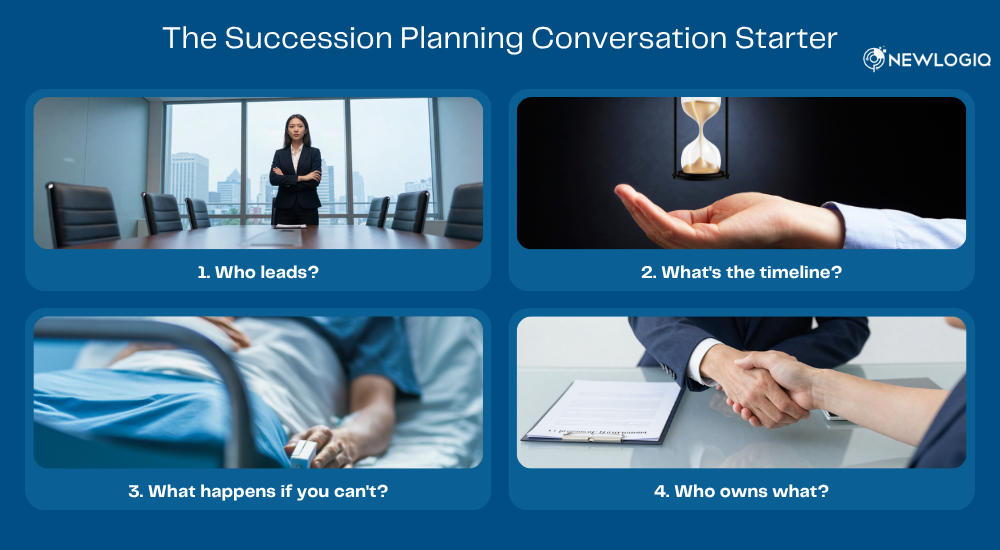
You do not need a lawyer or a financial advisor to have the first succession conversation. You need a quiet afternoon and the willingness to sit with four uncomfortable questions. I call these the Succession Starter Questions, and I use them with every family business client I coach.

Question 1: Who leads when you step back?

Not “who do you want it to be,” but who is actually ready right now. This is the hardest question for most family business owners because the honest answer often reveals a capability gap you have been looking past. That is useful information, not bad news.

Question 2: What is the timeline?

Even a rough timeline changes everything. Experts consistently note that succession transitions take five to ten years, not the two that most owners assume. If you think you have time, you probably have less than you think. Naming even a loose horizon — “I want to be stepping back significantly by the time I’m 65” — creates accountability.

Question 3: What happens if you cannot lead tomorrow?

This is the one nobody wants to ask. Illness, accident, sudden burnout — any of these can happen without warning. The business that cannot answer this question is fragile by design. You would not build a product without a contingency plan. Do not build a company that way either.

Question 4: Who owns what, and when?

Ownership and leadership are different things, and confusing them is one of the most common and costly mistakes in family businesses. A child can work in the business without owning it. A non-family leader can run the company without being an equity partner. Getting clear on this distinction early prevents a lot of conflict later.

Having the Conversation With Your Family

Once you have sat with those four questions yourself, the next step is to have the conversation with the people it affects. That means your family. It means your key leadership team. And it means being willing to hear perspectives that might surprise you.

I recommend scheduling a dedicated family meeting — not at a holiday dinner, not as a side conversation after a board meeting. A real, dedicated conversation where the only agenda is the future of the business. Come with your honest answers to the four questions above, and open the meeting by saying clearly: “I want to make sure this business is in good hands when I step back, and I want to start talking about it together.

Patrick Lencioni’s work on organizational health reminds us that the absence of trust is the root of most team dysfunction — and family business succession is no different. The families that navigate succession well are the ones where people can say the hard things out loud. The families that struggle are the ones where everyone assumes they know what everyone else wants, without ever asking. This connects directly to the CEO loneliness challenge that so many business owners experience: the cost of not having real conversations with the people closest to you.

Building the Plan: What Comes After the Conversation

Once the conversation has started, you can begin building an actual succession plan. In my coaching practice, I use a phased approach that mirrors the quarterly Rocks framework from EOS: we identify the two or three most critical succession-related priorities each quarter and make steady progress without trying to solve everything at once.

This is also a good time to think hard about your leadership structure. Many family business owners who are working on succession realize they need someone to run day-to-day operations so they can focus on strategy and transition. If you have been wondering whether now is the time for that conversation, my post on when to hire a COO walks through exactly how to make that decision.

A solid succession plan has four components: a clear leadership development roadmap for your potential successor, an ownership transition structure (including any tax and legal considerations), documented operating systems so the business can run on process instead of personality, and a personal financial plan for you as the owner so you understand what you need from the transition.

That last piece matters more than most people realize. One of the reasons owners delay succession planning is that they are not sure what life looks like on the other side. If you are making decisions from a place of decision fatigue without a clear picture of your own next chapter, the whole process feels like giving something up rather than building toward something. Reframe it. Succession planning is not the end of your story. It is how you make sure the business story continues.

The Cost of Continued Silence

Here is people tell every client who tells me they are not ready to have this conversation yet: your silence has a price tag. Businesses without succession plans sell for less, because buyers price in the risk of leadership dependency. Families without succession conversations end up in court at a higher rate than those who plan. And employees — especially your best ones — start to look elsewhere when they cannot see a stable future for the company they work for.

The statistics on family business succession are stark. Research shows 70% of family businesses do not survive to the second generation, and 90% do not make it to the third. This is not inevitable. It is largely the result of the conversation that never happened.

According to Project Equity’s business owner exit research, less than one in five boomer business owners has started any form of exit planning. If you are reading this and realizing that describes you, you are not behind — you are right on time. The best moment to start was ten years ago. The second best moment is now.

Start Here

If you take nothing else from this post, take this: the succession planning conversation is not a formal event. It does not require lawyers and accountants in the room. It starts with you sitting across from the people who matter most to your business and saying: “I want to talk about the future. Can we do that?

That sentence costs nothing. And it might be the most valuable thing you do this year.

If you are a family business owner working through succession and want a thinking partner to help you structure the conversation and build a plan that actually sticks, I would be glad to talk. Reach out through the Contact Us page at Newlogiq.com. This is exactly the kind of work I do.

Stop Being the Ceiling of Your Own Company: When to Hire a COO

There is a specific moment most business owners remember, even if they can’t name it. Revenue was climbing. The team was growing. Everything felt like momentum. Then something shifted. Decisions that should take an hour started taking days. You found yourself in conversations you used to delegate. Emails that weren’t yours to answer somehow ended up in your inbox. The business kept calling for your attention, and your attention kept running out.

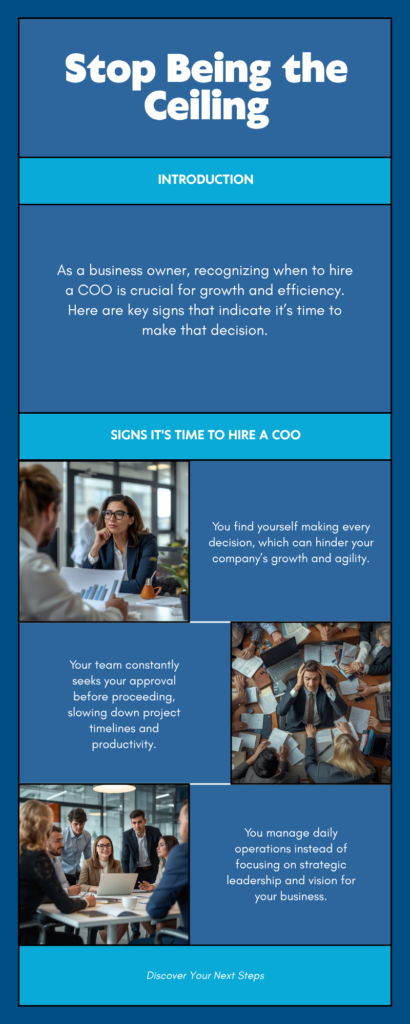
If this sounds familiar, here is the truth most coaches won’t say out loud: the problem isn’t your team, your market, or your systems. The problem is you. Not because you are doing something wrong — but because you have outgrown your own role, and no one has stepped in to run the business while you lead it.

This is the question a lot of growing business owners are afraid to ask right now: is it time to hire a COO?

You’re Not the Only One Asking This

LinkedIn is flooded right now with posts from founders and CEOs who are exhausted. Not exhausted from lack of passion. Exhausted from carrying too much of the operational load. A 2026 survey found that 34% of entrepreneurs experience burnout, and research shows that when key decisions get stuck at the top, companies can lose up to 30% of their growth potential. The numbers match what I hear from clients every single week: ‘I’m the only one who can handle this’ has quietly become ‘I’m the only one handling everything.’

This is what happens when you scale a business without scaling your leadership structure. Your company grows past what one person can hold. But nobody tells you what to do next. And so you keep doing what got you here — which, by the way, is exactly what will keep you stuck.

You’re a Visionary. That’s the Problem.

In the EOS (Entrepreneurial Operating System) framework, every company has two critical roles: the Visionary and the Integrator. The Visionary is the founder — the idea generator, the culture keeper, the relationship builder. The Integrator is the operator — the person who executes the plan, manages the team, and makes sure things actually get done.

Here’s what is surprising: research from EOS Worldwide shows that only about 4% of the population are true Visionaries, and just 1% are natural Integrators. And only 5% of Visionary entrepreneurs can effectively do both roles at once. If you have been trying to be both the Visionary and the Integrator in your business, you are not failing — you are just fighting against your own design.

A COO (or Integrator, in EOS language) is the person who runs the business so you can lead it. They handle the day-to-day decisions. They own the execution. They give you back the mental space to do what you actually do best. We explored this same tension in our post on CEO decision fatigue — when every decision lands on your desk, the cost isn’t just time. It’s capacity. And capacity, once gone, does not come back on its own.

Signs It’s Time

You don’t need a specific revenue number or a headcount threshold to know you are ready for a COO. You need honest answers to a few simple questions.

Are you doing work that someone else could be doing? Are decisions slowing down because they have to go through you? Is your team waiting on you to move forward? Do you end your week feeling like you managed the business instead of led it? Has your calendar become a graveyard of operational fire drills that have nothing to do with the future of the company?

If you answered yes to most of those, you have become what scaling experts call the bottleneck. Not because you are bad at your job. Because you have been doing two jobs — and the business has outgrown that arrangement.

This is also closely tied to the delegation problem. As we wrote in Why Delegation Really Fails, the real barrier isn’t that you don’t trust your team — it’s that you don’t have the right leadership structure to support what you’re trying to hand off. Without someone in an operator role, delegation often stalls because there’s no one accountable for making it stick.

What a COO Actually Does (And What They Don’t)

A lot of owners think hiring a COO means giving up control. That is the wrong mental model. A great COO doesn’t replace your judgment — they extend it. They translate your vision into action. They run the weekly leadership meetings. They hold team members accountable to goals. They handle the decisions that drain you without adding strategic value. And they flag the decisions that actually need you.

In practical terms, a COO in a $5M-$50M company usually owns internal operations, team performance, cross-functional coordination, and the execution of your quarterly priorities. Your job doesn’t disappear — it gets cleaner. You go back to building relationships, setting direction, making big bets, and staying out of the weeds.

If you’ve been wondering what great execution looks like with the right operational leader in place, this post on quarterly planning walks through what that rhythm can look like when there is someone accountable for making sure it actually happens — not just that it gets discussed.

The Financial Case Is Stronger Than You Think

The most common objection I hear is cost. A COO is not cheap. But here is the calculation most people skip: what is the cost of not hiring one? If decisions are slow, if team members are stuck waiting for you, if good opportunities are passing by because you are too buried to act on them — that is already costing you. Research suggests that CEO bottlenecks can reduce productivity by 26%. On a $10 million company, that is $2.6 million of unrealized value sitting there waiting for you to do something about it.

The right COO doesn’t cost you money. They make you money by making your business faster, more accountable, and less dependent on you for every single call. That is the return on investment most owners never bother to calculate before they decide they can’t afford it.

Think about it this way. If hiring a COO at $150,000 per year allows your company to make even 10% better decisions on revenue-generating activities, what does that mean on a $5 million business? The math is not complicated. The fear of the number is what makes it feel that way.

How to Think About the Timing

You don’t need to have everything figured out before you make this hire. You need three things: a clear sense of what you want to hand off, a company big enough to support an executive-level addition (or a fractional arrangement to start), and enough trust in yourself to stay in your lane once someone else is running operations.

If you are not sure you are ready to fully hire, fractional COOs — part-time operators who work across multiple companies — have become a much more accessible option for growing businesses in 2026. You can start there, learn what you actually need, and scale the role over time.

If you are running a growing company and feeling like the loneliest, most overloaded person in the building, that feeling is worth paying attention to. We wrote about the isolation that comes with the CEO role — and hiring a great second-in-command doesn’t just fix the operational problem. It changes who you get to be at work. That matters more than most people admit.

The Question Isn’t If. It’s When.

Most growing business owners wait too long to make this hire. They wait until they are completely burned out. Until the business has stalled. Until they have lost good people who needed leadership they couldn’t provide. Do not wait that long.

Ask yourself one question. If your business is going to be twice the size it is today in three years, can you run it alone? If the answer is no — and for most of you, it is — then now is exactly the right time to start planning for this hire.

You built something worth protecting. Make sure you have the structure to take it where it deserves to go.

About the Author

Jeff Oskin is the founder of Newlogiq and a Scaling Up Certified Coach and DISCPlus Certified Coach who works with $5M-$100M business owners to help them grow, scale, and build companies that work without them. Learn more at newlogiq.com.

The AI Advantage: What Smart Business Owners Are Doing Differently in 2026

Here is a number worth sitting with: according to PwC’s 2026 AI Performance Study, 74% of the economic value created by AI is being captured by just 20% of companies. Everyone else is experimenting, spending, and hoping—but not winning.

If you run a business between $5 million and $50 million in revenue, you are almost certainly somewhere in the middle of this picture. You have probably adopted a few AI tools. Your team may be using ChatGPT for content or email drafts. You might be exploring automation in your operations. But the results have felt scattered. Helpful in spots, but not transformational.

That gap—between the companies AI is helping a little and the companies AI is genuinely accelerating—is not about technology. It is about leadership and process. Specifically, it is about how the owner is thinking about AI’s role in the business and how to transform business processes.

The Mistake Most Business Owners Are Making

The most common mistake I see is treating AI like a tool rather than a strategy. Business owners hand it to individual team members and say, ‘figure out how to use this.’ A few people do. Most do not. And the business captures a fraction of the possible value.

The companies in that top 20% are doing something different. According to IBM’s 2026 CEO Study, the CEOs of high-performing AI organizations are spending more than eight hours per week personally learning and directing AI adoption. They are not delegating the thinking. They are leading it.

That does not mean you need to become a technologist. It means you need to understand enough about what AI can and cannot do to make smart decisions about where it belongs in your business model. That is a leadership challenge, not a technical one.

Where AI Actually Creates Value for Your Size Business

For businesses in the $5M–$50M range, AI creates the most immediate value in three areas.

The first is decision support. Your instincts are valuable. But they are also shaped by what you have already experienced. AI can surface patterns across data that you would never have the time to analyze manually—customer behavior, pricing sensitivity, hiring patterns, operational bottlenecks. Used well, it does not replace your judgment. It improves the inputs your judgment is working from.

This is especially important if you are struggling with decision fatigue. When every decision flows through one person—you—the quality of those decisions erodes over time. AI does not eliminate that problem, but it can significantly reduce the cognitive load on the decisions that matter least, freeing you to think clearly about the ones that matter most.

The second area is operations. Scheduling, invoicing, inventory alerts, customer follow-up sequences, HR onboarding flows—these are the processes that consume enormous amounts of time in a $5M or $20M business, and they are also the processes most ready to be automated. The businesses capturing real AI value have mapped their operational workflows and systematically identified where a human is not actually required.

The third is marketing and content. This is where most business owners start, and they are right to. AI has become genuinely excellent at helping small businesses produce the volume of content, outreach, and follow-up that used to require a much larger team. The caveat: AI can produce the volume, but you still need to bring the voice. Content that converts is content that sounds like you, not like a machine.

The Leadership Question AI Cannot Answer

Here is the thing about AI that does not get discussed enough: it is extraordinarily good at executing on clarity and extraordinarily bad at creating it. If you do not have a clear strategy, a clear ideal customer, and a clear set of priorities, AI will help you pursue the wrong things faster. This is one of the core challenges I see in the shift from founder to CEO. Early-stage business owners often have strategic ambiguity baked into how they operate. That ambiguity was survivable when everything was slower. With AI accelerating execution, the cost of strategic confusion goes up significantly.

This is why the business owners getting the most out of AI are typically also the ones who have done the hardest leadership work: clarifying what they are building, who they serve, and what they are not going to do. AI does not make strategy less important. It makes it more important.

What the Winning 20% Have in Common

Based on the research and what I observe in my coaching work, the business owners capturing real value from AI share a few consistent traits. They treat AI adoption as a leadership initiative, not an IT initiative. They have identified two or three high-value use cases and gone deep on those rather than spreading AI thinly across everything. And they have built their teams’ capacity to work with AI—not just given people access to tools. This connects directly to what high-performing leadership teams do differently: they align on strategy first, then build the systems to execute it. AI is no different.

The 80% who are not capturing AI’s value are not failing because they lack the tools. They are failing because they have not made the leadership decisions that allow the tools to deliver. They are implementing before they have clarity. They are delegating the thinking before they have done it themselves.

A Practical Starting Point

If you want to close the gap between where you are and where the top performers are, start with one question: what is the highest-cost, lowest-judgment activity in your business right now?

Highest-cost means it consumes significant time from you or your team. Lowest-judgment means it does not require deep expertise or relationship—it is mostly process. That intersection is your best first AI opportunity. Fix it there. Learn from it. Then move to the next one.

If you want a more structured approach, this framework for evaluating the ROI of strategic investments applies directly to how you should be thinking about AI adoption. The discipline is the same: be clear about what you are trying to achieve, measure what changes, and do not mistake activity for progress.

AI is not going to make leadership easier. It is going to make strategic clarity more valuable. The business owners who win the next decade will be the ones who used this moment not just to adopt better tools, but to become sharper, clearer, more deliberate leaders. That is the advantage the top 20% already have. And it is available to you.

So What’s Next?

If you know you need to be doing something with AI, but aren’t sure what or where to start, the Newlogiq AI Assessment is worth exploring.  It is a structured 6-week package that includes education, an assessment of your current operations and a detailed 4-6 item roadmap with a guaranteed ROI that you can adopt.  It is a great starting point for owners and leaders of $5-$100M businesses.  Contact us today to learn more.