
The Loneliest Role in Your Company Is Yours
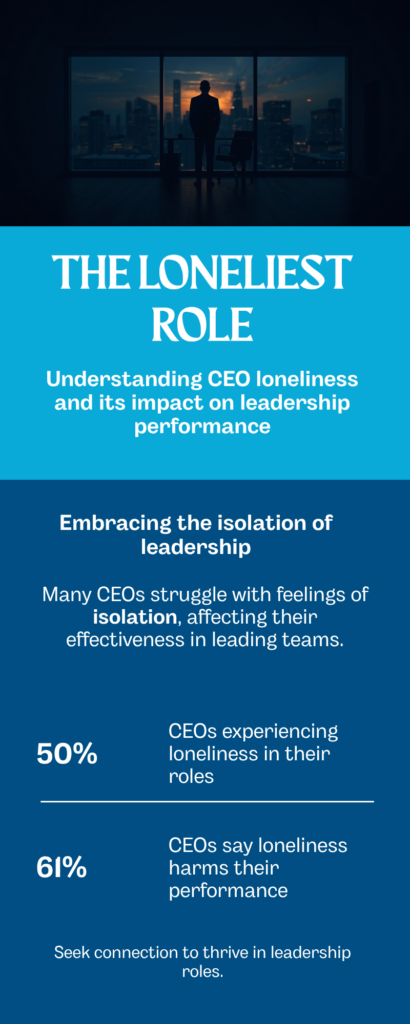
Let me be clear about something: CEO loneliness is not a character flaw. It is a design problem. The role itself creates isolation. You hold information your team cannot know — about finances, about future plans, about personnel decisions. You cannot be fully honest with employees because you are their employer. You cannot be fully vulnerable with your spouse or partner because it is not fair to put that weight on them. You cannot be fully candid with peers at other companies because they are your competition.
Inside your own organization, nobody truly occupies the same seat as you. And that is exactly what makes it so hard. Research published in the Workplace Journal shows that the cost of isolated leadership shows up in slower decision-making, lower creativity, and reduced performance across the entire company. This is not a soft problem. It is a hard business problem. If you have been noticing that your decisions feel harder than they used to, you may want to read about CEO decision fatigue — because loneliness and fatigue are often running together.
The Family Business Layer
If you run a family business, the isolation runs even deeper. You carry the emotional weight of family relationships alongside the business pressures. The conversation about whether your son is ready for more responsibility, or whether your co-founder sister is underperforming, is not one you can have with your executive team. Those conversations live somewhere between ‘business decision’ and ‘Thanksgiving dinner,’ and most family business owners navigate that territory completely alone.
Patrick Lencioni has written extensively about what happens to teams when the top leader stops being honest. When the CEO cannot process their own anxiety and doubt out loud, it filters down. The team senses it. They become cautious. They stop pushing back. If your team is staying silent when they should be speaking up, that dynamic is worth examining closely. The business begins to feel the effects in ways that show up in the numbers long before they appear in any conversation.
The Real Cost Lives in Your Decisions
Here is where CEO loneliness gets expensive. Isolated CEOs make worse decisions. Not because they are bad at their jobs, but because good decision-making requires a sounding board. It requires someone who can say ‘have you thought about this from a different angle?’ or ‘I think you are too close to this one.’
Without that voice, CEOs tend to do one of two things. They either overthink — spinning in circles on a decision that should take an hour — or they under-deliberate, making impulsive calls because the weight of evaluating every option has become unbearable. Research from Vistage shows that CEOs who engage regularly with peer groups outperform those who go it alone, achieving faster growth and higher profits than industry averages. This same pattern shows up in what happens to leaders who try to scale without the right support structure. Isolated leadership is expensive leadership.
What Marshall Goldsmith Would Tell You
Marshall Goldsmith is one of the most respected executive coaches in the world. His core teaching is simple: the behaviors that got you to the top are often the same behaviors that will limit your growth from here. One of those behaviors is the belief that you should be able to figure it all out alone.
For many high-achieving business owners, asking for help feels like weakness. The identity of ‘the one who has the answers’ is deeply embedded. And yet Goldsmith’s research consistently shows that the best leaders are not the ones who know the most — they are the ones who are most coachable, most willing to seek perspective outside their own head, and most able to separate their ego from their decisions. CEO loneliness often masks a belief that you should not need anyone. That belief is one of the most expensive myths in business. The shift from founder to CEO requires letting go of the ‘I carry it alone’ identity, and that transition is one of the hardest identity shifts leaders face.
Three Practical Ways to Break the Cycle
So what do you actually do with this? Three things.
First, find a real peer group. Not a networking event. Not a chamber of commerce happy hour. A structured group of other CEOs who meet regularly, share real numbers, and hold each other accountable. Organizations like Vistage, YPO, and The Alternative Board exist precisely because this problem is universal. The return on investing time with people who actually understand what you carry is hard to quantify and nearly impossible to overstate.
Second, get a coach. Not because you are broken, but because you need someone in your corner who is not on your payroll and does not have a stake in your decisions. A great coach creates the space to think out loud — to question your assumptions, process the decisions that weigh on you at 2 a.m., and get honest feedback without burdening the people around you. The research on coaching ROI is compelling, but more than that, the leaders I have worked with consistently describe it as the best investment they made in their business.
Third, create structured moments of honesty inside your company. Lencioni’s model, the Five Dysfunctions of a Team, starts with trust — and trust starts at the top. When the CEO models vulnerability and candor, the whole culture shifts. This does not mean oversharing. It means being willing to say ‘I do not have all the answers, and I am going to need your help on this one.’ That single sentence can change the energy in a room and signal to your team that it is safe to be honest with you too.
You Are Not Alone in Feeling Alone
CEO loneliness is trending on LinkedIn right now because people are tired of pretending. Business owners at every level are recognizing that isolation is a choice, not a built-in feature of the role. According to recent research, over 70% of incoming CEOs report feeling lonelier when they take on new responsibilities — and 25% of younger leaders say isolation is a frequent reality, not an occasional one.
If you have been carrying this weight alone, that is worth examining. Not because something is wrong with you. Because something better is available. You built a company. You can also build the support system that makes leading it sustainable. If you are a business owner running a $5M–$50M company and this resonates, learn more about how Newlogiq works with business owners like you. The first conversation is always free.