Stop Winging Q3: What a Real Quarterly Planning Session Looks Like for Growing Companies
Q2 ends in about five weeks. That means Q3 is coming whether you are ready or not. And right now, LinkedIn is full of business owners and executives talking about something that does not get enough airtime: the gap between having a strategy and actually executing one. It is a gap that shows up most painfully at the start of every new quarter.
Here is the hard truth: most business owners in the $5M to $50M range do not have a real quarterly planning process. They have a quarterly meeting. Those are not the same thing.
The Meeting That Masquerades as Planning
You have probably been in this meeting. Eight to ten people around a table. Someone pulls up a slide deck from the previous quarter and walks through what was on the list. Half the items are done. A few are partially done. A handful got quietly pushed to this quarter — or just disappeared. Nobody mentions the disappearing items.
Then the leader goes around the room asking each person what they are going to focus on for the next 90 days. Everyone calls out three to five things. Someone writes them down in a spreadsheet or maybe a project management tool that only one person looks at. The meeting ends and everyone goes back to their desks feeling mildly optimistic.
This is not planning. This is calendar theater.
Research from Rhythm Systems, one of the leading execution strategy firms for mid-market companies, confirms that most growing companies do not fail at strategy. They fail at execution — and that failure is quiet and cumulative. Goals get announced, but tradeoffs get deferred. Initiatives launch, but nobody truly owns them. Metrics exist, but they show up too late. Meetings fill calendars, but the same problems keep coming up. This is the pattern that keeps good companies stuck. Recognizing it is the first step. (Source: Rhythm Systems — Quarterly Planning Best Practices)
What Verne Harnish Got Right About 90 Days
In Scaling Up, Verne Harnish teaches that a company moves forward in 90-day sprints. Not a fiscal year. Not a three-year plan. Ninety days. The reason is simple: human beings are not wired to sustain focus for twelve months at a stretch. But most people can hold three to five priorities in mind for about 90 days if those priorities are clear and the team is aligned around them.
Harnish borrowed the concept of “Rocks” from Stephen Covey — the idea that before you fill a jar with sand and small pebbles, you need to drop in the big rocks first or they will never fit. In Scaling Up, Rocks are the three to five most important things that must get done this quarter. Not the top twenty things you wish would happen. The three to five non-negotiables. If everything else falls away and only the Rocks get done, the quarter is a success.
EOS — the Entrepreneurial Operating System — uses the same language and the same logic. So does the Business Made Simple framework. These systems are not identical, but they all arrive at the same conclusion: execution without a clear 90-day rhythm is execution in name only.
The business owners I work with who struggle most with execution are not the ones who lack ambition. They are the ones who carry too many priorities at once. When everything is a priority, nothing is. And when nothing is a priority, CEO decision fatigue sets in — that slow draining of mental energy that makes every decision feel heavier than it should.
What a Real Quarterly Planning Session Actually Looks Like
A proper quarterly planning session is not a three-hour meeting. It is a half-day to full-day event, held off-site if possible, with the senior leadership team and no laptops open for email. It follows a structure. It is not a brainstorm.
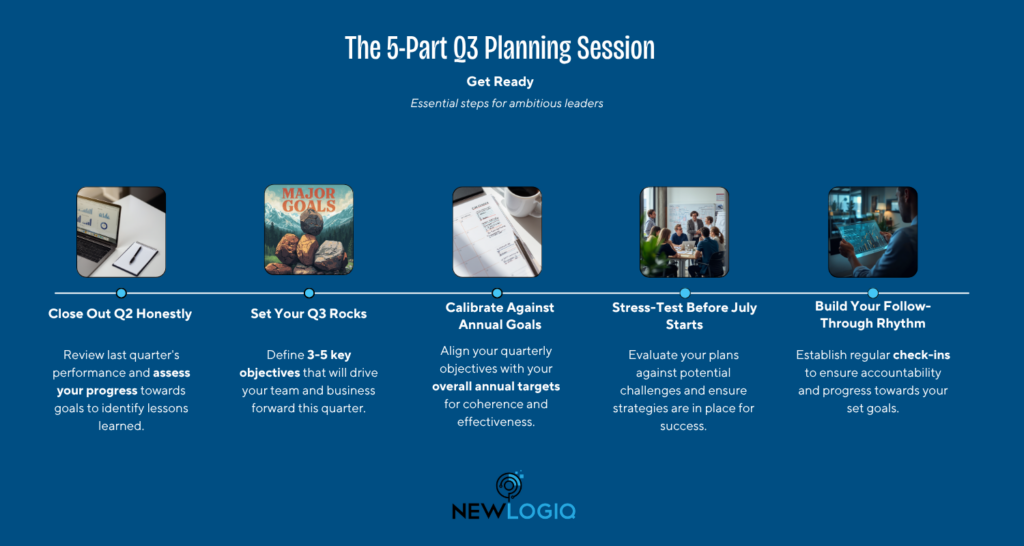
The agenda covers five things. First, you close out the last quarter honestly. You look at the Rocks from Q2. Which ones are done? Which ones slipped? And critically — why? This is not a blame exercise. It is a learning exercise. If the same Rock keeps getting pushed to next quarter, you either have a clarity problem, a capacity problem, or a commitment problem. All three have different solutions.
Second, you calibrate against your annual goals. You are a certain percentage through the year. Are you on track? Where is the gap? This is the moment to stress-test your numbers, not to celebrate that things are generally fine. Good companies use this moment to make honest adjustments to their annual forecast and their strategy. Struggling companies use it to reassure themselves that things will get better in the next quarter.
Third, you set Rocks for Q3. Three to five per functional leader. Not seven. Not nine. Three to five. Each Rock needs an owner, a clear definition of done, and a measurable outcome. If someone cannot articulate what “done” looks like for a Rock, it is not ready to be a Rock.
Here is a real-world example of how this plays out. A regional distribution company with $18M in revenue was trying to expand into a second geographic market. In their Q2 planning session, they set four company-level Rocks — including “complete the operational readiness checklist for the new market launch.” By the start of Q3 planning, three of the four Rocks were complete and the fourth was 60% done. The honest debrief revealed that the checklist had no single owner: the operations director thought the VP of sales owned it, and vice versa. They fixed the accountability structure and made it the lead Rock for Q3. That is what real planning catches before it becomes expensive.
Fourth, you establish a follow-through rhythm. The planning session itself is only as valuable as what happens after it. The Scaling Up model prescribes a weekly team meeting, a monthly review, and then the quarterly session again. Without this execution rhythm and leadership structure, even the best quarterly plan will drift within weeks.
Fifth, and this is the one most leaders skip: you discuss the one or two things most likely to derail the quarter before it starts. What is the biggest threat to Q3? What assumption are you making that might be wrong? The companies that navigate uncertainty best are not the ones with the most detailed plans. They are the ones that stress-test their plans before the stress arrives.
The Real Test Is What Your Team Does Monday Morning
Here is how you know if your quarterly planning is working: does your team come in on Monday morning knowing exactly what matters most this week? Not vaguely — specifically. “I am focused on X because it moves Rock 2 forward.” If your team cannot answer that question, your planning session was theater.
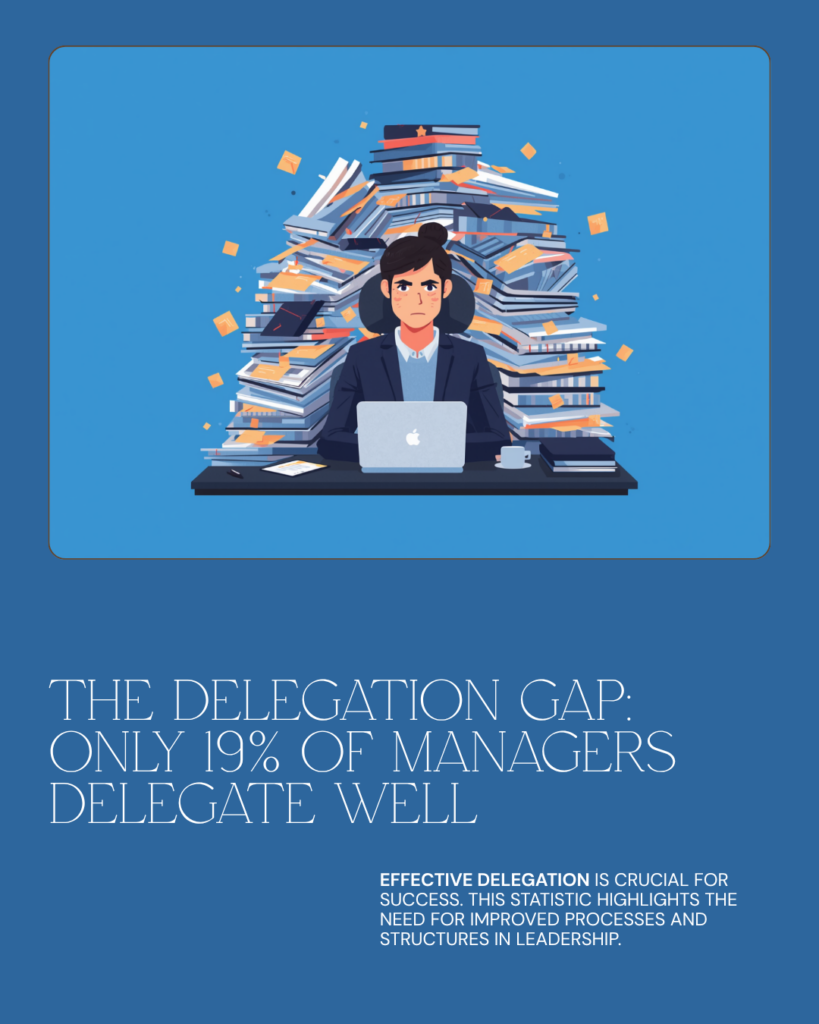
Better delegation does not happen by accident. It happens when everyone on your team knows what they own, what done looks like, and what support they need to get there. The quarterly planning session is where that clarity begins. Without it, you are the one holding everything together — which might feel like leadership but is actually the thing that keeps your business from growing.
The companies that run tight quarterly rhythms do not just execute better. They build cultures where people feel ownership instead of waiting for direction. If you have been noticing that your company values feel more decorative than operational, the quarterly planning process is one of the most practical places to start fixing that. Values become real when there are Rocks tied to them.
Q3 Starts in Five Weeks. Use Them.
You have roughly five weeks before Q2 is officially over. That is enough time to design and run a real quarterly planning session before July starts. If you have never done one the right way, this quarter is a good place to begin. If you have been doing something that looks like planning but does not quite feel like it, this is the moment to raise the bar.
LinkedIn right now is full of CEOs and founders talking about the gap between intention and execution. The gap is real. But it is closable — 90 days at a time.
If you are a business owner running a $5M to $50M company and want to talk through what a quarterly planning session should look like for your specific business, Newlogiq works with business owners like you to build these systems from the ground up. The first conversation is always free.