
The Succession Conversation You Keep Avoiding Could Cost Your Family Business Everything
Here is a number worth sitting with: only 30% of family-owned businesses survive into the second generation. Only 12% make it to the third. And the biggest reason—the one most people never talk about—is not the economy, a bad product, or even bad leadership. It is the conversation no one is willing to have.
The “succession conversation” sounds like a legal event. Something you schedule with an attorney and an accountant. Something you do when you are ready to retire. Something you plan to get to eventually. But in my work with business owners running $5M to $50M companies—many of them family businesses—I have seen the painful truth: the longer you wait to have this conversation, the harder it becomes. And the harder it becomes, the more you avoid it. And so the years pass.
This is the succession paradox. And it is destroying family businesses from the inside.
The Numbers Are Hard to Ignore
A February 2026 survey found that while 85% of business owners agree that succession planning is critical to long-term success, only 57% have even started a plan—and 23% are actively doing anything about it. Nearly half of all owners believe their next-generation leaders are only “somewhat prepared” to take the wheel, with 40% admitting those successors are simply unprepared.
What is behind this gap? The same survey revealed something telling: 62% of owners behind on succession planning said it is not a critical business priority “at the moment.” That phrase—at the moment—has been the most expensive pair of words in the family business world for decades.
The other problem is time. Leaders tend to dramatically underestimate how long succession takes. Many assume two years. Experts say it is closer to five to ten. That means the owner who is three years from wanting to retire and has not yet had the first real conversation is already behind. Not a little behind—significantly behind.
Why We Avoid the Conversation
I want to be direct here, because this is where most coaching conversations get uncomfortable. You are not avoiding succession planning because you are lazy or irresponsible. You are avoiding it because the conversation is loaded with things that feel dangerous: identity, mortality, family dynamics, and money.
For the founder who built a company from scratch, succession is not just a business event. It is the moment you begin to separate your identity from the company. That is terrifying. The business has been the source of your purpose, your income, your status, and your daily structure for decades. Talking about succession feels, on some deep level, like planning your own irrelevance.
For family businesses specifically, there is another layer: the risk of breaking relationships. If you have three children and one of them is clearly the right leader while the others are not, having that conversation means choosing. That feels like playing favorites. Many owners would rather avoid the conversation entirely than risk the fallout.
And yet avoiding the conversation does not prevent the fallout. It guarantees a bigger one later. As I explore in our work on developing the next generation of leaders, the cost of silence is always higher than the cost of an honest conversation.
What the Conversation Actually Needs to Cover
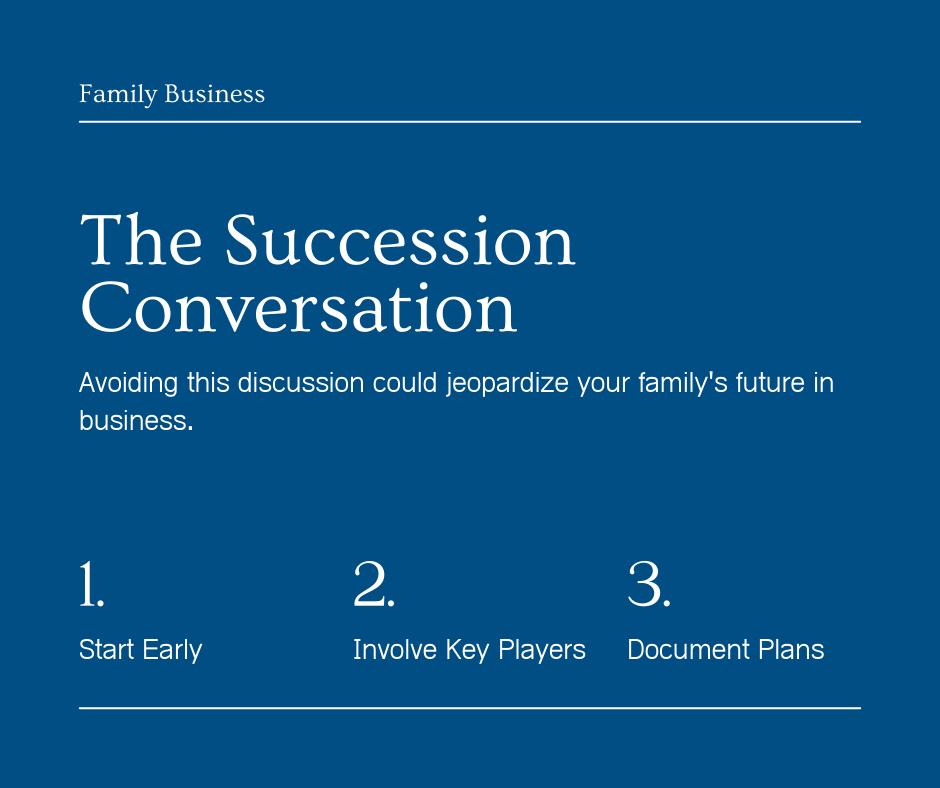
Most people think of succession as one conversation: “Who gets the business?” But that is not a conversation. That is an announcement. Real succession planning is a series of conversations that happen over months and years. Here is the framework I use with clients.
1. The Values Conversation
Before you talk about who leads the company, talk about what the company stands for. What does it mean to be a leader here? What do you protect at all costs? What can never be compromised? This conversation grounds everything that follows. It also opens the door for the next generation to contribute to the identity of the business, rather than just inherit it.
2. The Readiness Conversation
This is not about declaring someone ready or not ready. It is about being honest about what readiness looks like and what gaps exist. Tools like the Momentum Lab leadership development framework can help identify where future leaders need to grow. The honest readiness conversation is an act of respect, not judgment. It says: we want you to succeed, and here is what it will take.
3. The Timeline Conversation
Give people a rough roadmap. It does not have to be exact. But saying “I plan to transition leadership responsibility within the next five to seven years” gives everyone a frame to work from. It reduces anxiety for both the current owner and the next generation. It also forces you to start acting accordingly.
4. The Financial Conversation
This is often the most avoided. But the next generation cannot make good decisions without understanding the financial picture. You do not have to share everything at once. But “age-appropriate” financial transparency—shared incrementally as trust and readiness grow—is how you build the capacity for real ownership.
A Framework from the Field: How to Start
I worked with a second-generation owner of a $22M manufacturing business. He had three children, two of whom worked in the company. He knew one of them was the stronger operational leader. He had been avoiding the conversation for four years because he did not want the other to feel overlooked.
We started not with the succession question itself, but with the values and legacy question: “What do you want this business to be in twenty years? What role does each child play in that?” That reframe changed everything. It moved the conversation from “who wins” to “how do we all contribute?”
The child who was not selected as the operational successor ended up taking on a board role and a real estate investment arm. Both felt heard. The succession process was not painless—but it was honest. That is the best you can ask for. For a deeper look at how this connects to your overall growth strategy, consider how succession fits into your long-range plan.
The EOS framework, from Gino Wickman’s Traction, refers to this kind of ownership-level clarity as “getting the right people in the right seats.” Succession is the ultimate version of that. You cannot get the right person in the right seat if you never have the honest conversation about who that person is and whether they are ready.
Make Succession a Rhythm, Not a Crisis
The best succession plans are not documents. They are habits. They are built into quarterly planning conversations, annual leadership reviews, and board discussions. When succession is on the agenda every year, it becomes normal. When it is normal, the conversations get easier. When the conversations get easier, the transitions get smoother.
Half of boards that have them include succession on the agenda at least once a year. If you do not have a board, build the habit another way. A trusted advisor, a peer group like the ones in Newlogiq’s Momentum Lab, or a structured coaching process can give you the external accountability to keep the conversation alive.
Here is the bottom line: your business does not fail because of a bad succession plan. It fails because the conversation never happened. The plan is just paper. The conversation is where the real work gets done.
The Question Worth Asking Today
If something happened to you tomorrow, would your company know what to do? Not the legal documents—would the
If the answer is uncertain, the problem is not your succession plan. The problem is that you have not had the conversation yet. Start there. Not with the attorney. Not with the accountant. With the people who matter.
The best time to have this conversation was ten years ago. The second-best time is today. If you’re ready to start thinking through your succession roadmap, explore more leadership insights on the Newlogiq blog or reach out to schedule a conversation.
Sources & Further Reading
ABA Banking Journal (2026): Survey — Family Businesses Facing a ‘Succession Paradox’