
The AI Divide Is Real: What Small Business Owners Need to Know in 2026
LinkedIn is buzzing with a single conversation right now. Business owners, CEOs, and founders across every industry are asking the same question: “Are we falling behind on AI?” The answer, for most small businesses, is complicated. And that’s exactly why this topic deserves your full attention.
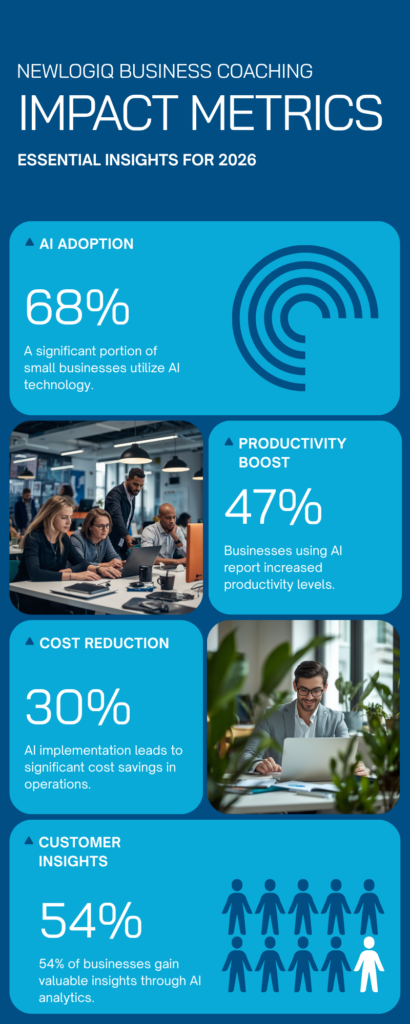
LinkedIn’s own economists have called 2026 “the defining year for small business AI adoption.” And the data backs that up. A QuickBooks survey found that 68% of U.S. small businesses now use AI regularly — up from just 48% in mid-2024. But here’s the part that almost nobody is talking about: adoption rate does not equal advantage. Using AI is not the same as using it well. For business owners running companies in the $5 million to $50 million range — especially family businesses — the AI conversation is filled with noise. Everyone is promising transformation. Most of what gets implemented ends up being a glorified email shortcut. Let’s cut through that.
The Gap Is Growing — And It’s Happening Fast
The Federal Reserve published research in April 2026 tracking AI adoption patterns across the U.S. economy. What they found should wake up any owner who has been on the sidelines: companies that adopted AI tools earlier are now pulling away from competitors at a pace that is difficult to close. It is not just about speed. It is about compounding advantage.
Here is a simple way to think about it. Imagine a business that uses AI to handle its weekly reporting, draft client communications, analyze margin data, and screen job applicants. That business gets back roughly six to ten hours of leadership time every week. Multiply that across a year and you are looking at 300 to 500 hours returned to strategy, client relationships, and growth. A competitor who is not doing this is running slower — permanently. This is what I call the AI divide. And it is not between big companies and small ones. It is between the small businesses that have gotten intentional about AI and the ones still treating it as a curiosity.
What’s Actually Working Right Now
When I work with business owners inside my coaching practice, I ask one simple question before we talk about any tool: “What is eating your time that does not require you specifically?” The answers are almost always the same. Reports. Emails. Research. Scheduling. Meeting summaries. Drafting SOPs. These are not strategic tasks. And they are exactly where AI earns its keep.
The data backs this up. According to 2026 research aggregated across multiple SMB studies, 62% of small businesses are using AI primarily for data analysis and reporting — the highest ROI category by a wide margin. Marketing automation comes in second at 54%. And the average productivity gain from generative AI tools works out to roughly $7,800 per employee per year. For a company with 20 employees, that is $156,000 in recovered capacity — without adding a single headcount.
But here is where most small businesses get it wrong. They buy tools before they buy clarity. They subscribe to five platforms, use none of them consistently, and conclude that “AI doesn’t work for our business.” That is not an AI problem. That is a process problem. I have written about how decision fatigue and poor decision frameworks derail even the best-intentioned leaders. The same principle applies here. Too many options, no clear filter.
Three Moves Every Small Business Owner Should Make Right Now
The first move is to audit your time — not your tools. Before you download anything, spend one week tracking where you and your leadership team are spending time on tasks that do not require your direct judgment. Most owners are shocked by what they find. This is not about efficiency for efficiency’s sake. It is about identifying where AI can buy you back the time you need to lead.
The second move is to start small and specific. Do not try to transform your entire operation in 90 days. Pick one workflow — meeting summaries, weekly reports, first drafts of client communications — and get great at using AI for that one thing. Master it. Then expand. The businesses building real advantage right now are not the ones chasing the newest tools. They are the ones who get disciplined about quarterly priorities and execute with focus.
The third move is to invest in your team’s AI literacy, not just your own. One of the most common mistakes I see is the owner becoming the AI champion while the team stays skeptical. Your business will only scale if your people are using these tools consistently. This is fundamentally a leadership development conversation as much as it is a technology conversation. The owner who hoards the tools creates a bottleneck. The owner who trains the team creates leverage.
A Real-World Example of the AI Advantage
Consider a hypothetical family-owned distribution company running about $18 million in revenue. The owner spends roughly 12 hours each week in operational review meetings, writing updates, and answering status questions that his team could handle with better systems. After working together on a 90-day AI integration plan — meeting transcription tools, automated weekly reporting dashboards, AI-drafted client proposals — that time drops to under four hours. What does he do with the extra eight hours? He visits two new prospective clients per week, re-engages a supplier relationship he had let drift, and starts working on the succession plan he has been putting off for two years.
That is not a technology story. That is a leadership story. AI just removed the obstacles. This kind of outcome is available to most small business owners. The gap is not technical. It is clarity about where to start and the discipline to follow through. If you are working through the Scaling Up or EOS frameworks, AI integration fits naturally into your rhythm. It supports your meeting structures, your KPIs, your accountability cadence. It does not replace the system — it accelerates it.
What AI Cannot Replace (And Why That Matters)
There is a counterweight to all of this worth naming directly. I have written about what AI genuinely cannot do, and that list matters now more than ever as AI becomes more capable. AI cannot replace your judgment about your people. It cannot sense the tension in a room during a family business disagreement. It cannot have the hard conversation with an underperforming manager or read the quiet signals in a client relationship that is starting to drift. These are the moments where leadership still wins — and where coaching still matters.
The best frame I have found: AI helps you execute faster, but it cannot help you choose the right strategy. Strategy is still yours. The goal is to free your brain from operational noise so you can think more clearly about the moves that actually matter.
The Question Worth Asking Yourself
Here is the version of the AI question I think is worth sitting with. Not “Are we using AI?” but “Is AI buying us more time to become the kind of company we want to be?” For a family business, that might mean the founder finally has two hours every Friday to think about succession. For a manufacturing CEO, it might mean the leadership team gets out of status meetings and into genuine strategy conversations. For a service company, it might mean proposals go out in two hours instead of two days.
The competitive environment in 2026 is real. The scaling challenges do not get easier. But the tools available to small business owners have never been more accessible. The question is whether you are going to use them with intention — or let the noise decide for you.
At Newlogiq, we work with business owners in the $5M–$50M range to build the clarity, systems, and leadership habits that create sustainable growth. If you are trying to figure out how AI fits into your strategy — not just your workflow — reach out at newlogiq.com. We would love to help you think it through.
ai business consultant, Artificial Intelligence, Strategic Planning