
Tag: Scaling Up

The Three Conversations Every Family Business Owner Avoids (And Why They Can’t Afford To)

Tom had been running his family’s manufacturing business for 28 years. His son, Marcus, had worked there for the last six. Everyone on the outside assumed the plan was clear. Tom would hand it off, Marcus would take over, and the business would keep humming along. But when Tom had a minor health scare at 61, the truth came out: they had never actually talked about it. Not really. Tom had assumed Marcus wanted it. Marcus had assumed Tom would never let go. And the business, worth nearly $14 million at that point, was sitting on a plan that existed only in two people’s heads — differently.
That story is not unusual. According to the Family Business Alliance, fewer than one-third of family businesses successfully transition to the second generation, and only about 12 percent make it to the third. The reasons are rarely about business performance. They are almost always about conversations that never happened.

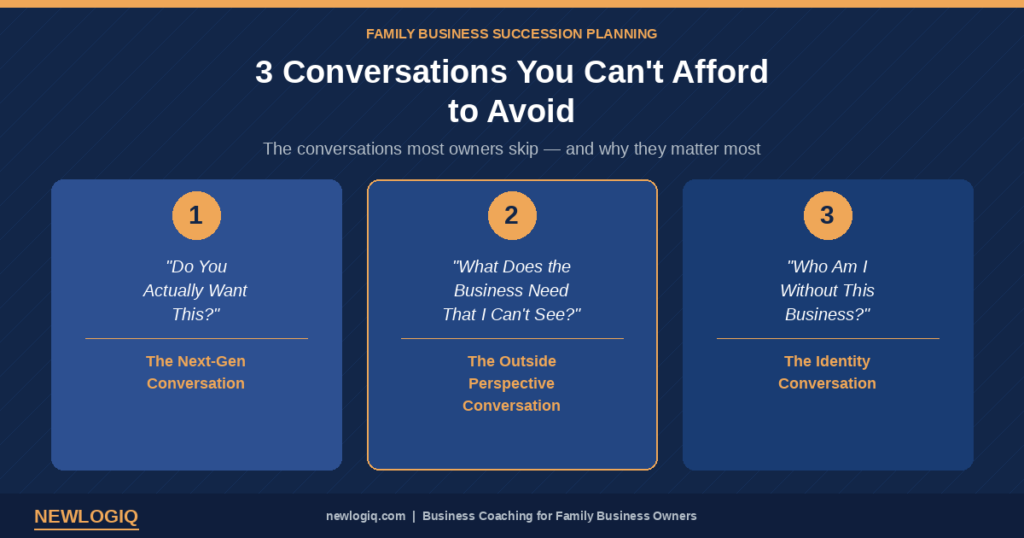
If you are a family business owner thinking about succession planning, this post is not about the legal structure of a buy-sell agreement or how to value your company. Those things matter, but they are not where most family businesses break down. They break down because three specific conversations never take place. Let’s talk about each one.

Why Most Succession Plans Fail Before They Start

Here is something I have observed working with family business owners across a wide range of industries: most of them have a succession “plan” that is really just a wish. It exists in the owner’s head, maybe sketched on a napkin, maybe outlined loosely in a conversation with an attorney. But it has never been tested by the one thing that makes plans real: honest conversation with the people it affects.

The Scaling Up framework talks about getting clear on your long-range goals — who you want to become as a company and what that requires. The problem with succession is that it is deeply personal. It involves identity, money, family dynamics, and fear. No framework can give you the courage to have hard conversations. But knowing which conversations to have is a good place to start.

Below are the three conversations I see family business owners avoid most often. Avoiding even one of them puts your legacy at risk.

Conversation #1: “Do You Actually Want This?”

This is the most uncomfortable conversation for most owners, so it gets skipped entirely. The owner assumes the child or next-gen family member wants to run the business. The next-gen member does not want to disappoint the person who built it. So everyone just moves forward without ever saying the quiet part out loud.

The question “Do you actually want this?” has three parts. First, does the next-generation leader genuinely want to run this business, or do they feel obligated? Second, are they capable of running it — not just technically, but in terms of temperament and leadership style? And third, do they want to run it the way it currently operates, or do they have a vision that might look quite different from yours?

I worked with one owner who had spent three years grooming his daughter to take over. She was smart, hardworking, and well-respected by the team. What she had never told her father was that she wanted to scale back the retail side and grow wholesale — a strategy he would have rejected outright. They got that conversation on the table about six months before the planned transition. It was hard. It also saved the business, because they worked through it together instead of discovering the disagreement after the handoff.

If you have been avoiding this conversation, I would encourage you to read our post on how to stop being the bottleneck in your own business. One of the root causes of bottleneck behavior in family businesses is an owner who has never been fully honest about whether they are developing a successor or controlling one.

Conversation #2: “What Does This Business Need That I Can’t See?”

Most founders have blind spots about their businesses. That is not an insult — it is just physics. You cannot see clearly what you are standing inside of. The second conversation that almost never happens is the one where the outgoing owner asks a trusted outside voice to tell them the truth about what the business needs during a transition.

This is where working with an outside coach or advisor pays for itself many times over. Not because an outside perspective is always right, but because it surfaces things the internal team has stopped saying. Your people may know that the company’s operations depend too heavily on your relationships. They may see that the systems are not documented well enough for someone new to run effectively. They may notice that the leadership team is loyal to you personally, not to the role of CEO — which means your successor walks into a credibility problem on day one.

The EOS Accountability Chart is a useful tool here. It forces a family business to look honestly at who is sitting in what seat, whether they are truly the right person for that seat, and what gaps would be exposed if the current owner stepped away. Doing this exercise with someone who does not have an emotional stake in the answer is far more valuable than doing it alone.

Our Leadership Team Alignment Test is a good starting point. It helps you see whether your team is aligned around the same direction — or just aligned around you.

Conversation #3: “Who Am I Without This Business?”

This is the one most owners resist most. It sounds soft. It feels irrelevant to a business conversation. And yet it is the number-one reason I see owners drag out the succession process, re-insert themselves after agreeing to step back, and sabotage successors in ways they do not even recognize.

Marshall Goldsmith writes extensively about the problem of identity tied to achievement. For family business owners, the business is not just a job. It is often the central organizing force of their life — their sense of purpose, their social circle, their daily structure, and in many cases, their identity in the community. Letting go of the business means answering a question most owners have never had to face: who are you when you are not the owner?

This is not a weakness. It is a normal human response to a major identity transition. But left unaddressed, it turns into behavior that wrecks succession plans. The owner who “transitions” but keeps calling the shots. The founder who undercuts the successor’s authority in front of the team. The parent who cannot stop parenting their child in front of employees.

The conversation to have — honestly, and ideally with someone outside the family — is about what comes next for you. What will you do with your time? What will give you purpose? What relationships outside the business are you investing in? This is not about retirement planning. It is about building an identity robust enough to survive the transition, so your successor can lead without your shadow making every decision for them.

How to Start

You do not have to do all three conversations at once. In fact, trying to is usually a mistake. Each one deserves its own time and space. Here is a simple sequence that works well.

Start with Conversation #3. Get clear on your own identity and what you want the next chapter to look like. This is private work, ideally with a coach. Until you have done it, you will not be able to have Conversations #1 and #2 with full honesty.

Then move to Conversation #1. Have a direct, honest, non-pressured conversation with the people you are considering as successors. Not “This is the plan” but “What do you want?” and “What do you see for this business?” Listen without defending. Take notes. Give it time to settle.

Finally, bring in Conversation #2. Engage someone outside the business — a coach, a board member, a trusted advisor — to help you see the gaps. Use tools like the EOS Accountability Chart or Scaling Up’s OPSP (One-Page Strategic Plan) to get an honest picture of what the business needs from its next leader.

If you are wondering whether coaching is worth it for this kind of work, I encourage you to read A Practical Guide for Business Owners Who Need Proof Coaching Works. Succession is exactly the kind of transition where having the right thinking partner makes a measurable difference.

The Cost of Waiting

I want to leave you with this: succession planning is not something you do when you are ready to leave. It is something you do while you still have time to fix what you find. Most of the family businesses that lose their way during a transition did not fail because the successor was unqualified. They failed because the conversations that should have happened over three or five years got compressed into six months of crisis.

Tom and Marcus, the father-son pair I mentioned at the start, eventually got their conversations on the table. It took a health scare to force it, but they got there. The business is still running today, with Marcus at the helm and Tom as a genuine advisor — not a shadow CEO. That outcome was possible because they finally started talking.

Your business is worth that conversation. So is your family.

Ready to work through your succession planning conversations?

Schedule a complimentary strategy conversation at newlogiq.com to see if a coaching engagement is the right next step.


Verne Harnish’s Scaling Up: Unlock Business Growth

Scaling Up is a guide for businesses wanting to grow. Written by Verne Harnish, it offers strategies and advice for entrepreneurs and leaders.

The book covers what’s needed for business growth. This includes leadership, management, and organizational structure. By using the strategies in Scaling Up, businesses can beat common challenges and reach their goals.

Good business growth strategies are key to staying ahead in today’s market. By learning from Scaling Up, businesses can reach their full growth.

Key Takeaways

  • Understand the key elements necessary for successful business growth.
  • Implement effective leadership and management strategies.
  • Develop a robust organizational structure to support growth.
  • Overcome common obstacles to achieve business goals.
  • Unlock full potentia and achieve sustainable growth.

The Business Scaling Challenge

Scaling a business is tough. It needs overcoming growth barriers and using the right scaling methods. As companies grow, they face many challenges that slow them down.

Common Growth Barriers for Mid-Market Companies

Mid-market companies hit specific hurdles when they scale. These include inefficient processes, inadequate systems, and leadership gaps. These obstacles make it hard for companies to grow well.

Barrier Description Impact
Inefficient Processes Manual or redundant processes that slow down operations. Reduced productivity and increased costs.
Inadequate Systems Outdated technology or insufficient infrastructure. Limited scalability and flexibility.
Leadership Gaps Insufficient or unskilled leadership at various levels. Poor decision-making and strategy execution.

Why Traditional Growth Strategies Often Fail

Traditional growth plans often fail because they don’t fit the company’s needs. Verne Harnish’s Scaling Up methodology stresses the need for a custom approach to scaling.

The Cost of Scaling Without a Framework

Scaling without a framework can be costly. It can waste resources and miss opportunities. Using a scaling up methodology can help avoid these problems.

Who is Verne Harnish?

Verne Harnish has made a big impact in the business world. He has started many companies and helped others grow. He is known for founding the Entrepreneurs’ Organization.

Background and Entrepreneurial Journey

Verne Harnish started his first company early in his career. He faced ups and downs, but learned a lot. These experiences helped him understand how businesses can grow.

Founding of Entrepreneurs’ Organization

Verne Harnish is proud of starting the Entrepreneurs’ Organization (EO). It’s a global group for entrepreneurs. Here, they can share ideas and learn from each other.

The “Growth Guy” Legacy and Influence

People call Verne Harnish the “Growth Guy” because he knows how to make businesses bigger. His book “Scaling Up” and his consulting work have helped many companies grow.

Aspect Description Impact
Entrepreneurial Journey Multiple successful ventures Shaped insights into business growth
Founding of EO Global network of entrepreneurs Pivotal platform for knowledge sharing
“Growth Guy” Legacy Expertise in scaling businesses Influence through writings and consulting

Verne Harnish’s Scaling Up: Core Framework Overview

Verne Harnish’s Scaling Up has changed how businesses grow. It offers a detailed plan for success. This plan helps businesses grow by focusing on important areas.

Evolution from “Mastering the Rockefeller Habits”

The Scaling Up framework is an update from Harnish’s “Mastering the Rockefeller Habits.” It’s more detailed and effective for business growth. It uses lessons from many businesses and the best ways to grow.

The Four Decisions Framework

The Scaling Up method centers on the Four Decisions Framework. It highlights four key decisions for business leaders. These decisions are about people, strategy, execution, and cash.

Scaling Up vs. Scaling Out

Scaling Up means growing the business by adding more to what you do. Scaling out means growing by doing more in the same way. Both are important for business growth.

Vertical Growth Strategies

Vertical growth means adding new parts to your business. This can be getting suppliers or distributors. It helps control and improve your business.

Horizontal Expansion Approaches

Horizontal growth means getting more customers or entering new markets. You can do this through mergers, partnerships, or growing on your own. It increases your revenue and customer base.

Growth Strategy Description Benefits
Vertical Integration Expanding along the value chain Increased control, improved efficiency
Horizontal Expansion Increasing market share or entering new markets Increased revenue, diversified customer base

The People Component

In Verne Harnish’s Scaling Up framework, the people component is key for lasting business growth. It focuses on creating a strong organizational structure. This structure supports the company’s growth plans.

Building a Winning Team Structure

A solid team structure is essential for any successful business. Harnish stresses the need for clear roles and responsibilities. This prevents confusion and overlapping work.

  • Defining clear job descriptions
  • Establishing a chain of command
  • Ensuring the right people are in the right positions

The Function Accountability Chart (FACe)

The Function Accountability Chart (FACe) clarifies and visualizes the organizational structure. It helps in:

  1. Identifying key functions within the organization
  2. Assigning accountability for each function
  3. Ensuring that all necessary tasks are covered

Developing Leadership at All Levels

Developing leadership across the organization is vital for scalability. This involves:

Accountability Systems

Implementing systems that hold individuals accountable for their tasks and performance. This includes regular check-ins and feedback loops.

Talent Attraction and Retention

Strategies to attract and retain top talent are key. This includes creating a positive company culture, competitive compensation, and growth opportunities.

By focusing on the people component, businesses can lay a strong foundation for scaling. It’s not just about hiring the right people. It’s also about developing their skills and aligning them with the company’s goals.

The Strategy Element

Verne Harnish’s Scaling Up framework puts business strategy at its core. A solid strategy is key for scaling and lasting growth.

Defining Your Core Values and Purpose

At the heart of a good strategy are your core values and purpose. Core values guide decisions and actions in your company. They help build a strong culture. The purpose or mission statement gives your team direction and motivation. It tells them why you’re here and what you’re trying to achieve.

The One-Page Strategic Plan (OPSP)

The One-Page Strategic Plan (OPSP) is a simple document that outlines your strategy. It includes your core values, purpose, goals, and priorities. This plan keeps everyone in your organization on the same page with your goals.

7 Strata of Strategy Implementation

Verne Harnish breaks down strategy into seven layers:

  • Core Values
  • Purpose (Why)
  • BHAG (Big Hairy Audacious Goal)
  • Brand Promise
  • 3-4 Critical Goals
  • Core Customer
  • Brand Identity

Market-Facing Activities

Understanding customer needs and competitors is key. Developing a unique value proposition is also important. These steps help you stand out in the market.

Internal Capabilities Development

Building the skills and systems you need is vital. This includes hiring the right people, training, and investing in technology. It’s all about improving how you operate.

By focusing on these areas, businesses can build a strong growth framework, as shown in Scaling Up.

The Execution Framework

Verne Harnish’s Scaling Up focuses on a key part: the execution framework. It’s designed to help businesses grow. This framework makes sure strategies are put into action and goals are reached through a clear plan.

Establishing Effective Meeting Rhythms

Setting up good meeting rhythms is a big part of this framework. Regular meetings keep everyone on the same page. Verne Harnish stresses the need for regular talks to prevent confusion and keep everyone focused on the same goals.

Priority Management and Rockefeller Habits

Managing priorities is also key, with Rockefeller Habits being a big help. These habits help sort out what’s most important to do first. By focusing on the most critical tasks, businesses can move forward faster and reach their goals more effectively.

Key Performance Indicators (KPIs)

Using Key Performance Indicators (KPIs) is vital to track progress. KPIs show how well the business is doing against its goals. By watching the right KPIs, companies can make smart choices and tweak their plans when needed.

The Power of Daily Huddles

“Daily huddles are a powerful tool for aligning teams and driving execution.”

Daily meetings are short but powerful. They help set daily goals, solve problems, and make sure everyone knows what to do. These daily huddles build a culture of responsibility and openness, helping the whole framework succeed.

By using these strategies, businesses can get better at executing plans. This leads to better performance and lasting growth.

The Cash Component

The cash component is key in Verne Harnish’s Scaling Up method. It focuses on managing cash flow well to help businesses grow.

Cash Flow Management Techniques

Managing cash flow well is essential for scaling up. This means using robust cash flow forecasting, handling accounts receivable and payable well, and keeping a good cash reserve.

  • Use a cash flow forecasting system to guess future cash needs.
  • Make accounts receivable better by improving billing and collection.
  • Work with suppliers to get better terms for accounts payable.

The Power of Cash Acceleration Strategies

Using cash acceleration strategies can really boost a company’s cash. These include invoice financing, supply chain financing, and dynamic discounting.

Financial Literacy Across the Organization

It’s important to teach everyone in the company about managing cash. This means showing them why cash flow matters and giving them the tools and training they need.

Cash Conversion Cycle Optimization

Improving the cash conversion cycle is key for better cash flow. This means cutting down on days inventory outstanding (DIO), days sales outstanding (DSO), and days payable outstanding (DPO).

Profit per X analysis helps understand how profitable different parts of the business are. This could be profit per customer or profit per product.

  • Look at profit per customer to find the most valuable ones.
  • Use profit per product analysis to choose the best products.

By focusing on the cash component, businesses can manage their cash flow better, speed up cash, and teach everyone about finance. This leads to lasting growth.

Implementing the Scaling Up Process

The Scaling Up process, created by Verne Harnish, is a guide for businesses to grow sustainably. It helps companies get past common growth hurdles with a detailed framework for scaling.

Getting Started with Scaling Up

To start with Scaling Up, businesses need to grasp the four key decisions for growth: People, Strategy, Execution, and Cash. Focusing on these areas lays a strong base for scaling.

Key steps to get started include:

  • Assessing the current state of the business
  • Defining core values and purpose
  • Establishing a clear strategic plan

Common Implementation Challenges

Businesses often face hurdles when starting Scaling Up, like resistance to change and team alignment issues. It’s key to clearly share the benefits of Scaling Up to overcome these.

“The biggest challenge in implementing Scaling Up is not the framework itself, but the cultural shift needed to make it work.” – Verne Harnish

Measuring Implementation Success

To gauge Scaling Up success, track KPIs for the four decision areas. Regularly reviewing these metrics ensures the company is meeting its growth targets.

90-Day Implementation Plan

A 90-day plan is vital for smoothly integrating Scaling Up into a business. It outlines specific actions and milestones for the first three months.

Week Action Items Responsible Team
1-2 Assess current state, define core values Leadership Team
3-6 Develop strategic plan, establish KPIs Strategy Team
7-12 Implement execution framework, monitor cash flow Execution Team

Technology Tools for Scaling Up

Technology tools, like project management software and financial planning tools, support Scaling Up. They make processes smoother and more efficient.

Scaling Up vs. Other Business Growth Methodologies

Many methods have been created to help businesses grow. ‘Scaling Up’ is one of the most well-known. It’s important to know how different methods work when scaling a business.

Comparison with Traction/EOS

‘Scaling Up’ and Traction/EOS share some key points. Both stress the need for a clear vision, core values, and goals. But ‘Scaling Up’ offers a broader framework. It includes People, Strategy, Execution, and Cash.

Scaling Up vs. Lean Startup

Lean Startup is all about quick changes and listening to customers. ‘Scaling Up’ looks at the whole picture. It covers strategy, planning, and money management. This makes ‘Scaling Up’ better for balanced growth.

When to Choose the Scaling Up Approach

Choose ‘Scaling Up’ for a detailed growth plan. It’s great for mid-market companies. They need a solid base for lasting growth.

Methodology Key Focus Suitable For
Scaling Up Holistic growth framework Mid-market companies
Traction/EOS Clear vision and measurable goals Businesses seeking simplicity
Lean Startup Rapid iteration and customer feedback Startups and innovative ventures

scaling up methodology comparison

Conclusion: Leveraging Verne Harnish’s Scaling Up for Sustainable Growth

Verne Harnish’s Scaling Up offers a detailed plan for businesses to grow sustainably. It focuses on four key areas: People, Strategy, Execution, and Cash. This helps companies overcome growth hurdles and succeed in the long run.

The Scaling Up framework gives a clear path to business growth. It helps companies build a strong team, set a clear strategy, execute well, and manage cash flow. By using Verne Harnish’s strategies, businesses can innovate, work more efficiently, and make more money.

To grow sustainably, businesses need to follow Scaling Up’s key principles. This creates a strong base for lasting success and keeps them competitive in today’s fast business world. Verne Harnish’s Scaling Up is a key resource for businesses aiming to grow and scale sustainably.

FAQ

What is Verne Harnish’s Scaling Up methodology?

Verne Harnish’s Scaling Up is a way to grow a business. It focuses on four main areas: People, Strategy, Execution, and Cash. It aims to help businesses grow in a sustainable way.

How does Scaling Up differ from other business growth methodologies like Traction/EOS?

Scaling Up and Traction/EOS both aim to help businesses grow. But Scaling Up is more detailed. It covers People, Strategy, Execution, and Cash. Traction/EOS focuses more on the Entrepreneurial Operating System.

What is the Four Decisions Framework in Scaling Up?

The Four Decisions Framework is a key part of Scaling Up. It involves making decisions in four areas: People, Strategy, Execution, and Cash. This framework helps businesses make important decisions for growth.

How can businesses implement the Scaling Up process?

Businesses can start by checking where they are now and what needs work. Then, they can make a 90-day plan. They can use tools like the One-Page Strategic Plan (OPSP) and the Function Accountability Chart (FACe).

What is the role of the One-Page Strategic Plan (OPSP) in Scaling Up?

The OPSP is a key tool in Scaling Up. It gives a clear plan for a company’s values, purpose, and goals. It helps businesses stay focused and grow.

How does Scaling Up address cash flow management?

Scaling Up focuses a lot on managing cash flow. It offers ways to improve cash flow. This includes speeding up cash, improving cash cycle, and analyzing profit per X.

What are the benefits of using the Scaling Up methodology?

Using Scaling Up can help businesses grow, work more efficiently, and make better decisions. It focuses on People, Strategy, Execution, and Cash. This leads to sustainable growth and success.

Is Scaling Up suitable for all types of businesses?

Scaling Up works for many businesses, but it’s best for mid-market companies. It helps them overcome growth challenges and grow sustainably.