
The Three Conversations Every Family Business Owner Avoids (And Why They Can’t Afford To)
Tom had been running his family’s manufacturing business for 28 years. His son, Marcus, had worked there for the last six. Everyone on the outside assumed the plan was clear. Tom would hand it off, Marcus would take over, and the business would keep humming along. But when Tom had a minor health scare at 61, the truth came out: they had never actually talked about it. Not really. Tom had assumed Marcus wanted it. Marcus had assumed Tom would never let go. And the business, worth nearly $14 million at that point, was sitting on a plan that existed only in two people’s heads — differently.
That story is not unusual. According to the Family Business Alliance, fewer than one-third of family businesses successfully transition to the second generation, and only about 12 percent make it to the third. The reasons are rarely about business performance. They are almost always about conversations that never happened.
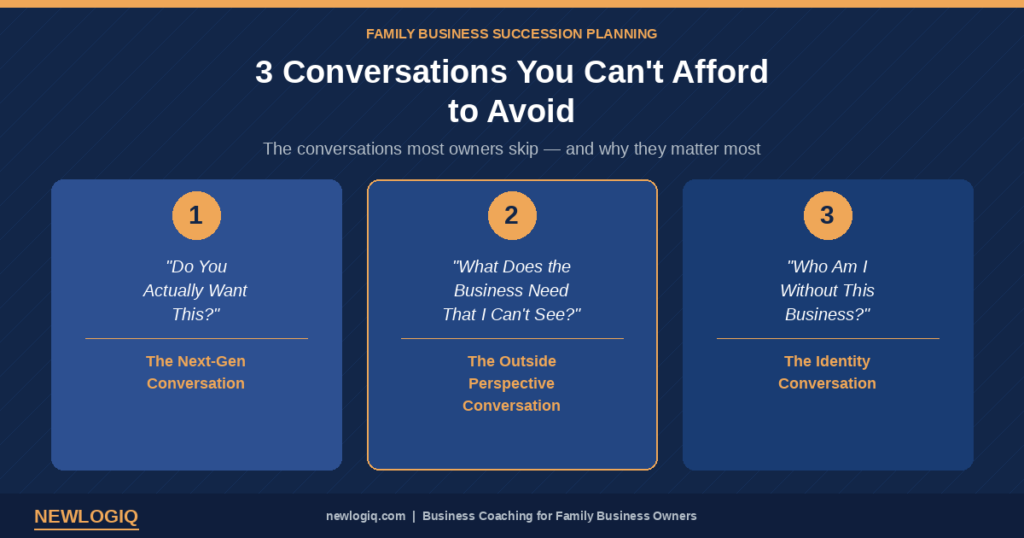
If you are a family business owner thinking about succession planning, this post is not about the legal structure of a buy-sell agreement or how to value your company. Those things matter, but they are not where most family businesses break down. They break down because three specific conversations never take place. Let’s talk about each one.
Why Most Succession Plans Fail Before They Start
Here is something I have observed working with family business owners across a wide range of industries: most of them have a succession “plan” that is really just a wish. It exists in the owner’s head, maybe sketched on a napkin, maybe outlined loosely in a conversation with an attorney. But it has never been tested by the one thing that makes plans real: honest conversation with the people it affects.
The Scaling Up framework talks about getting clear on your long-range goals — who you want to become as a company and what that requires. The problem with succession is that it is deeply personal. It involves identity, money, family dynamics, and fear. No framework can give you the courage to have hard conversations. But knowing which conversations to have is a good place to start.
Below are the three conversations I see family business owners avoid most often. Avoiding even one of them puts your legacy at risk.
Conversation #1: “Do You Actually Want This?”
This is the most uncomfortable conversation for most owners, so it gets skipped entirely. The owner assumes the child or next-gen family member wants to run the business. The next-gen member does not want to disappoint the person who built it. So everyone just moves forward without ever saying the quiet part out loud.
The question “Do you actually want this?” has three parts. First, does the next-generation leader genuinely want to run this business, or do they feel obligated? Second, are they capable of running it — not just technically, but in terms of temperament and leadership style? And third, do they want to run it the way it currently operates, or do they have a vision that might look quite different from yours?
I worked with one owner who had spent three years grooming his daughter to take over. She was smart, hardworking, and well-respected by the team. What she had never told her father was that she wanted to scale back the retail side and grow wholesale — a strategy he would have rejected outright. They got that conversation on the table about six months before the planned transition. It was hard. It also saved the business, because they worked through it together instead of discovering the disagreement after the handoff.
If you have been avoiding this conversation, I would encourage you to read our post on how to stop being the bottleneck in your own business. One of the root causes of bottleneck behavior in family businesses is an owner who has never been fully honest about whether they are developing a successor or controlling one.
Conversation #2: “What Does This Business Need That I Can’t See?”
Most founders have blind spots about their businesses. That is not an insult — it is just physics. You cannot see clearly what you are standing inside of. The second conversation that almost never happens is the one where the outgoing owner asks a trusted outside voice to tell them the truth about what the business needs during a transition.
This is where working with an outside coach or advisor pays for itself many times over. Not because an outside perspective is always right, but because it surfaces things the internal team has stopped saying. Your people may know that the company’s operations depend too heavily on your relationships. They may see that the systems are not documented well enough for someone new to run effectively. They may notice that the leadership team is loyal to you personally, not to the role of CEO — which means your successor walks into a credibility problem on day one.
The EOS Accountability Chart is a useful tool here. It forces a family business to look honestly at who is sitting in what seat, whether they are truly the right person for that seat, and what gaps would be exposed if the current owner stepped away. Doing this exercise with someone who does not have an emotional stake in the answer is far more valuable than doing it alone.
Our Leadership Team Alignment Test is a good starting point. It helps you see whether your team is aligned around the same direction — or just aligned around you.
Conversation #3: “Who Am I Without This Business?”
This is the one most owners resist most. It sounds soft. It feels irrelevant to a business conversation. And yet it is the number-one reason I see owners drag out the succession process, re-insert themselves after agreeing to step back, and sabotage successors in ways they do not even recognize.
Marshall Goldsmith writes extensively about the problem of identity tied to achievement. For family business owners, the business is not just a job. It is often the central organizing force of their life — their sense of purpose, their social circle, their daily structure, and in many cases, their identity in the community. Letting go of the business means answering a question most owners have never had to face: who are you when you are not the owner?
This is not a weakness. It is a normal human response to a major identity transition. But left unaddressed, it turns into behavior that wrecks succession plans. The owner who “transitions” but keeps calling the shots. The founder who undercuts the successor’s authority in front of the team. The parent who cannot stop parenting their child in front of employees.
The conversation to have — honestly, and ideally with someone outside the family — is about what comes next for you. What will you do with your time? What will give you purpose? What relationships outside the business are you investing in? This is not about retirement planning. It is about building an identity robust enough to survive the transition, so your successor can lead without your shadow making every decision for them.
How to Start
You do not have to do all three conversations at once. In fact, trying to is usually a mistake. Each one deserves its own time and space. Here is a simple sequence that works well.
Start with Conversation #3. Get clear on your own identity and what you want the next chapter to look like. This is private work, ideally with a coach. Until you have done it, you will not be able to have Conversations #1 and #2 with full honesty.
Then move to Conversation #1. Have a direct, honest, non-pressured conversation with the people you are considering as successors. Not “This is the plan” but “What do you want?” and “What do you see for this business?” Listen without defending. Take notes. Give it time to settle.
Finally, bring in Conversation #2. Engage someone outside the business — a coach, a board member, a trusted advisor — to help you see the gaps. Use tools like the EOS Accountability Chart or Scaling Up’s OPSP (One-Page Strategic Plan) to get an honest picture of what the business needs from its next leader.
If you are wondering whether coaching is worth it for this kind of work, I encourage you to read A Practical Guide for Business Owners Who Need Proof Coaching Works. Succession is exactly the kind of transition where having the right thinking partner makes a measurable difference.
The Cost of Waiting
I want to leave you with this: succession planning is not something you do when you are ready to leave. It is something you do while you still have time to fix what you find. Most of the family businesses that lose their way during a transition did not fail because the successor was unqualified. They failed because the conversations that should have happened over three or five years got compressed into six months of crisis.
Tom and Marcus, the father-son pair I mentioned at the start, eventually got their conversations on the table. It took a health scare to force it, but they got there. The business is still running today, with Marcus at the helm and Tom as a genuine advisor — not a shadow CEO. That outcome was possible because they finally started talking.
Your business is worth that conversation. So is your family.
Ready to work through your succession planning conversations?
Schedule a complimentary strategy conversation at newlogiq.com to see if a coaching engagement is the right next step.