Author: spacityadmin

The Three Conversations Every Family Business Owner Avoids (And Why They Can’t Afford To)

Tom had been running his family’s manufacturing business for 28 years. His son, Marcus, had worked there for the last six. Everyone on the outside assumed the plan was clear. Tom would hand it off, Marcus would take over, and the business would keep humming along. But when Tom had a minor health scare at 61, the truth came out: they had never actually talked about it. Not really. Tom had assumed Marcus wanted it. Marcus had assumed Tom would never let go. And the business, worth nearly $14 million at that point, was sitting on a plan that existed only in two people’s heads — differently.

That story is not unusual. According to the Family Business Alliance, fewer than one-third of family businesses successfully transition to the second generation, and only about 12 percent make it to the third. The reasons are rarely about business performance. They are almost always about conversations that never happened.

If you are a family business owner thinking about succession planning, this post is not about the legal structure of a buy-sell agreement or how to value your company. Those things matter, but they are not where most family businesses break down. They break down because three specific conversations never take place. Let’s talk about each one.

Why Most Succession Plans Fail Before They Start

Here is something I have observed working with family business owners across a wide range of industries: most of them have a succession “plan” that is really just a wish. It exists in the owner’s head, maybe sketched on a napkin, maybe outlined loosely in a conversation with an attorney. But it has never been tested by the one thing that makes plans real: honest conversation with the people it affects.

The Scaling Up framework talks about getting clear on your long-range goals — who you want to become as a company and what that requires. The problem with succession is that it is deeply personal. It involves identity, money, family dynamics, and fear. No framework can give you the courage to have hard conversations. But knowing which conversations to have is a good place to start.

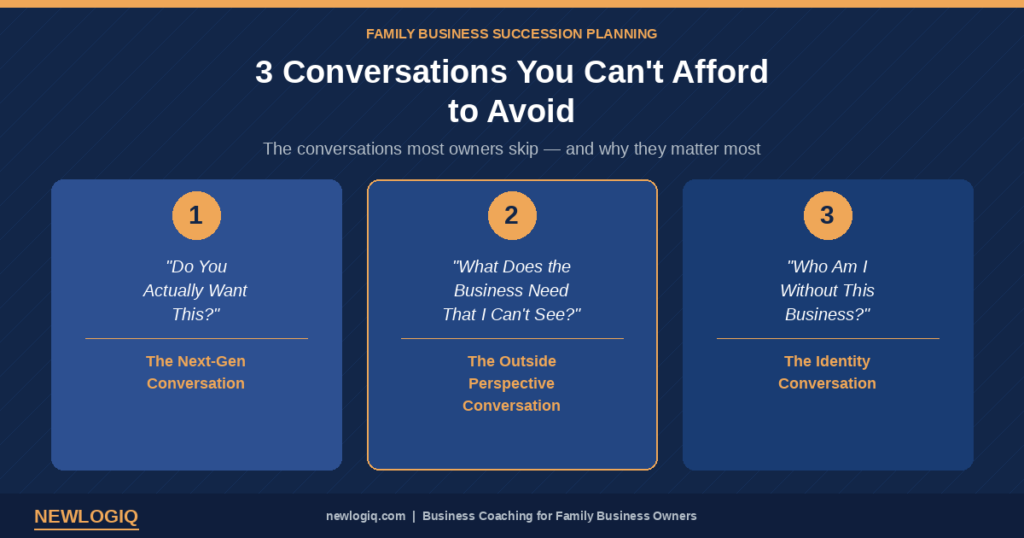
Below are the three conversations I see family business owners avoid most often. Avoiding even one of them puts your legacy at risk.

Conversation #1: “Do You Actually Want This?”

This is the most uncomfortable conversation for most owners, so it gets skipped entirely. The owner assumes the child or next-gen family member wants to run the business. The next-gen member does not want to disappoint the person who built it. So everyone just moves forward without ever saying the quiet part out loud.

The question “Do you actually want this?” has three parts. First, does the next-generation leader genuinely want to run this business, or do they feel obligated? Second, are they capable of running it — not just technically, but in terms of temperament and leadership style? And third, do they want to run it the way it currently operates, or do they have a vision that might look quite different from yours?

I worked with one owner who had spent three years grooming his daughter to take over. She was smart, hardworking, and well-respected by the team. What she had never told her father was that she wanted to scale back the retail side and grow wholesale — a strategy he would have rejected outright. They got that conversation on the table about six months before the planned transition. It was hard. It also saved the business, because they worked through it together instead of discovering the disagreement after the handoff.

If you have been avoiding this conversation, I would encourage you to read our post on how to stop being the bottleneck in your own business. One of the root causes of bottleneck behavior in family businesses is an owner who has never been fully honest about whether they are developing a successor or controlling one.

Conversation #2: “What Does This Business Need That I Can’t See?”

Most founders have blind spots about their businesses. That is not an insult — it is just physics. You cannot see clearly what you are standing inside of. The second conversation that almost never happens is the one where the outgoing owner asks a trusted outside voice to tell them the truth about what the business needs during a transition.

This is where working with an outside coach or advisor pays for itself many times over. Not because an outside perspective is always right, but because it surfaces things the internal team has stopped saying. Your people may know that the company’s operations depend too heavily on your relationships. They may see that the systems are not documented well enough for someone new to run effectively. They may notice that the leadership team is loyal to you personally, not to the role of CEO — which means your successor walks into a credibility problem on day one.

The EOS Accountability Chart is a useful tool here. It forces a family business to look honestly at who is sitting in what seat, whether they are truly the right person for that seat, and what gaps would be exposed if the current owner stepped away. Doing this exercise with someone who does not have an emotional stake in the answer is far more valuable than doing it alone.

Our Leadership Team Alignment Test is a good starting point. It helps you see whether your team is aligned around the same direction — or just aligned around you.

Conversation #3: “Who Am I Without This Business?”

This is the one most owners resist most. It sounds soft. It feels irrelevant to a business conversation. And yet it is the number-one reason I see owners drag out the succession process, re-insert themselves after agreeing to step back, and sabotage successors in ways they do not even recognize.

Marshall Goldsmith writes extensively about the problem of identity tied to achievement. For family business owners, the business is not just a job. It is often the central organizing force of their life — their sense of purpose, their social circle, their daily structure, and in many cases, their identity in the community. Letting go of the business means answering a question most owners have never had to face: who are you when you are not the owner?

This is not a weakness. It is a normal human response to a major identity transition. But left unaddressed, it turns into behavior that wrecks succession plans. The owner who “transitions” but keeps calling the shots. The founder who undercuts the successor’s authority in front of the team. The parent who cannot stop parenting their child in front of employees.

The conversation to have — honestly, and ideally with someone outside the family — is about what comes next for you. What will you do with your time? What will give you purpose? What relationships outside the business are you investing in? This is not about retirement planning. It is about building an identity robust enough to survive the transition, so your successor can lead without your shadow making every decision for them.

How to Start

You do not have to do all three conversations at once. In fact, trying to is usually a mistake. Each one deserves its own time and space. Here is a simple sequence that works well.

Start with Conversation #3. Get clear on your own identity and what you want the next chapter to look like. This is private work, ideally with a coach. Until you have done it, you will not be able to have Conversations #1 and #2 with full honesty.

Then move to Conversation #1. Have a direct, honest, non-pressured conversation with the people you are considering as successors. Not “This is the plan” but “What do you want?” and “What do you see for this business?” Listen without defending. Take notes. Give it time to settle.

Finally, bring in Conversation #2. Engage someone outside the business — a coach, a board member, a trusted advisor — to help you see the gaps. Use tools like the EOS Accountability Chart or Scaling Up’s OPSP (One-Page Strategic Plan) to get an honest picture of what the business needs from its next leader.

If you are wondering whether coaching is worth it for this kind of work, I encourage you to read A Practical Guide for Business Owners Who Need Proof Coaching Works. Succession is exactly the kind of transition where having the right thinking partner makes a measurable difference.

The Cost of Waiting

I want to leave you with this: succession planning is not something you do when you are ready to leave. It is something you do while you still have time to fix what you find. Most of the family businesses that lose their way during a transition did not fail because the successor was unqualified. They failed because the conversations that should have happened over three or five years got compressed into six months of crisis.

Tom and Marcus, the father-son pair I mentioned at the start, eventually got their conversations on the table. It took a health scare to force it, but they got there. The business is still running today, with Marcus at the helm and Tom as a genuine advisor — not a shadow CEO. That outcome was possible because they finally started talking.

Your business is worth that conversation. So is your family.

Ready to work through your succession planning conversations?

Schedule a complimentary strategy conversation at newlogiq.com to see if a coaching engagement is the right next step.

Why Your Best Employees Are Staying Silent (And What It’s Costing You)

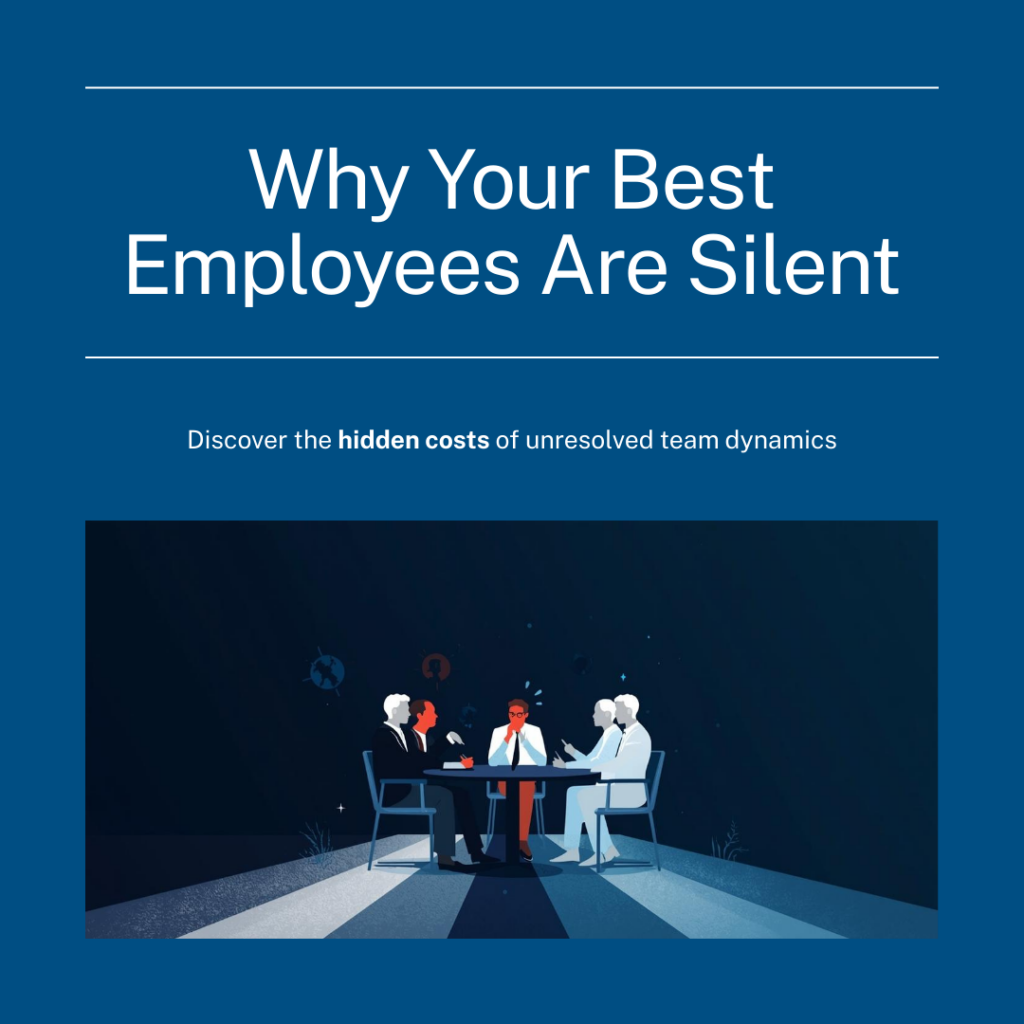
Why Your Best Employees Are Silent

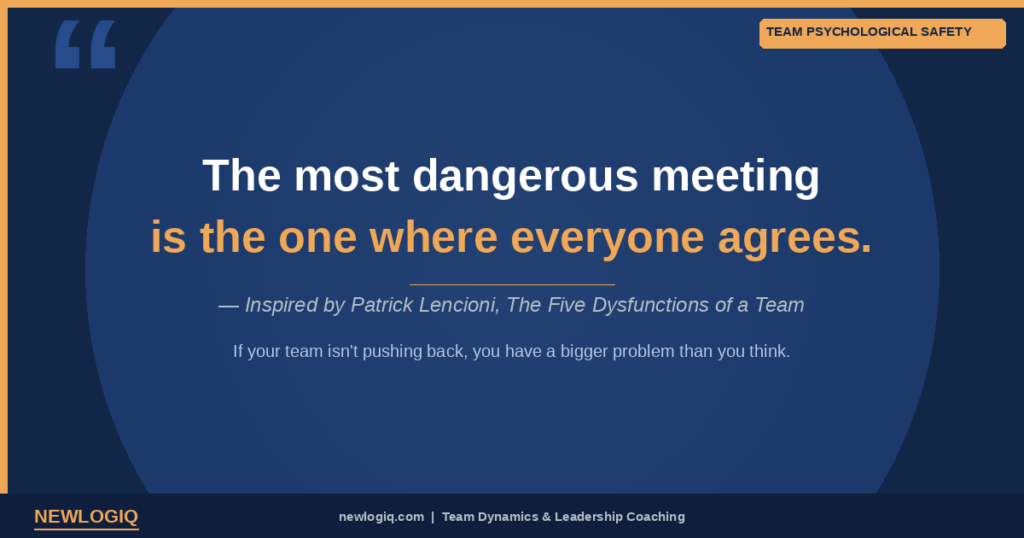
Think about your last leadership team meeting. Every item got reviewed. People nodded. Nobody pushed back. The meeting ended on time, and everyone walked out. Then, about ten minutes later, two of your best people found each other in the hallway and had the real conversation—the one that should have happened in the room.

That gap—between what gets said in the meeting and what gets said outside of it—is one of the most expensive problems in a growing business. Patrick Lencioni called it artificial harmony. And in his landmark work The Five Dysfunctions of a Team, he argued that the absence of conflict is not a sign of a healthy team. It is a sign of a broken one.

For business owners running $5M to $50M companies, this shows up in subtle but costly ways. Decisions get made in rooms but reversed in hallways. Good ideas die because no one felt safe enough to challenge the status quo. Your most capable people disengage quietly, long before they ever hand you a resignation letter.

What Lencioni Actually Said (And Why It Still Matters in 2026)

Lencioni’s five dysfunctions build on each other like a pyramid. At the base is absence of trust—the unwillingness to be vulnerable with each other. On top of that sits fear of conflict. And fear of conflict creates exactly what you see in most leadership meetings: polished agreement that masks real disagreement.

Here is the key insight that most leaders miss. Lencioni was not saying that teams should fight. He was saying that teams should be willing to engage in what he called “passionate, unfiltered debate around issues of importance.” That is a very different thing from arguments and blame. It is the kind of productive tension that actually leads to better decisions.

The problem is that most leaders, especially founders and longtime CEOs, have accidentally trained their teams not to push back. Maybe they got defensive when challenged once. Maybe they moved quickly past ideas that contradicted their own. Maybe the culture of the company simply rewards agreement and punishes dissent. Whatever the cause, the result is the same: silence.

The Real Cost of Playing Nice

Let’s be specific about what artificial harmony actually costs a $15M or $25M company. First, you get poor decisions. When nobody challenges the strategy in the room, you lose the chance to catch blind spots before they become expensive mistakes. The leader’s perspective, however experienced, is still just one perspective.

Second, you get disengagement. Research from Gallup consistently shows that employees who feel their voice does not matter are significantly more likely to be disengaged. In a company with 50 to 150 employees, low engagement is not an HR problem. It is a revenue and retention problem. Your best people have options. They will find a culture where their voice counts.

Third, and perhaps most damaging: you lose institutional intelligence. The people closest to your customers, your operations, and your front lines have information you do not have. When they stop sharing it—because experience has taught them that sharing leads to awkward silence or dismissal—you are making decisions with incomplete data. This connects directly to how we think about leadership effectiveness at Newlogiq: the leader who creates safety for honest input consistently outperforms the one who demands agreement.

How to Tell If Your Team Has Stopped Talking

Most leaders with artificial harmony problems do not know they have them. That is part of what makes it so insidious. Here are the signs I look for when working with a new client.

Meetings end too quickly. If every agenda item gets resolved in under ten minutes and there are never any hard conversations, that is not efficiency. That is avoidance. Real decisions in complex businesses take real debate.

Agreement comes too fast. If your team consistently aligns on the first option presented, you should be suspicious. Good teams generate real alternatives and push on assumptions before committing. When consensus happens in under five minutes, someone is staying quiet.

Conversations happen after the meeting. As I mentioned at the top, the hallway conversation is the red flag. If you are the last person to know that your team has reservations about a decision you made, you have an artificial harmony problem.

Feedback stays surface level. Annual reviews that produce only positive feedback—or that produce carefully cushioned criticism delivered in vague language—are a symptom of this same culture. Real growth requires honest feedback. As we explore in our work on developing your leadership team, psychological safety is not the absence of standards. It is the presence of trust.

What Lencioni Recommends (And What Actually Works)

Lencioni recommends that leaders become “miners of conflict.” That means actively pulling buried disagreements to the surface. It means asking questions like: “Who disagrees with this?” or “What are the strongest arguments against this approach?” It means rewarding the person who raises the hard question, not tolerating them.

I have used a simple practice with clients that I call the “Contrarian Round.” Before any significant decision gets finalized, one team member is assigned the role of making the strongest possible case against it. Not because we expect the decision to change, but because the exercise surfaces assumptions, risks, and objections that would otherwise stay buried. After a few rounds, you will find that your quieter team members start to participate more naturally. They see that challenge is not just allowed—it is expected.

Marshall Goldsmith’s coaching work adds another layer here. He has written extensively about how leaders inadvertently discourage input by adding their own opinion too early, by “winnersizing” (agreeing and improving upon) every idea, or by reacting defensively to pushback. The leader sets the tone. If you want your team to speak up, you have to model what it looks like to welcome disagreement.

Building a Culture Where People Actually Speak Up

Culture change in a $10M to $30M company is not a programs initiative. It is a behavioral change that starts at the top and happens repeatedly, in small moments, over time. Here’s the practical framework I recommend. You can also see how this ties into your overall growth strategy and team alignment.

Make it safe to be wrong.

The next time someone raises an idea that does not work, your response is the teaching moment. If you dismiss it quickly, you train everyone else in the room to stay quiet. If you engage it seriously—even while ultimately declining it—you signal that ideas are welcome.

Ask for disagreement explicitly.

Do not just open the floor. Ask specifically: “Who sees this differently?” or “What am I missing here?” The explicit invitation lowers the social risk of being the person who pushes back.

Follow up on what gets raised.

When someone raises a concern or a challenge, come back to it. Even if the decision did not change, acknowledge what was raised: “Jen raised a concern in our last meeting about the timeline. Here’s how we addressed it.” This signals that speaking up leads to real engagement, not just acknowledgment and dismissal.

Build it into your meeting cadence.

Using the EOS (Entrepreneurial Operating System) model, Issues Lists exist for exactly this purpose—to surface and resolve the real problems that are slowing the business down. When conflict has a sanctioned, structured place in your operating rhythm, it becomes normal. Normal conflict is healthy. Suppressed conflict is poison.

The Leader’s Real Job

Here is the hardest truth Lencioni offers: if your team is not engaging in honest conflict, that is a leadership problem. Not a team problem. Not a personality problem. A leadership problem.

The culture of your company is a direct reflection of what you tolerate, what you model, and what you reward. If you have been tolerating polite agreement while decisions fester and resentments build, the fix is not a team training. The fix is you deciding to do something different.

The good news is that this is entirely fixable. Teams that learn to disagree well become dramatically better at deciding, executing, and holding each other accountable. That is not a coincidence. It is exactly the model Lencioni mapped out twenty-five years ago—and it still holds.

If you want to explore what this looks like in practice for your leadership team, browse the Newlogiq blog or reach out directly. The conversation your team is not having might be the most important one you can start.

Sources & Further Reading

Lencioni, Patrick M. The Five Dysfunctions of a Team (20th Anniversary Edition). Jossey-Bass.

Consult Clarity: 13 Warning Signs of Artificial Harmony in Your Team

The Succession Conversation You Keep Avoiding Could Cost Your Family Business Everything

Here is a number worth sitting with: only 30% of family-owned businesses survive into the second generation. Only 12% make it to the third. And the biggest reason—the one most people never talk about—is not the economy, a bad product, or even bad leadership. It is the conversation no one is willing to have.

The “succession conversation” sounds like a legal event. Something you schedule with an attorney and an accountant. Something you do when you are ready to retire. Something you plan to get to eventually. But in my work with business owners running $5M to $50M companies—many of them family businesses—I have seen the painful truth: the longer you wait to have this conversation, the harder it becomes. And the harder it becomes, the more you avoid it. And so the years pass.

This is the succession paradox. And it is destroying family businesses from the inside.

The Numbers Are Hard to Ignore

A February 2026 survey found that while 85% of business owners agree that succession planning is critical to long-term success, only 57% have even started a plan—and 23% are actively doing anything about it. Nearly half of all owners believe their next-generation leaders are only “somewhat prepared” to take the wheel, with 40% admitting those successors are simply unprepared.

What is behind this gap? The same survey revealed something telling: 62% of owners behind on succession planning said it is not a critical business priority “at the moment.” That phrase—at the moment—has been the most expensive pair of words in the family business world for decades.

The other problem is time. Leaders tend to dramatically underestimate how long succession takes. Many assume two years. Experts say it is closer to five to ten. That means the owner who is three years from wanting to retire and has not yet had the first real conversation is already behind. Not a little behind—significantly behind.

Why We Avoid the Conversation

I want to be direct here, because this is where most coaching conversations get uncomfortable. You are not avoiding succession planning because you are lazy or irresponsible. You are avoiding it because the conversation is loaded with things that feel dangerous: identity, mortality, family dynamics, and money.

For the founder who built a company from scratch, succession is not just a business event. It is the moment you begin to separate your identity from the company. That is terrifying. The business has been the source of your purpose, your income, your status, and your daily structure for decades. Talking about succession feels, on some deep level, like planning your own irrelevance.

For family businesses specifically, there is another layer: the risk of breaking relationships. If you have three children and one of them is clearly the right leader while the others are not, having that conversation means choosing. That feels like playing favorites. Many owners would rather avoid the conversation entirely than risk the fallout.

And yet avoiding the conversation does not prevent the fallout. It guarantees a bigger one later. As I explore in our work on developing the next generation of leaders, the cost of silence is always higher than the cost of an honest conversation.

What the Conversation Actually Needs to Cover

Most people think of succession as one conversation: “Who gets the business?” But that is not a conversation. That is an announcement. Real succession planning is a series of conversations that happen over months and years. Here is the framework I use with clients.

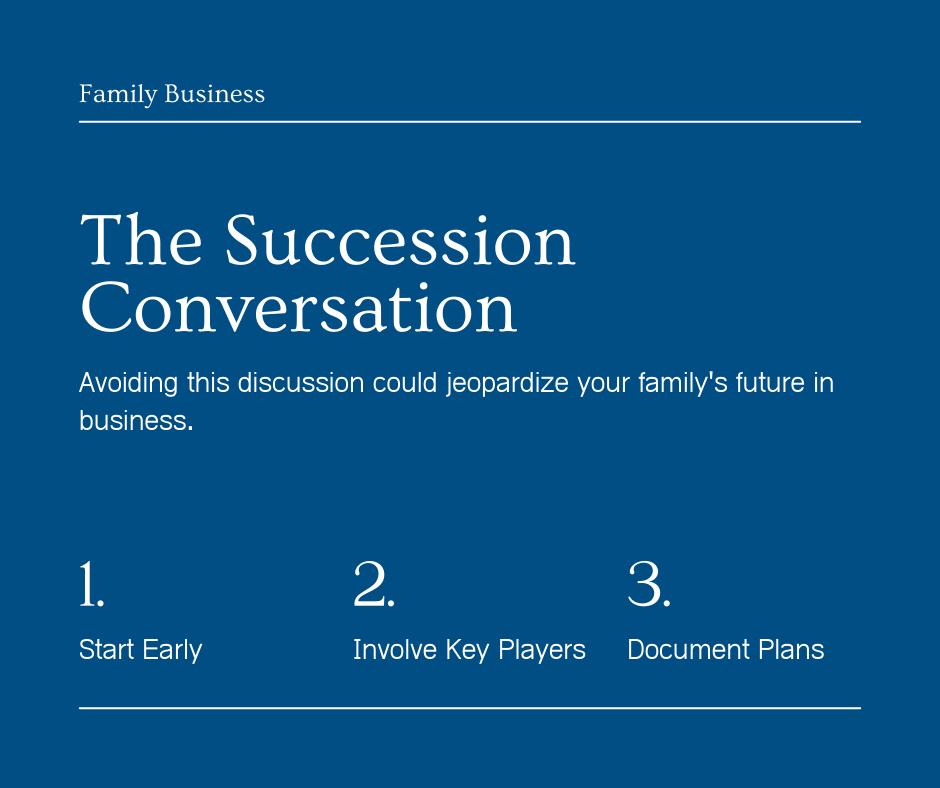
Avoiding this discussion could jeopardize your family's future in business.

1. The Values Conversation

Before you talk about who leads the company, talk about what the company stands for. What does it mean to be a leader here? What do you protect at all costs? What can never be compromised? This conversation grounds everything that follows. It also opens the door for the next generation to contribute to the identity of the business, rather than just inherit it.

2. The Readiness Conversation

This is not about declaring someone ready or not ready. It is about being honest about what readiness looks like and what gaps exist. Tools like the Momentum Lab leadership development framework can help identify where future leaders need to grow. The honest readiness conversation is an act of respect, not judgment. It says: we want you to succeed, and here is what it will take.

3. The Timeline Conversation

Give people a rough roadmap. It does not have to be exact. But saying “I plan to transition leadership responsibility within the next five to seven years” gives everyone a frame to work from. It reduces anxiety for both the current owner and the next generation. It also forces you to start acting accordingly.

4. The Financial Conversation

This is often the most avoided. But the next generation cannot make good decisions without understanding the financial picture. You do not have to share everything at once. But “age-appropriate” financial transparency—shared incrementally as trust and readiness grow—is how you build the capacity for real ownership.

A Framework from the Field: How to Start

I worked with a second-generation owner of a $22M manufacturing business. He had three children, two of whom worked in the company. He knew one of them was the stronger operational leader. He had been avoiding the conversation for four years because he did not want the other to feel overlooked.

We started not with the succession question itself, but with the values and legacy question: “What do you want this business to be in twenty years? What role does each child play in that?” That reframe changed everything. It moved the conversation from “who wins” to “how do we all contribute?”

The child who was not selected as the operational successor ended up taking on a board role and a real estate investment arm. Both felt heard. The succession process was not painless—but it was honest. That is the best you can ask for. For a deeper look at how this connects to your overall growth strategy, consider how succession fits into your long-range plan.

The EOS framework, from Gino Wickman’s Traction, refers to this kind of ownership-level clarity as “getting the right people in the right seats.” Succession is the ultimate version of that. You cannot get the right person in the right seat if you never have the honest conversation about who that person is and whether they are ready.

Make Succession a Rhythm, Not a Crisis

The best succession plans are not documents. They are habits. They are built into quarterly planning conversations, annual leadership reviews, and board discussions. When succession is on the agenda every year, it becomes normal. When it is normal, the conversations get easier. When the conversations get easier, the transitions get smoother.

Half of boards that have them include succession on the agenda at least once a year. If you do not have a board, build the habit another way. A trusted advisor, a peer group like the ones in Newlogiq’s Momentum Lab, or a structured coaching process can give you the external accountability to keep the conversation alive.

Here is the bottom line: your business does not fail because of a bad succession plan. It fails because the conversation never happened. The plan is just paper. The conversation is where the real work gets done.

The Question Worth Asking Today

If something happened to you tomorrow, would your company know what to do? Not the legal documents—would the

If the answer is uncertain, the problem is not your succession plan. The problem is that you have not had the conversation yet. Start there. Not with the attorney. Not with the accountant. With the people who matter.

The best time to have this conversation was ten years ago. The second-best time is today. If you’re ready to start thinking through your succession roadmap, explore more leadership insights on the Newlogiq blog or reach out to schedule a conversation.

Sources & Further Reading

ABA Banking Journal (2026): Survey — Family Businesses Facing a ‘Succession Paradox’

Teamshares: Succession Planning Statistics in 2025

The One Thing Your Team Needs From You That You Are Probably Not Giving

Introduction

Most business owners I talk to want the same thing: a team that takes ownership, makes good decisions on their own, and does not need constant direction.

But when I ask what happens in their weekly team meetings, I almost always hear the same answer. Status updates. Problem-solving. A lot of talking from the top. The leader is working hard. The team is listening. And yet nothing really changes.

Here is the truth: if your team is not stepping up, it is usually not because they do not want to. It is because they do not have what they need to feel confident doing it. And what they need more than anything else is clarity. This is one of the central challenges I focus on in executive coaching — and the good news is that it is one of the fastest things to fix once you see it.

Your team does not need more of your time. They need clarity.

What Clarity Actually Means

Clarity is not a list of tasks. It is not a mission statement on a wall. It is not even a job description, though that certainly helps.

Real clarity means every single person on your team can answer three questions without hesitation: What are the most important goals right now? What is my specific role in reaching them? How will I know if I am doing a good job?

When those three questions go unanswered, people fill in the blanks themselves. They usually get it wrong. Or they stop trying and wait to be told what to do next. Neither outcome is good for your business.

Why Leaders Skip the Clarity Conversation

This is a pattern I see in almost every growing company I work with. A leader knows exactly what they want. It is perfectly clear in their head. So they assume it is clear to everyone else, too.

It is not.

Author and organizational health expert Patrick Lencioni — whose work through The Table Group has shaped how thousands of leadership teams operate — calls this “the assumption of alignment.” You think everyone is rowing in the same direction because you announced the destination once, back in January. But clarity is not a one-time announcement. It is an ongoing conversation that has to be repeated again and again.

The best leaders I have coached say the same priorities so many times that their team could recite them in their sleep. That feels repetitive to the leader. To the team, it feels like a compass. It tells them exactly where to point their energy each day.

How to Build More Clarity Into Your Business Right Now

You do not need a big offsite or a new software tool to do this. Here are three practical changes you can make this week.

Set three priorities for the quarter — and only three. In Scaling Up, we call these Rocks. They are the three to five most important things your business must accomplish this quarter. When everything is a priority, nothing is. Committing to three Rocks forces you to choose what actually matters most right now, and gives your team a clear finish line to run toward.

Open every team meeting with a priorities check. Not a long review — just five minutes at the start of your weekly meeting to remind everyone what the Rocks are and why they matter. This one habit does more for team alignment than most strategic planning sessions ever will.

Give specific, positive feedback regularly. Most leaders only speak up when something goes wrong. But your team needs to know when they are doing the right things, too. A two-minute conversation that says “I noticed how you handled that situation — that was exactly the kind of judgment I want to see” does more for clarity and confidence than almost anything else you can offer as a leader.

Conclusion

Your team wants to do great work. Most of them want to succeed just as much as you do. What they need from you is not more oversight, more meetings, or more pressure. They need a clearer picture of what success looks like.

When you give them that clarity — and keep reinforcing it — everything starts to change. Decisions get made at the right level. Problems get solved before they reach your desk. And you finally get to lead the business instead of running inside of it.

If you would like help building that kind of clarity in your business, reach out to schedule a free discovery call. I work with a small number of business owners at a time, and I would love to hear about where you are headed.

How to Stop Being the Bottleneck in Your Own Business

Introduction

There is a question I ask every new client in our very first session:

“What would happen to your business if you took two weeks off tomorrow?”

Most of them laugh. Then they get quiet.

The truth is, if everything stops when you leave — you do not have a business. You have a job that you own. And while that may have worked when you were just starting out, it is the single biggest thing holding you back from real growth. The good news is that this is a fixable problem. You do not have to hire ten new people or rebuild everything from scratch. You just need to make a few key shifts in how you think, how you communicate, and how you hand work off to the people around you.

Why This Happens to Good Business Owners

This is not a failure. It is actually a sign that you have been really good at your job.

When your business was small, you were fast, reliable, and you knew every detail. Customers loved working with you personally. Decisions happened quickly because they all came through you. But then the business grew. And those same habits that made you successful started to slow everything down.

Now every decision waits for your approval. Every problem finds its way back to you. Your team checks in before acting on anything. And you wonder why you are working harder than ever but the business is not moving as fast as you want it to.

This is what the Scaling Up framework calls the “founder bottleneck.” It is one of the most predictable growth barriers a small business hits — and one of the most important things structured business coaching is designed to help you break through.

The Shift From Operator to CEO

Moving from operator to strategic CEO is less about what you do and more about how you think.

An operator asks: “How do I get this done today?” A CEO asks: “How do I build a team that gets this done without me?”

That mindset shift sounds simple, but it changes everything — who you hire, how you run meetings, and what you choose to spend your time on each week.

One of the most powerful exercises I do with new clients is called an Accountability Chart. It comes from EOS, the Entrepreneurial Operating System. We map out every key function in the business, and then we ask one simple question: who really owns this? In most founder-led businesses, the answer is the same name in almost every box. That is the problem — and that is exactly what we work to change together.

The goal is to get to a place where each function has a clear owner who is not you, and who has the authority to make decisions in their area without waiting for your sign-off.

Three Things You Can Do This Week

You do not have to fix everything at once. Here are three things you can start doing right now.

Make a “stop doing” list. Write down everything you did last week. Then go through it and highlight everything you could have handed off if someone else knew how to do it. Those items go on your stop doing list. Start treating that list as seriously as your to-do list.

Pick one decision and give it away. Not a small one. A real decision — one that you normally make without thinking. Tell a team member that starting today, that decision is theirs. Then do not take it back. Resist the urge to review their choice unless it creates a serious problem.

Build one simple process. Pick a task that keeps coming back to you over and over. Write down, in plain steps, exactly how you do it. Hand that document to the person who should own it going forward. Even a rough, imperfect process is better than keeping everything inside your head.

Conclusion

Getting out of the bottleneck does not happen all at once. It happens one decision at a time, one handoff at a time, one honest conversation at a time.

The business owners I work with who make this shift do not just get more free time. They get a better business — one that can grow without them needing to be in every room and on every call.

If you are ready to start making that shift, I would love to talk. Schedule a free discovery call and let’s figure out exactly where to start.

A Practical Guide for Business Owners Who Need Proof Coaching Works

The ROI of Executive Coaching

The ROI of Executive Coaching
The return on executive coaching shows up in behavior first; and business results second.

You hired an executive coach six months ago. You’ve attended monthly sessions. You’ve worked through frameworks. You’ve adjusted some of your leadership habits. But as you sit in your office this morning, you’re asking yourself the question that most business owners ask at this point in their coaching journey: Is this actually working?

Here’s what I’ll tell you. It’s more common than most coaches admit that you feel stuck right now. The changes aren’t dramatic yet. Your revenue hasn’t spiked. Your team hasn’t transformed overnight. And you’re wondering whether you should keep going or cut your losses. The problem is that you’re looking for ROI in the wrong place. And that’s exactly what we need to fix.

Why ROI Is Hard to Measure in Coaching (And Why That’s Not an Excuse)

Let’s be honest. Leadership development is not the same as buying a new piece of equipment. When you install a new software system, you can measure cost savings within weeks. When you hire a new salesperson, you can track their revenue within a quarter. But when you work with a coach to develop as a leader, the improvements follow a different timeline.

The real changes from coaching are lagging indicators. They show up slowly. They compound quietly. And they often feel invisible until suddenly they aren’t. A decision that used to keep you up at night now takes you two hours to make. A conversation with your team that used to feel combative now feels collaborative. You’re delegating work that was keeping you stuck at sixty-hour weeks. None of these changes triggered an instant financial event, but all of them are moving your business forward.

The real trap is that many business owners confuse what’s hard to measure with what’s unmeasurable. There is a massive difference. The soft outcomes of coaching — self-awareness, behavioral change, clearer thinking — absolutely can be measured. You just have to know what to look for.

So here’s my commitment to you. If you work with a coach who doesn’t help you see and measure progress, that coach is failing you. The ROI has to be visible. It might not be obvious, but it has to be there.

The Three Levels Where Coaching Actually Pays Off

Real coaching doesn’t work in a vacuum. It creates a chain reaction. The chain always starts the same way. But most business owners never see the full chain because they’re looking at the wrong level.

Level One is where coaching happens first. This is leader behavior change. How do you communicate? How fast do you make decisions? How do you handle pressure? Do you listen with curiosity or listen to respond? Are you creating psychological safety on your team or fear? These behaviors are the soil where everything else grows. If your leadership behavior doesn’t change, nothing else changes. This is where the first ninety days of coaching happen. You’re building awareness. You’re noticing patterns. You’re experimenting with new ways of showing up.

Level Two is team performance. This is where the behavior changes start to cascade into measurable team outcomes. When you communicate with more clarity and less intensity, your team stops second-guessing your direction and starts executing faster. When you create psychological safety, people bring their ideas instead of hiding them. When you delegate with confidence, people step up. You see this in retention, in engagement scores, in the number of decisions that don’t need your sign-off. This is where months four through nine of coaching show up most clearly. Your team is performing differently because you are leading differently.

Level Three is business results. This is where most business owners start looking for ROI. But if you only look here, you miss the story. By the time your revenue, margin, or growth rate changes, two other levels of change have already happened. You see faster execution. You see better employee retention. You see fewer mistakes because your team is more aligned. All of those things eventually show up on the bottom line. But they show up late. Most coaching engagements hit meaningful business-level ROI somewhere between month nine and month twelve.

The mistake most business owners make is skipping Levels One and Two. They’re fixated on Level Three. They want to see the business results right now. But that’s like checking on a garden every day and being disappointed that the tomatoes aren’t ready to pick. The growth is happening underneath the soil first. You have to let that happen before you see the fruit.

A Simple Scorecard for Tracking Coaching Impact

Here’s what I do with every coaching client. Around month two or three, when the impatience usually starts creeping in, we build a simple scorecard. This scorecard cuts through all the noise. It answers the question you’re really asking: Am I actually different? Is my leadership changing?

The scorecard is straightforward. You ask yourself six questions and rate yourself honestly on a scale of one to ten. Question one: Are you making decisions faster than you used to? Not faster without thinking, but faster with confidence? Question two: How many decisions are escalating to you that didn’t before? Are fewer people bringing you problems that they should be solving themselves? Question three: Is your team more aligned on the direction and priorities of the business? Do they repeat back to you the same three to five things that matter most? Question four: How much of your time are you spending on strategic work versus firefighting? Are you protecting your thinking time, or is your calendar still chaos?

Question five: Do you feel less reactive? Can you pause before you respond to things? And question six: Is your team asking you better questions? Are they taking more initiative? These six questions are the real ROI of coaching. They’re measurable. They’re honest. And they tell you what’s actually changing.

Rate yourself on each question at the start of your coaching. Then check in every ninety days. Watch those numbers move. That’s your ROI. That’s the proof that something is working.

What to Expect in the First 90 Days vs. the First Year

If you’re going to measure coaching ROI honestly, you have to have realistic expectations about timing. The first ninety days feel very different from months nine through twelve. And if you don’t know what to expect, you’ll quit right when the real work is about to pay off.

In the first ninety days, expect discomfort. Your coach is going to hold up a mirror. You’re going to see patterns in your leadership that you didn’t see before. Some of these patterns are helping you. Many of them are limiting you. You’re going to start experimenting with new behaviors. You might feel awkward. You’re going to question whether this is worth the investment. This is normal. This is the work. You’ll notice some small shifts in how people respond to you. You’ll catch yourself pausing instead of reacting. Your awareness is going up faster than your execution. This is supposed to happen.

By month six, the awkwardness starts fading. The new behaviors are becoming more natural. You’re getting feedback from your team that something has shifted. They don’t have words for it yet, but they feel it. You’re making decisions faster. Your team is bringing you fewer problems that they could solve themselves. You’re spending more time thinking about where the business is going and less time putting out fires.

By month twelve, the changes are obvious. Your team is aligned. Execution is crisper. People are staying longer. You’re thinking like a CEO instead of a firefighter. And yes, by now, your business metrics are probably showing movement too. Revenue might be up. Margins might be improving. But more importantly, the trajectory of your business has changed because the trajectory of your leadership has changed.

Here’s the truth about ROI in coaching. I stand behind my work in a way that most coaches don’t. I offer every client I chose to help a short-pay guarantee. If you’re not fully satisfied with your results, you can pay me any amount you believe represents the value you received. If you don’t see the value, you don’t have to pay. I’m that confident the work delivers real impact.

But I can only stand behind that guarantee if you know what to measure. The ROI of coaching isn’t always obvious. But it is always real if you’re working with a coach who knows how to build it. If you want to explore what a year of focused coaching could look like for you and your business, I’d love to talk. Visit Newlogiq to learn more about how we work together.

Why Modern Leaders Need an AI Strategy—Not Just AI Tools

AI Needs to be in Your Leadership Playbook

You hear about artificial intelligence everywhere these days. The conversation is all about what it means for big companies, tech giants, and the jobs of the future. But if you lead a business in the $5 to $50 million dollar range, most of that noise is not your story. The real question is not whether AI will change leadership. It will. The real question is what you do about it right now.

AI Is Not Coming for Your Job — It’s Coming for Your Excuses

Here is what I see with my coaching clients. Most of them spend their days drowning in operational work. They read emails. They synthesize reports. They write the same response to the same question over and over. They sit in meetings trying to figure out what information matters. They do all of this because it feels urgent. It feels like their job.

And it is their job. Partially. The problem is that all of these tactical tasks use up the cognitive real estate that should be reserved for strategic thinking. When you are reading emails, you are not thinking about whether your market is shifting. When you are preparing for a meeting, you are not questioning whether the meeting itself should exist. When you are drafting a response to a supplier problem, you are not stepping back to ask whether that supplier relationship should evolve.

AI removes the excuse. Not overnight. Not magically. But meaningfully. When an AI tool can read through ten months of customer feedback in sixty seconds and hand you the three patterns that actually matter, you have bought back two hours of thinking time. When AI can draft your weekly communication to your team and you spend fifteen minutes refining rather than ninety minutes writing, you have reclaimed your attention. That is the real power of AI for a small business owner. It is not about replacing your judgment. It is about freeing you from the friction that keeps your judgment locked in the basement.

What AI Actually Does for a Leader

Let me be practical about this. AI is not magic, and I do not use it that way. Here is what it genuinely helps you do.

First, AI summarizes complexity. You have sales data, operational metrics, customer feedback, and market signals all coming at you. AI can run through that noise and distill it down to what actually moves the needle. It surfaces patterns you might have felt but not quite articulated. That is decision-making leverage.

Second, AI drafts at speed. Whether you are writing a difficult message to your team, preparing talking points for a board conversation, or outlining a proposal, AI gives you a first draft in seconds. You still make it yours. You still bring judgment to it. But you skip the blank page problem and start from something real. This matters more than you think. It turns writing from a creative act into an editing act, and editing is much faster than creation.

Third, AI runs scenarios faster. You are thinking about a price increase, a market expansion, or a hiring shift. What if we did X instead? AI can model that faster than you can think about it. You still make the decision. But you make it from a place of more information and fewer mental gymnastics.

None of this replaces your wisdom. None of it makes you less important. It makes you less bogged down.

What AI Cannot Replace

Now let me be equally clear about what AI cannot do. And this matters because I see leaders getting nervous about the wrong things.

AI cannot read a room. You have sat in thousands of conversations. You know what silence means. You understand what someone is really asking when they ask something else entirely. You can feel when a person is uncomfortable or excited or checked out. That pattern recognition lives in your body and your experience. AI does not have that. It reads scripts. It processes words. It does not feel the temperature of the moment.

AI cannot build trust. Your team member works harder for you because she knows you care about her growth. Your customer buys from you because he believes you understand his real problem. Your board believes in your vision because they have watched you navigate difficult seasons with integrity. None of that comes from AI. It comes from you. From your consistency. From your judgment. From your willingness to be wrong and learn.

AI cannot set culture. Culture is not a policy. It is not a memo. It is the way you show up, the kind of question you ask in a meeting, the kind of mistake you forgive, the kind of excellence you celebrate. That is human. That is leadership. That cannot be automated or outsourced or generated by a tool.

And that is actually why I think coaching matters more in an AI world, not less. As leaders have access to better tools to handle complexity, the differentiator becomes the quality of your judgment, the clarity of your thinking, and your ability to grow. That is where real leadership development happens.

How to Add an AI Chapter to Your Leadership Playbook

Here is how I recommend you start. Do not try to do everything at once. Do not subscribe to every tool. Do not redesign your entire workflow. That path leads to overwhelm and abandonment.

Instead, pick one thing. Just one. Look at your week. Where do you spend thirty minutes that could be compressed or elevated? Maybe it is weekly communication to your team. Maybe it is meeting prep. Maybe it is drafting an email to a difficult client. Pick that one thing and bring in an AI tool to help.

Use it for a month. Get real with yourself about whether it actually works. Does it save you time? Does it improve the quality of the output? Does it free up mental space for thinking that matters? If the answer is yes, keep it. If the answer is no, drop it. This is not religion. It is pragmatism.

Once you have one AI habit that works, add a second. Now you have reclaimed an hour or more per week. That is real time that you can now spend thinking. And thinking is what separates good leaders from great ones. That is when you rethink your strategy. That is when you notice that a key relationship needs attention. That is when you design your next move instead of just reacting to this week’s crisis.

The point is this. AI is not a magic wand. It is a tool. A good one, but a tool. The real power comes from what you do with the space it creates.

If you are curious about how to sharpen your leadership approach in 2026, I would love to talk about it. Visit Newlogiq to learn more about the coaching programs I offer for small business owners in your range. Or reach out directly. I respond to everyone who gets in touch, and I am always happy to have a conversation about what you are trying to build and where leadership development can help you get there.

Strategic Planning for Growth: Insights from Momentum Lab

Can a well-crafted strategic plan really help a business grow? For solopreneurs, having a clear plan is key to reaching their business goals.

Momentum Lab helps solopreneurs stay on track and meet their goals. It offers monthly masterclasses, a special ChatGPT assistant, and live Q&A sessions with a certified coach.

Momentum Lab gives solopreneurs the tools and advice they need to make effective plans. This helps them grow their business. For more information or to join, email momentum@newlogiq.com.

Key Takeaways

  • Understanding the importance of strategic planning for business growth.
  • Momentum Lab’s role in supporting solopreneurs through productivity tools and coaching.
  • The benefits of having a clear roadmap for achieving business goals.
  • How Momentum Lab’s resources can empower solopreneurs to drive growth.
  • The value of community support in achieving business objectives.

Understanding the Importance of Strategic Planning

Strategic planning is key for businesses to set clear goals and map out how to reach them. It’s a detailed method that lets companies make smart choices, use resources well, and adapt to market shifts.

Defining Strategic Planning

Strategic planning starts with defining a company’s mission, vision, and goals. It involves a deep look at the company’s current situation, including its strengths, weaknesses, opportunities, and threats. This helps businesses craft a strategy that fits their goals.

Companies with a growth mindset and flexibility usually do well. For example, Outschool shows how strategic planning can lead to success, no matter the size of the company.

Key Benefits for Businesses

The perks of strategic planning are many. It helps businesses:

  • Clarify their mission and vision
  • Set realistic and achievable goals
  • Enhance decision-making processes
  • Improve resource allocation
  • Respond effectively to market changes

These benefits help businesses scale up and perform better. For more on Momentum Lab’s strategic planning, email momentum@newlogiq.com.

Common Misconceptions

Despite its value, strategic planning is often misunderstood. Some think it’s a one-time thing or only for top management. But, it’s an ongoing effort that needs input from all parts of the organization.

The Strategic Planning Process

To grow sustainably, businesses need a solid strategic planning process. This process has key steps. It helps organizations know where they stand, where they want to go, and how to get there.

Analyzing the Current State

The first step is to look at where the organization is now. This means checking internal strengths, market trends, and who they compete with. Knowing this helps spot what’s working and what’s not, and what chances and risks there are.

Setting Vision and Mission Statements

After understanding the current situation, the next step is to set the vision and mission statements. The vision statement shows what the organization aims to become. The mission statement explains its purpose and main goals. These statements guide the strategic planning process.

“A clear vision and mission statement are essential for directing the strategic planning process and ensuring everyone is working towards the same goals.”

Establishing Goals and Objectives

With vision and mission in hand, the next step is to set clear, reachable business goals and objectives. These goals should match the overall strategy and be achievable in a set time frame. Coaching is key here, helping teams set realistic targets and make plans to achieve them.

Momentum Lab uses AI to turn insights into action, helping businesses outperform the market. For more information or to reach out, email momentum@newlogiq.com.

By taking these steps and using tools like strategic planning software and coaching, businesses can make a strong plan. This plan drives growth and success.

Conducting a SWOT Analysis

A SWOT analysis is key to understanding a business’s internal and external factors. It’s a tool for identifying Strengths, Weaknesses, Opportunities, and Threats. This helps companies see where they stand and make smart choices to grow and scale.

Identifying Strengths and Weaknesses

First, a SWOT analysis looks at a company’s strengths and weaknesses. Strengths are good things like a strong brand, skilled team, or new products. Weaknesses are things that might hold the company back, like high turnover, slow processes, or not enough resources.

Outschool’s research shows the value of using data to find top classes and improve or remove others. It also helps with pricing and formats. This way, businesses can better spot their strengths and weaknesses.

Opportunities and Threats in the Market

Next, a SWOT analysis looks at opportunities and threats outside the company. Opportunities are chances to grow, like new trends, tech, or markets. Threats are things that could harm the business, like more competition, rules changes, or economic troubles.

Knowing these, businesses can plan to use their strengths and opportunities. They can also work on their weaknesses and threats. For example, a company might use its brand to enter new markets or create new products to stay competitive.

For any inquiries or to learn more about Momentum Lab, please contact momentum@newlogiq.com.

Engaging Stakeholders in Planning

To hit business goals, it’s key to get stakeholders involved in planning. Newlogiq Momentum Lab values community and support in reaching these goals. It offers live Q&A sessions and a productivity assistant to help everyone work together.

Importance of Team Involvement

Getting the team involved in planning is vital. It makes sure everyone is on the same page with the company’s vision. Coaching is important here, helping team members know their part in reaching goals.

Team input also brings new ideas and solutions to the table. This teamwork leads to better strategies and their successful use.

Techniques for Gathering Feedback

Getting feedback is a big part of working with stakeholders. Newlogiq Momentum Lab uses many ways to get feedback that can be used. Regular updates and check-ins help spot what needs to change.

  • Conducting surveys and questionnaires to gather input from team members.
  • Organizing workshops and brainstorming sessions to encourage open discussion.
  • Utilizing digital tools for continuous feedback and monitoring progress.

For any questions or to find out more about Newlogiq Momentum Lab’s support for planning, email momentum@newlogiq.com.

Setting Measurable Objectives

Effective strategic planning starts with setting clear, measurable goals. These goals guide businesses toward their targets. By focusing efforts and resources, organizations can reach tangible results.

The SMART Criteria

The SMART criteria help set goals that are Specific, Measurable, Achievable, Relevant, and Time-bound. This method makes sure goals are clear and reachable. It helps avoid setting goals that are too vague or impossible to achieve.

  • Specific: Objectives should clearly define what is to be achieved.
  • Measurable: Progress should be quantifiable, allowing for accurate tracking.
  • Achievable: Objectives must be realistic based on available resources and constraints.
  • Relevant: Objectives should align with the overall strategic plan and business goals.
  • Time-bound: Establishing deadlines ensures timely progress and focus.

Tracking Progress Over Time

Tracking progress is key to strategic planning success. The Momentum AI platform helps businesses monitor their progress. It allows for the optimization of go-to-market strategies with confidence.

For better strategic planning, using tools and resources for tracking and adjustment is crucial. For more information or to learn about Momentum Lab, contact momentum@newlogiq.com.

Implementation of the Strategy

Strategic planning is not complete without effective implementation. This is what drives real results. Companies like Outschool have grown by creating action plans and analyzing data.

Creating an Action Plan

An action plan outlines the steps to achieve strategic objectives. It breaks down big goals into smaller tasks. Effective action plans are detailed, realistic, and have timelines.

“A good plan violently executed now is better than a perfect plan next week,” as the saying goes. This shows the importance of taking action. A comprehensive action plan helps organizations move towards their goals.

Assigning Responsibilities

For an action plan to succeed, responsibilities must be clearly assigned. This ensures accountability and timely task completion. Coaching is key, helping team members understand their roles and develop skills.

  • Identify team members’ strengths and weaknesses.
  • Assign tasks based on these strengths.
  • Provide necessary training and resources.

Monitoring and Adjusting

Monitoring progress is crucial for a strategic plan’s success. It involves tracking KPIs and making adjustments as needed. Scaling Up efforts can be informed by these insights, allowing businesses to adapt and grow.

“The key to successful scaling is not just about growing fast, but growing smart.”

For any inquiries or to learn more about Momentum Lab’s approach to strategic planning and implementation, please contact momentum@newlogiq.com.

Tools and Resources for Strategic Planning

The right tools and resources are key to better strategic planning for businesses. Good planning uses many tools and methods to analyze, plan, and put plans into action well.

Software Solutions for Planning

Using software can make planning easier. Momentum AI, from Newlogiq Momentum Lab, uses generative AI to boost Account-Based Marketing (ABM) programs. It offers top security and privacy, making it a strong choice for companies.

Software solutions offer many benefits, including:

  • Better data analysis
  • Improved team collaboration
  • Tracking progress in real-time

Essential Frameworks and Models

There are also frameworks and models to help with planning. Some include:

  1. SWOT analysis: Finds strengths, weaknesses, opportunities, and threats.
  2. Balanced Scorecard: Gives a full view of how well a company is doing.
  3. McKinsey 7S Framework: Helps improve how well a company works.

For more information or to find out how Newlogiq Momentum Lab can help with planning, email momentum@newlogiq.com.

Real-Life Case Studies of Success

Outschool’s case studies show how strategic planning can change a business. They look at different companies to see how planning helps reach goals.

Companies That Thrived Through Strategic Planning

Many companies have grown a lot by using strategic planning. For example, those who followed a Scaling Up strategy saw big increases. Coaching was key in helping them improve their plans and keep their focus.

Setting clear goals is a big part of success in strategic planning. Companies that did well had clear goals and plans to reach them.

Lessons Learned from Their Experiences

The case studies teach us a few important lessons. First, being able to change plans is key. Companies need to adjust to new market trends. Second, having a growth mindset helps businesses innovate and stay competitive.

If you have questions or want to know more about Momentum Lab, email momentum@newlogiq.com. Learning from others’ success can help your business grow and achieve its goals.

Overcoming Challenges in Strategic Planning

Effective strategic planning needs a clear vision and the skill to tackle challenges. Organizations face many obstacles when trying to put their plans into action.

Common Obstacles Organizations Face

One big challenge is resistance to change. Employees and stakeholders might prefer old ways and resist new ideas. Effective communication is crucial to beat this. It’s important to explain the benefits of the plan and how it fits with the company’s business goals.

Another big hurdle is not having enough resources, like money, people, or technology. Companies must choose their priorities and use their resources wisely. As a business strategist said,

“The key to successful strategic planning is not just about having a plan, but also about having the resources to execute it.”

Tips for Effective Problem Solving

To tackle these challenges, organizations should be proactive in solving problems. This means:

  • Encouraging a culture of innovation and creativity
  • Fostering open communication and teamwork
  • Regularly checking and tweaking the strategic plan

By being flexible and strong, companies can get through the hurdles of strategic planning and keep their eyes on their business goals. For more information or help with strategic planning challenges, email momentum@newlogiq.com.

Momentum Lab offers resources and support to help solopreneurs face challenges and stay on track. They make sure entrepreneurs have the tools they need to succeed in their strategic planning.

The Future of Strategic Planning

Businesses are always changing, and strategic planning is key to success. Newlogiq Momentum Lab leads the way with coaching and new solutions. They help organizations grow and succeed.

Emerging Trends

AI and other technologies are changing strategic planning. The Momentum AI platform is a great example. It helps businesses make smart decisions and stay competitive.

Technology in Planning

Technology is playing a bigger role in planning. Advanced tools and platforms make planning easier, improve teamwork, and boost growth.

For businesses to stay ahead, they must adopt these new technologies. To find out how Newlogiq Momentum Lab can help with your planning, email momentum@newlogiq.com.


How Momentum Lab Empowers Both CEOs and Their Key Leaders

Can companies really succeed without everyone being on the same page? The answer is yes, but only if they understand the importance of being in sync.

Momentum Lab helps companies make exceptional hardware products by getting everyone, processes, and products working together. This teamwork is essential for CEOs and their leaders to move their companies forward.

Want to know how Momentum Lab can help your company? Reach out to momentum@newlogiq.com.

Key Takeaways

  • Momentum Lab aligns people, processes, and products for hardware product success.
  • Effective alignment is crucial for CEOs and key leaders.
  • Momentum Lab empowers companies to deliver exceptional hardware products.
  • Contact Momentum Lab for more information on driving organizational success.
  • Synchronization is key to achieving exceptional success.

The Role of a CEO in Modern Businesses

In today’s fast-paced business world, the CEO’s role is more important than ever. They make key decisions, lead the company culture, and drive growth. Good CEOs know how crucial CEO support is for their leaders. They create a team environment that encourages business partnership at every level.

Defining the CEO’s Responsibilities

CEOs have many responsibilities. They set the company’s strategy, make big decisions, and keep an eye on finances. They also need to be visionaries, predicting market trends and adjusting the company’s path.

CEOs also build and keep a strong leadership team. They find, grow, and keep the best talent. This helps the company stay competitive and ready for the future.

Strategic Decision-Making

CEOs make strategic decisions to move the company forward. They look at market data, weigh risks, and find growth opportunities. They balance today’s needs with tomorrow’s goals, making choices that help the company now and later.

Good decision-making comes from knowing the company’s strengths, weaknesses, and rivals. CEOs must share their decisions clearly with everyone involved.

Leadership and Company Culture

CEOs shape their company’s culture. They set the example, influencing how people work together and with the company’s mission. A good culture boosts employee engagement, productivity, and keeps them around.

To build a great culture, CEOs must lead by example. They should show the values and behaviors they want from their team. This means being open, working together, and celebrating success.

For more on how Momentum Lab can help CEOs and their teams, email momentum@newlogiq.com.
Understanding the Second-in-Command Position

Knowing what the second-in-command role is key for good leadership. This role is crucial in a company’s leadership, helping the CEO make big decisions and push strategies forward.

Key Qualities of a Successful Second-in-Command

A good second-in-command needs certain qualities. They must think strategically, communicate well, and create a team atmosphere. These skills help them support the CEO and help the company succeed.

Executive coaching is very helpful for these qualities. It helps the second-in-command improve their leadership, make better decisions, and handle tough business issues.

Differences Between a CEO and Second-in-Command

The CEO sets the company’s direction. The second-in-command makes sure these plans work and are carried out. They need to know the company’s goals well and motivate the team to reach them.

The second-in-command also needs to match the CEO’s leadership style. They fill in gaps and offer support when needed. This teamwork is essential for a strong leadership team.

The Importance of Trust and Collaboration

Trust and teamwork are vital for the second-in-command. Building trust helps with open communication, teamwork, and success for everyone.

For more on building effective leadership teams, email momentum@newlogiq.com. The second-in-command role needs trust and teamwork. Executive coaching helps develop these important qualities.

The Partnership Between CEOs and Second-in-Command

The partnership between CEOs and their second-in-command is crucial for success. It’s based on trust, clear communication, and defined roles.

Enhancing Communication

Good communication is key in any business partnership. CEOs and their second-in-command must share ideas and concerns openly. Regular talks and open dialogue prevent misunderstandings and keep goals in line.

Encouraging feedback also strengthens the partnership. By listening to each other, they can spot and fix problems together.

Balancing Responsibilities

It’s important for CEOs and their second-in-command to balance responsibilities. The CEO focuses on big decisions and outside relations. The second-in-command handles day-to-day operations and internal matters.

This setup lets the team work well together. The CEO sets the direction, and the second-in-command makes sure things run smoothly.

Navigating Challenges Together

Every business faces hurdles, and CEOs and their second-in-command must tackle them together. Presenting a united front helps manage crises and make tough choices.

In tough financial times, they can work as a team. They find ways to save money, adjust resources, and keep staff morale up. Their teamwork helps the company get through hard times.

For more on building a strong partnership, email momentum@newlogiq.com.

Momentum Lab’s Unique Approach

Momentum Lab focuses on teamwork and clear results. It aims to help CEOs and their leaders succeed. This approach boosts business growth through strong leadership.

Tailored Leadership Programs

Momentum Lab has tailored leadership programs for each company. These programs tackle the unique problems CEOs and leaders face. They give the tools and strategies needed for success.

These programs are made with the help of industry experts. They are based on the latest research in leadership. This ensures the programs meet each company’s specific needs.

Collaborative Workshops

Momentum Lab also has collaborative workshops for leaders. These workshops let leaders share their experiences and learn from each other. They help find new ways to tackle common problems.

The workshops are interactive, focusing on practical use and real scenarios. They create a team environment. This helps leaders build strong relationships and understand each other’s challenges better.

Measurable Outcomes

Momentum Lab’s big plus is its focus on measurable outcomes. It sets clear goals and tracks progress. This way, it can improve its programs as needed.

This focus on results means the programs actually work. Leaders can make real changes in their companies. For more details on how Momentum Lab can help your company, email momentum@newlogiq.com.

Building Effective Leadership Teams

Creating strong leadership teams is key for any business to thrive. It begins with knowing how CEOs and their second-in-command work together. A good team drives decisions and builds a positive work culture.

Importance of Team Dynamics

The way a team works together greatly affects a company’s success. Effective communication and trust are vital for a team to excel. When CEOs and their second-in-command work well together, they can grow the business and meet their goals.

A positive team dynamic helps leaders face challenges better. It creates an environment where everyone can work together smoothly. This way, teams can tackle problems more effectively and efficiently.

Conflict Resolution Strategies

Conflicts in a leadership team are common, but how they’re solved is what counts. Effective conflict resolution strategies keep the team positive. This means dealing with issues quickly and constructively, encouraging everyone to speak up, and finding solutions that help the company.

Using these strategies, teams can turn conflicts into chances for growth. For more on building strong leadership teams, email momentum@newlogiq.com.

Case Studies of Successful Partnerships

Momentum Lab has helped many CEOs and their leaders form strong partnerships. These partnerships boost business growth and improve leadership skills. They are based on trust, clear communication, and a shared understanding of the company’s goals.

Well-Known Examples

Many famous companies have grown thanks to great partnerships between their CEOs and second-in-command. For example, a top tech firm grew fast because of its CEO and COO working together. This teamwork allowed the company to stay ahead in the market.

Another example is a big retail chain that boosted its sales with a leadership program from Momentum Lab. The program improved the CEO-COO partnership. This led to better decision-making and planning.

Lessons Learned

These stories teach us important lessons. First, effective communication is key. CEOs and their leaders need to talk openly to stay on the same page.

Second, trust is essential. When CEOs and their leaders trust each other, they can face challenges better and make big decisions that help the company grow.

  • Regular feedback keeps trust and alignment strong.
  • Working together on goals ensures everyone is moving in the same direction.
  • Being able to change plans is important for success.

Industry Insights

Studies show that companies with strong partnerships between CEOs and their leaders do better than others. Momentum Lab’s help in building these partnerships has been key to its clients’ success.

For more details on how Momentum Lab can help your leadership team, email momentum@newlogiq.com.

Developing Leadership Skills

Building leadership skills is a complex task that needs strategic training and ongoing learning. Today’s fast business world demands that CEOs and top leaders have the newest skills to tackle challenges.

Training and Development Initiatives

Strong training and development initiatives are key to better leadership. These efforts include executive coaching, where seasoned coaches help leaders spot areas for growth and create personal plans for improvement.

Companies can also set up training programs on strategic decision-making, leadership, and company culture. These efforts boost the abilities of CEOs and their teams. They also encourage a culture of ongoing improvement.

Continuous Learning Opportunities

Continuous learning opportunities are essential for keeping leaders up-to-date. This can be through workshops, seminars, and online courses on the latest industry trends and technologies.

For example, a second-in-command can greatly benefit from leadership development programs. These programs help improve strategic thinking and problem-solving. By investing in continuous learning, companies can make sure their leaders stay flexible and competitive.

For more details on improving leadership skills, please reach out to momentum@newlogiq.com.

Measuring Leadership Effectiveness

It’s crucial to assess how well leaders do their job. Good leaders help their company succeed, create a positive work environment, and make sure everyone’s goals match the company’s plan.

Key Performance Indicators

Organizations use Key Performance Indicators (KPIs) to check if leaders are doing well. These KPIs track things like team success, how happy employees are, and if they meet their goals.

CEOs and top leaders get a lot from KPIs. They show how well these leaders are pushing the company forward. Checking these KPIs often helps spot what’s going right and what needs work.

Regular Feedback Mechanisms

Regular feedback is also key to judging a leader’s success. Hearing from team members, peers, and bosses gives a full picture of a leader’s performance.

Having feedback often helps leaders know their good points and areas to get better. For tips on boosting leadership skills, email momentum@newlogiq.com.

By mixing KPIs with regular feedback, companies can really understand how well their leaders are doing. This helps grow current leaders and prepare future ones.

Scaling Leadership Practices Across Organizations

As organizations grow, it’s key to scale leadership practices for lasting success. Good leadership is about managing today and planning for tomorrow. Momentum Lab helps with this by offering executive coaching and leadership programs.

Adapting to Business Growth

Business growth brings new challenges that need adaptive leadership. Companies must scale their leadership to meet growing demands. This means developing leaders who can handle complex situations and make smart decisions. Momentum Lab’s leadership development aims to create agile leaders for growth and innovation.

Implementing Best Practices

It’s vital to implement best leadership practices for a cohesive team. This includes teamwork, learning, and executive coaching to improve leadership. These steps help ensure leaders can drive business success.

For scaling leadership, partnering with experts is crucial. Momentum Lab provides the support needed for scalable leadership. For more info, contact momentum@newlogiq.com.

  • Develop agile leaders who can drive growth and innovation.
  • Foster a culture of collaboration and continuous learning.
  • Leverage executive coaching to enhance leadership skills.

Future Trends in Leadership Development

Technology is changing how we develop leaders. As businesses grow fast, they need strong leaders more than ever. The second-in-command is key in helping CEOs succeed.

Impact of Technology on Leadership Roles

Technology is changing how leaders work. Digital literacy is now a must for leaders. They need to use tech to make smart choices and encourage learning.

Technology makes leaders more flexible and quick to respond. With tools like AI, they can understand their business better and make informed decisions.

Evolving Skill Sets for Executives

As tech advances, so do the skills needed for leaders. Adaptability and a love for learning are key. Leaders must handle fast changes and lead through uncertainty.

The bond between CEOs and their second-in-command is growing stronger. Working together is vital for success and facing market challenges.

For more on leadership development, reach out to momentum@newlogiq.com.

Testimonials from Momentum Lab Clients

Momentum Lab has helped CEOs and their leaders achieve great things. Its success is shown in the transformative experiences of its clients.

Success Stories of CEOs

CEOs who worked with Momentum Lab say the tailored leadership programs were crucial. One CEO said the program helped him refine his leadership style. This led to better team work and more productivity.

Another CEO loved the collaborative workshops. They gave valuable insights into leadership and built trust in their team.

Experiences of Second-in-Command Leaders

Second-in-command leaders have also seen big benefits. One leader talked about the continuous learning opportunities. These helped them support their CEO better.

Another second-in-command leader mentioned the measurable outcomes. They said it helped them align with the CEO’s vision. This made their team more cohesive and efficient.

For more information on how Momentum Lab can support your leadership journey, please contact momentum@newlogiq.com.

Conclusion: The Future of Leadership Alignment

Effective leadership is key for today’s businesses to thrive. Momentum Lab helps CEOs and leaders grow through special programs and workshops.

Effective Leadership Strategies

Building strong partnerships is vital for success. It means better communication and working together to solve problems. This leads to a strong partnership in business.

Executive coaching is also crucial. It helps leaders improve and keep up with business changes. This way, companies can always be learning and getting better.

Long-Term Partnerships

Creating lasting partnerships needs trust and teamwork. CEOs and leaders must understand each other’s roles well. This way, they can grow the business together.

Want to know how Momentum Lab can help your leadership? Contact us at momentum@newlogiq.com.

Scaling Your $1M-$5M Business with the Right Support System

Can your business grow fast without losing its edge? Companies making $1M to $5M face a big challenge. They need to expand operations while staying efficient.

Efficient scaling means more than just making more money. It’s about building a scalable business model that can handle market changes. For businesses looking to grow, knowing the right strategies and support is key.

To tackle this, focus on planning, efficient operations, and using tech for business growth. For more tips on scaling your business, email us at momentum@newlogiq.com.

Key Takeaways

  • Know your current business to spot areas for betterment.
  • Create a scalable business model that meets market needs.
  • Use technology to boost growth and efficiency.
  • Plan strategically to manage the scaling journey.
  • Get expert advice to help scale your business.

Understanding the Challenges of Small Business Scaling

Scaling a business is tough. It requires knowing the hurdles ahead. Businesses face many obstacles as they grow.

Common Obstacles for Growing Businesses

Growing businesses struggle with keeping quality high, managing resources well, and adapting to market changes. Maintaining quality is key for happy customers. Effective resource management helps meet demands without hurting operations.

Assessing Your Current Operations

Checking your current operations is vital. Look at customer satisfaction, market demand, and financial performance. This helps make smart scaling decisions.

The Importance of Timing in Scaling

Timing is everything when scaling. Scaling too soon or too late can be costly. Plan carefully to grow at the right time.

Need help scaling your business? Reach out to Momentum Lab at momentum@newlogiq.com for personalized advice.

Building a Strong Foundation for Growth

To grow your business, you need a solid foundation. This means setting up a base that supports growth, keeping things efficient and profitable. It also helps you stay ahead of the competition.

Establishing Clear Business Goals

Clear goals are essential for your company’s growth. They guide you in defining what makes your business unique and how you make money. Understanding your costs is also crucial. This way, you can focus on a strategy that moves your business forward.

Defining your value proposition is key. It sets you apart from others and draws in the right customers.

Developing a Scalable Business Model

A scalable model grows with the market without losing quality or profit. It’s about setting up systems that work well as your business gets bigger. Using technology to automate tasks is a great way to scale.

For more on making your business scalable, reach out to momentum@newlogiq.com.

By focusing on these areas, you can lay a strong foundation for growth. This includes both internal strategies and understanding outside factors like market trends and customer needs.

Leveraging Technology to Facilitate Growth

As businesses grow, using technology becomes key. It helps make things more efficient and helps make better decisions. With the right tech, businesses can work better, be more productive, and grow.

Choosing the Right Software Tools

Finding the right software is crucial for business growth. Tools like CRM systems and project management software are important. It’s important to pick tools that fit your business needs and work well together.

  • CRM Systems: Help with customer engagement and sales tracking.
  • Project Management Tools: Make team work and task management better.
  • Accounting Software: Simplifies financial tasks and reports.

For help with using technology for growth, email momentum@newlogiq.com. They can show you how tech can fit your business.

Automating Repetitive Tasks

Automation is a big help for business efficiency. It lets businesses do more important things by automating simple tasks.

“Automation is not just about reducing labor; it’s about augmenting human capability to achieve more.”

Here are some tasks that can be automated:

  1. Email marketing campaigns
  2. Data entry processes
  3. Customer service chatbots

Utilizing Data Analytics for Insights

Data analytics is key for business growth. It gives insights into customer behavior, market trends, and how well things are working.

With data analytics, businesses can:

  • Make smart strategic decisions
  • Find ways to get better
  • Improve customer experiences

In summary, using technology is vital for business growth. By picking the right tools, automating tasks, and using data analytics, businesses can succeed in a tough market.

Creating a Support Network

As your business grows, a strong support network is key. It helps you face the challenges of growth. This network offers guidance, support, and resources to help you overcome obstacles.

Finding the Right Mentors

Mentoring is a big part of a support network. The right mentors can guide you with their experience. They help you make smart decisions and avoid mistakes.

  • Look for mentors at industry events or through professional groups.
  • Get to know potential mentors to see if you’re a good match.
  • Tell your mentors about your goals and what you need from them.

Building Relationships with Peers

It’s also important to connect with peers. They can offer support, share their experiences, and give you a fresh view on problems. You can meet peers at networking events, conferences, or online groups.

“Surround yourself with people who are better than you, and empower them to do their best work.”

Richard Branson

Engaging with Professional Organizations

Joining professional organizations in your field is also helpful. These groups offer resources, training, and chances to network. Using the Scaling Up framework can help your business grow efficiently.

For more on building a support network, email momentum@newlogiq.com. Creating a strong network takes time and effort. But it’s essential for your business’s long-term success.

Financial Management for Scaling Businesses

Scaling a business from $1M to $5M requires a solid financial plan. This plan includes understanding funding, managing cash flow, and budgeting for growth. These steps are key to keeping the business financially stable and successful.

Understanding Funding Options Available

Knowing the different funding options is crucial. Businesses can look into:

  • Venture Capital: Good for fast-growing companies.
  • Angel Investors: Best for startups and early stages.
  • Loans and Credit Lines: Great for expansion needs.
  • Crowdfunding: Useful for businesses with a strong product or service.

Monitoring Cash Flow Effectively

Managing cash flow is essential for daily business operations. This means:

  1. Checking cash flow statements often.
  2. Efficiently handling accounts receivable and payable.
  3. Keeping a cash reserve for unexpected costs.

For help with financial management for scaling, contact momentum@newlogiq.com.

Budgeting for Growth Initiatives

Budgeting is vital for financial planning, even more so for growth. Businesses should:

  • Set clear financial goals and objectives.
  • Effectively allocate resources for growth.
  • Regularly review and adjust the budget as needed.

By focusing on these areas, businesses can build a strong financial base for scaling.

Marketing Strategies to Drive Your Growth

Effective marketing strategies are key for growing your business. They help you understand your audience and use the best marketing methods. This way, you can boost your brand, get more leads, and increase sales.

Defining Your Target Audience

Knowing your target audience is the first step in a good marketing plan. It means finding out who they are, what they like, and how they behave. This helps you make campaigns that really speak to them.

  • Do market research to learn what your audience wants and likes.
  • Use data analytics to see how customers act.
  • Make buyer personas to help guide your marketing.

Digital Marketing Techniques for Small Businesses

Digital marketing has many tools for small businesses to grow. Some of these include:

  1. Email Marketing: Build an email list and send campaigns to help leads grow and convert.
  2. Search Engine Optimization (SEO): Make your website better so it shows up more in search results. This brings more people to your site.
  3. Pay-Per-Click (PPC) Advertising: Use ads to find your audience and bring them to your website.

Leveraging Social Media and Content Marketing

Social media and content marketing are great for connecting with your audience and making your brand known. By making and sharing good content on social media, you can draw in and keep customers.

For more info on marketing strategies for business growth, contact momentum@newlogiq.com.

Recruiting and Retaining Talent

To grow sustainably, businesses must focus on hiring and keeping skilled workers. This means finding the right people, training them well, and creating a positive work culture. Such a culture boosts productivity and loyalty.

Hiring the Right People for Growth

Finding the right talent starts with knowing what skills your business needs. You must analyze your operations and goals. This helps you write job ads that draw in the right candidates. Talent acquisition is about more than just filling jobs; it’s about getting people who can help your business grow.

Implementing Training Programs

After hiring the right team, invest in their growth with training. This boosts their skills and shows you care about their development. It leads to happier employees and less turnover. Training should keep up with the needs of both employees and the company.

Fostering a Positive Company Culture

A positive work culture is key to success. It’s about making sure employees feel valued and supported. This can be done by encouraging open communication, celebrating successes, and supporting work-life balance. A strong company culture attracts and keeps top talent, driving business growth.

For advice on hiring and keeping talent, email momentum@newlogiq.com. By focusing on talent acquisition and retention, businesses can build the team needed for growth.

Customer Engagement and Retention

Keeping customers engaged and loyal is key for a business to grow. Good strategies for customer engagement and retention help increase satisfaction and loyalty. This is vital for business growth.

Building Loyalty Through Quality Products

Offering high-quality products is a great way to win customer loyalty. Happy customers tend to come back and tell others about the brand. It’s important for businesses to keep improving their products to stay ahead.

For more information on customer engagement and retention strategies, you can contact momentum@newlogiq.com.

Utilizing Customer Feedback for Improvement

Listening to customer feedback is essential for understanding what they want. By using feedback, businesses can spot areas to improve and make better choices. This boosts satisfaction and builds loyalty.

To use customer feedback well, businesses need a clear plan. They should use surveys, social media, and reviews to gather insights. This helps them make smart decisions based on what customers want.

Putting a focus on customer engagement and retention can help businesses grow. It’s crucial for those aiming to reach $5M from $1M. This approach ensures long-term success and keeps the business competitive.

Streamlining Operations and Processes

As businesses grow, making operations more efficient is key to success. This means cutting costs and making customers happier.

To start, businesses need to find where they can improve. They should look at their current processes, find bottlenecks, and see where resources are wasted.

Identifying Areas for Efficiency

Finding where to improve is a big step. It means looking at workflows, cutting out unnecessary tasks, and automating tasks. This way, businesses can save money and work better.

Key strategies for identifying areas for efficiency include:

  • Conducting regular audits of current processes
  • Engaging with employees to understand pain points
  • Utilizing data analytics to identify bottlenecks

Implementing Standard Operating Procedures (SOPs)

After finding where to improve, it’s time for SOPs. SOPs make sure things are done the same way, cut down on mistakes, and make things more efficient.

Best practices for implementing SOPs include:

  • Documenting every step of a process
  • Training employees on new procedures
  • Regularly reviewing and updating SOPs

For businesses wanting to improve, getting help from experts is smart. Reach out to experts at momentum@newlogiq.com for advice on making operations better.

Measuring Success: Key Performance Indicators (KPIs)

To grow sustainably, it’s key to know how to measure success with KPIs. Success measurement means setting up the right KPIs and checking them often. This helps businesses see how they’re doing and where they can get better.

Defining Relevant KPIs for Your Business

Choosing the right KPIs is crucial for checking if your business plans are working. These indicators should match your business goals and show what’s important in your operations. For example, if you want happier customers, look at customer retention, satisfaction scores, or net promoter scores.

It’s important to pick KPIs that are measurable, achievable, relevant, and time-bound (SMART). This makes sure the data you get is useful and can be acted on. For instance, aiming to keep more customers by 15% in a year is clear, measurable, and has a deadline.

Regularly Reviewing Performance Metrics

After setting up KPIs, it’s important to check them often. This means watching the data, spotting trends, and making changes when needed. Regular checks help businesses stay focused on their goals and make smart choices.

Using data analytics tools can make this easier, giving you quick insights into how you’re doing. For more on using KPIs to measure success, email momentum@newlogiq.com.

By focusing on the right KPIs and checking them often, businesses can grow, work better, and reach their goals. This active approach to measuring success helps businesses grow well and keep growing.

Preparing for Future Challenges and Opportunities

As businesses grow, they face new challenges and opportunities. They need to be flexible, plan strategically, and understand the market well.

Adapting to Change

Keeping up with market changes is key. Businesses must be quick to respond to what customers want. This way, they can grow and succeed in the long run.

Crafting a Long-Term Vision

Having a long-term plan is essential. It guides business decisions and keeps goals in sight. Businesses set clear goals, track progress, and adjust plans as needed.

For help with long-term planning and facing future challenges, businesses can get expert advice. Reach out to momentum@newlogiq.com. They offer coaching to boost business growth and success.